



 Chat with AI
Exam 6: Supply, Demand, and Government Policies

Exam 1: Ten Principles of Economics455 Questions
Exam 2: Thinking Like an Economist645 Questions
Exam 3: Interdependence and the Gains From Trade550 Questions
Exam 4: The Market Forces of Supply and Demand693 Questions
Exam 5: Elasticity and Its Application625 Questions
Exam 6: Supply, Demand, and Government Policies671 Questions
Exam 7: Consumers, Producers, and the Efficiency of Markets547 Questions
Exam 8: Application: The Costs of Taxation507 Questions
Exam 9: Application: International Trade521 Questions
Exam 10: Externalities543 Questions
Exam 11: Public Goods and Common Resources453 Questions
Exam 12: The Design of the Tax System563 Questions
Exam 13: The Costs of Production649 Questions
Exam 14: Firms in Competitive Markets608 Questions
Exam 15: Monopoly662 Questions
Exam 16: Monopolistic Competition649 Questions
Exam 17: Oligopoly522 Questions
Exam 18: The Markets for the Factors of Production592 Questions
Exam 19: Earnings and Discrimination511 Questions
Exam 20: Income Inequality and Poverty478 Questions
Exam 21: The Theory of Consumer Choice568 Questions
Exam 22: Frontiers in Microeconomics461 Questions
Select questions type


A tax on sellers and an increase in input prices affect the supply curve in the same way.
(True/False)
4.8/5  (78)
(78) A tax on the buyers of cereal will increase the price of cereal paid by buyers,
(Multiple Choice)
4.8/5 (79)
(79) Suppose the government imposes a 30-cent tax on the sellers of soft drinks. Which of the following is not correct? The tax would
(Multiple Choice)
4.8/5 (69)
(69) Figure 6-36 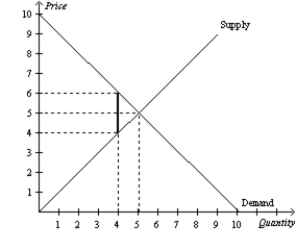 -Refer to Figure 6-36. If the government places a $2 tax in the market, the buyer pays $6.
 (True/False)
4.8/5 (87)
(87) When a binding price ceiling is imposed on a market to benefit buyers,
(Multiple Choice)
4.9/5 (90)
(90) Figure 6-22 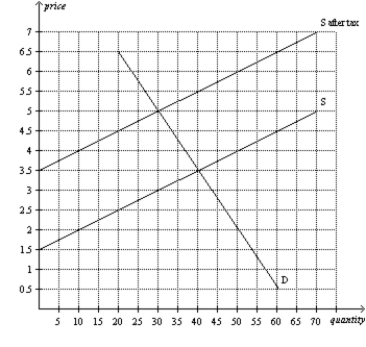 -Refer to Figure 6-22. Sellers pay how much of the tax per unit?
 (Multiple Choice)
4.9/5 (84)
(84) Figure 6-33 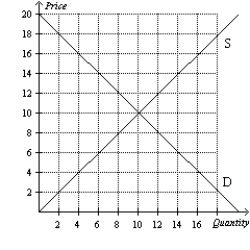 -Refer to Figure 6-33. Suppose a $3 per-unit tax is imposed on the sellers of this good. How much is the burden of this tax on the sellers in this market?
 (Short Answer)
4.8/5 (77)
(77) A price ceiling set above the equilibrium price causes quantity demanded to exceed quantity supplied.
(True/False)
4.7/5 (77)
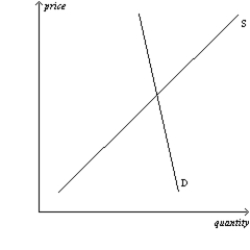
(77) Figure 6-30
Panel (a)
Panel (b) 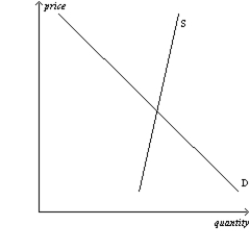
 Panel (c)
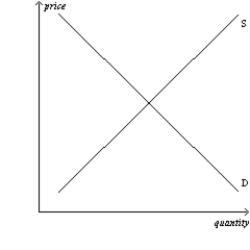 -Refer to Figure 6-30. In which market will the tax burden be most equally divided between buyers and sellers?
Panel (c)
-Refer to Figure 6-30. In which market will the tax burden be most equally divided between buyers and sellers? (Multiple Choice)
4.8/5 (75)
(75) Figure 6-1
Panel (a)
Panel (b) 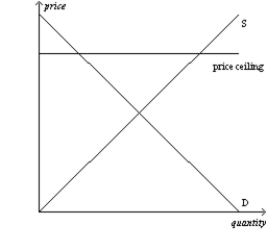
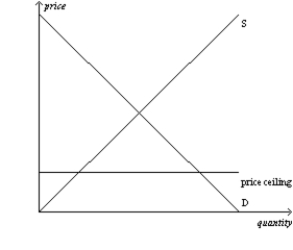 -Refer to Figure 6-1. A binding price ceiling is shown in
 (Multiple Choice)
4.9/5 (74)
(74) Figure 6-6 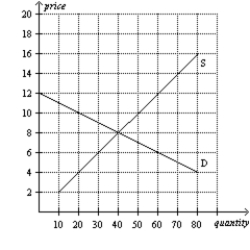 -Refer to Figure 6-6. If the government imposes a price floor of $10 on this market, then there will be
 (Multiple Choice)
4.9/5 (101)
(101) If the government passes a law requiring sellers of mopeds to send $200 to the government for every moped they sell, then
(Multiple Choice)
4.9/5 (90)
(90) Figure 6-23 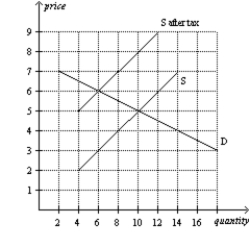 -Suppose the government imposes a $40 tax on the buyers of refrigerators. The tax would
 (Multiple Choice)
4.9/5 (85)
(85) If the equilibrium price of an airline ticket is $500 and the government imposes a price floor of $400 on airline tickets, then fewer airline tickets will be sold than at the market equilibrium.
(True/False)
5.0/5 (84)
(84) Figure 6-3
Panel (a)
Panel (b) 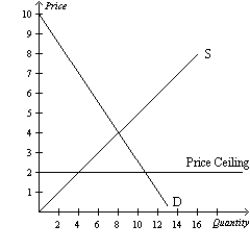
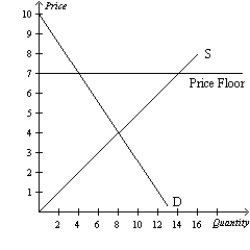 -Refer to Figure 6-3. In panel (a), there will be
 (Multiple Choice)
4.7/5 (76)
(76) If the government passes a law requiring buyers of college textbooks to send $5 to the government for every textbook they buy, then
(Multiple Choice)
4.9/5 (59)
(59) Figure 6-19 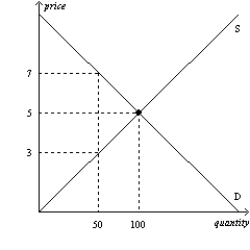 -Refer to Figure 6-19. Suppose a tax of $2 per unit is imposed on this market. What will be the new equilibrium quantity in this market?
 (Multiple Choice)
4.8/5 (94)
(94) Binding price ceilings benefit consumers because they allow consumers to buy all the goods they demand at a lower price.
(True/False)
4.9/5 (77)
(77) 
Filters
- Essay(0)
- Multiple Choice(0)
- Short Answer(0)
- True False(0)
- Matching(0)