



 Chat with AI
Exam 6: Supply, Demand, and Government Policies

Exam 1: Ten Principles of Economics455 Questions
Exam 2: Thinking Like an Economist645 Questions
Exam 3: Interdependence and the Gains From Trade550 Questions
Exam 4: The Market Forces of Supply and Demand693 Questions
Exam 5: Elasticity and Its Application625 Questions
Exam 6: Supply, Demand, and Government Policies671 Questions
Exam 7: Consumers, Producers, and the Efficiency of Markets547 Questions
Exam 8: Application: The Costs of Taxation507 Questions
Exam 9: Application: International Trade521 Questions
Exam 10: Externalities543 Questions
Exam 11: Public Goods and Common Resources453 Questions
Exam 12: The Design of the Tax System563 Questions
Exam 13: The Costs of Production649 Questions
Exam 14: Firms in Competitive Markets608 Questions
Exam 15: Monopoly662 Questions
Exam 16: Monopolistic Competition649 Questions
Exam 17: Oligopoly522 Questions
Exam 18: The Markets for the Factors of Production592 Questions
Exam 19: Earnings and Discrimination511 Questions
Exam 20: Income Inequality and Poverty478 Questions
Exam 21: The Theory of Consumer Choice568 Questions
Exam 22: Frontiers in Microeconomics461 Questions
Select questions type


Suppose the equilibrium price of a tube of toothpaste is $2, and the government imposes a price floor of $3 per tube. As a result of the price floor,
(Multiple Choice)
4.8/5  (68)
(68) Suppose that in a particular market, the demand curve is highly elastic, and the supply curve is highly inelastic. If a tax is imposed in this market, then the
(Multiple Choice)
4.8/5 (75)
(75) If a tax is levied on the buyers of a product, then there will be a(n)
(Multiple Choice)
4.7/5 (80)
(80) Figure 6-6 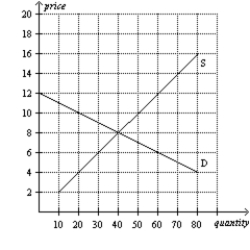 -Refer to Figure 6-6. If the government imposes a price floor of $6 on this market, then there will be
 (Multiple Choice)
4.8/5 (75)
(75) Scenario 6-2
Suppose demand for a product is given by the equation  and supply for the product is given by the equation
 -Refer to Scenario 6-2. What are the equilibrium price and equilibrium quantity in the market for this product?
and supply for the product is given by the equation
-Refer to Scenario 6-2. What are the equilibrium price and equilibrium quantity in the market for this product? (Essay)
4.8/5 (78)
(78) Figure 6-32 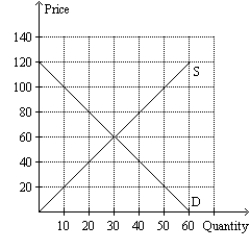 -Refer to Figure 6-32. If the government set a price floor at $55, would there be a shortage or surplus, and how large would be the shortage/surplus?
 (Essay)
4.8/5 (87)
(87) 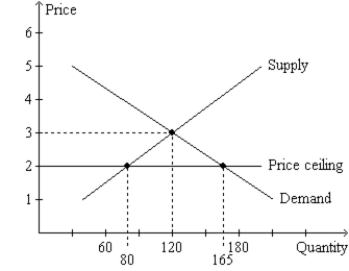 -Refer to Figure 6-2. The price ceiling
Figure 6-33 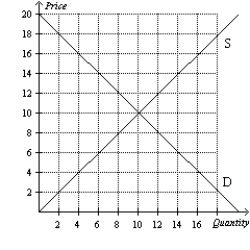 -Refer to Figure 6-33. Suppose a $3 per-unit tax is imposed on the sellers of this good. What is the effective price that sellers will receive for the good after the tax is imposed?
 (Essay)
4.8/5 (69)
(69) Even though federal law mandates that workers and firms each pay half of the total FICA tax, the tax burden may not fall equally on workers and firms.
(True/False)
4.8/5 (76)
(76) Workers with high skills and much experience are not typically affected by the minimum wage.
(True/False)
4.8/5 (82)
(82) Table 6-3
The following table contains the demand schedule and supply schedule for a market for a particular good. Suppose sellers of the good successfully lobby Congress to impose a price floor $2 above the equilibrium price in this market. 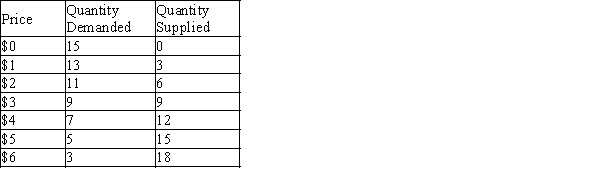 -Refer to Table 6-3. Following the imposition of a price floor $2 above the equilibrium price, irate buyers convince Congress to repeal the price floor and to impose a price ceiling $1 below the former price floor. The resulting shortage is
 (Multiple Choice)
4.9/5 (71)
(71) Figure 6-32
-Refer to Figure 6-32. If the government set a price ceiling at $80, would there be a shortage or surplus, and how large would be the shortage/surplus?
-Refer to Figure 6-32. If the government set a price ceiling at $80, would there be a shortage or surplus, and how large would be the shortage/surplus? (Essay)
4.9/5 (80)
(80) 
Filters
- Essay(0)
- Multiple Choice(0)
- Short Answer(0)
- True False(0)
- Matching(0)