



 Chat with AI
Exam 6: Supply, Demand, and Government Policies

Exam 1: Ten Principles of Economics455 Questions
Exam 2: Thinking Like an Economist645 Questions
Exam 3: Interdependence and the Gains From Trade550 Questions
Exam 4: The Market Forces of Supply and Demand693 Questions
Exam 5: Elasticity and Its Application625 Questions
Exam 6: Supply, Demand, and Government Policies671 Questions
Exam 7: Consumers, Producers, and the Efficiency of Markets547 Questions
Exam 8: Application: The Costs of Taxation507 Questions
Exam 9: Application: International Trade521 Questions
Exam 10: Externalities543 Questions
Exam 11: Public Goods and Common Resources453 Questions
Exam 12: The Design of the Tax System563 Questions
Exam 13: The Costs of Production649 Questions
Exam 14: Firms in Competitive Markets608 Questions
Exam 15: Monopoly662 Questions
Exam 16: Monopolistic Competition649 Questions
Exam 17: Oligopoly522 Questions
Exam 18: The Markets for the Factors of Production592 Questions
Exam 19: Earnings and Discrimination511 Questions
Exam 20: Income Inequality and Poverty478 Questions
Exam 21: The Theory of Consumer Choice568 Questions
Exam 22: Frontiers in Microeconomics461 Questions
Select questions type


When a tax is placed on the buyers of a product, buyers pay
(Multiple Choice)
4.7/5  (80)
(80) Figure 6-36 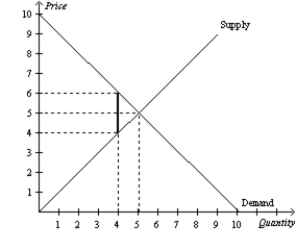 -Refer to Figure 6-36. If the government places a $2 tax in the market, the seller bears $2 of the tax burden.
 (True/False)
4.9/5 (79)
(79) Table 6-2 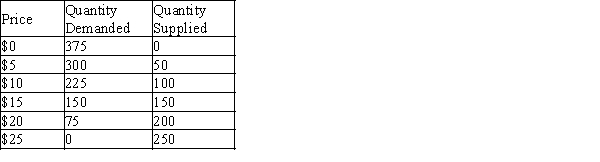 -Refer to Table 6-2. A price ceiling set at $20 will
 (Multiple Choice)
4.8/5 (67)
(67) Table 6-1 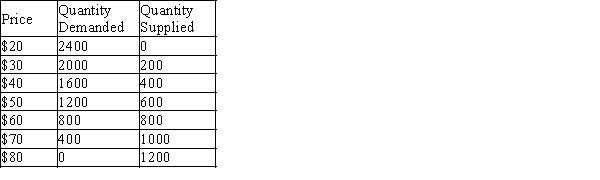 -Refer to Table 6-1. Suppose the government imposes a price ceiling of $70 on this market. What will be the size of the shortage in this market?
 (Multiple Choice)
4.8/5 (77)
(77) Figure 6-6 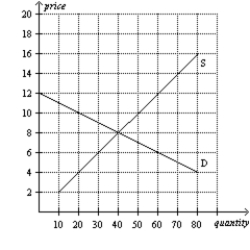 -Refer to Figure 6-6. Which of the following price floors would be binding in this market?
 (Multiple Choice)
4.9/5 (86)
(86) If the demand curve is more price elastic than the supply curve, will the buyers or the sellers bear a greater burden of a tax? Draw a diagram to illustrate your answer.
(Essay)
4.9/5 (90)
(90) Figure 6-2 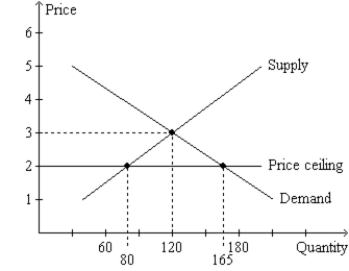 -Refer to Figure 6-2. The price ceiling causes quantity
 (Multiple Choice)
4.8/5 (66)
(66) Figure 6-21 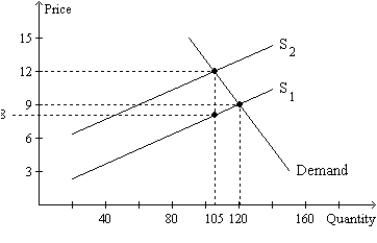 -Refer to Figure 6-21. What is the amount of the tax per unit?
 (Multiple Choice)
4.8/5 (79)
(79) In an unregulated labor market, the wage adjusts to balance labor supply and labor demand.
(True/False)
4.8/5 (86)
(86) Figure 6-32 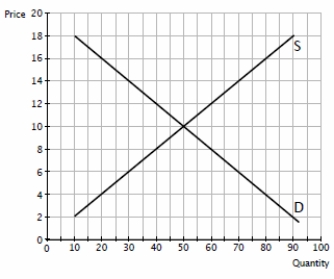 -Refer to Figure 6-32. Which of the following statements is NOT accurate regarding the situation reflected by this diagram?
 (Multiple Choice)
4.8/5 (101)
(101) Figure 6-7 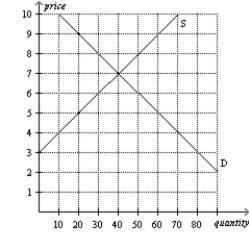 -Refer to Figure 6-7. Suppose a price floor of $8 is imposed on this market. As a result,
 (Multiple Choice)
4.9/5 (72)
(72) Studies by economists have found that a 10 percent increase in the minimum wage decreases teenage employment 10 percent.
(True/False)
4.9/5 (79)
(79) Price is the rationing mechanism in a free, competitive market.
(True/False)
4.7/5 (85)
(85) Figure 6-12 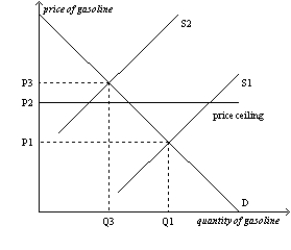 -Refer to Figure 6-12. When the price ceiling applies in this market, and the supply curve for gasoline shifts from S1 to S2, the resulting quantity of gasoline that is bought and sold is
 (Multiple Choice)
4.7/5 (84)
(84) Figure 6-35  -Refer to Figure 6-35. A price floor set at $40 would create a surplus of 20 units.
 (True/False)
4.9/5 (83)
(83) Table 6-6 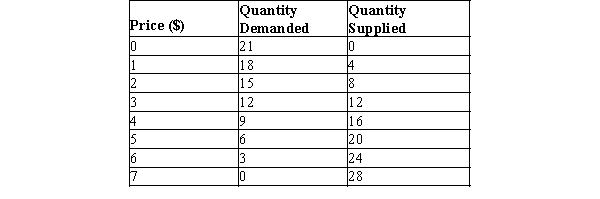 -Refer to Table 6-6. In this market, over what range of prices would a price floor set by the government be binding?
 (Essay)
4.9/5 (64)
(64) Figure 6-17
This figure shows the market demand and market supply curves for good Y 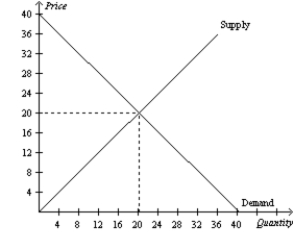 -Refer to Figure 6-17. A government-imposed price of $24 in this market is an example of a
 (Multiple Choice)
4.8/5 (79)
(79) 
Filters
- Essay(0)
- Multiple Choice(0)
- Short Answer(0)
- True False(0)
- Matching(0)