



 Chat with AI
Exam 6: Supply, Demand, and Government Policies

Exam 1: Ten Principles of Economics455 Questions
Exam 2: Thinking Like an Economist645 Questions
Exam 3: Interdependence and the Gains From Trade550 Questions
Exam 4: The Market Forces of Supply and Demand693 Questions
Exam 5: Elasticity and Its Application625 Questions
Exam 6: Supply, Demand, and Government Policies671 Questions
Exam 7: Consumers, Producers, and the Efficiency of Markets547 Questions
Exam 8: Application: The Costs of Taxation507 Questions
Exam 9: Application: International Trade521 Questions
Exam 10: Externalities543 Questions
Exam 11: Public Goods and Common Resources453 Questions
Exam 12: The Design of the Tax System563 Questions
Exam 13: The Costs of Production649 Questions
Exam 14: Firms in Competitive Markets608 Questions
Exam 15: Monopoly662 Questions
Exam 16: Monopolistic Competition649 Questions
Exam 17: Oligopoly522 Questions
Exam 18: The Markets for the Factors of Production592 Questions
Exam 19: Earnings and Discrimination511 Questions
Exam 20: Income Inequality and Poverty478 Questions
Exam 21: The Theory of Consumer Choice568 Questions
Exam 22: Frontiers in Microeconomics461 Questions
Select questions type


A price ceiling set above the equilibrium price causes a surplus in the market.
(True/False)
4.8/5  (74)
(74) Which of the following statements is correct concerning the burden of a tax imposed on take-out food?
(Multiple Choice)
4.9/5 (69)
(69) Minimum-wage laws benefit society by creating a surplus of labor.
(True/False)
4.7/5 (68)
(68) Minimum-wage laws are precise policy instruments that can specifically target workers whose family incomes are low.
(True/False)
4.9/5 (92)
(92) In the 1970s, long lines at gas stations in the United States were primarily a result of the fact that
(Multiple Choice)
4.8/5 (72)
(72) Although lawmakers legislated a fifty-fifty division of the payment of the FICA tax,
(Multiple Choice)
4.9/5 (65)
(65) The goal of the minimum wage is to ensure workers a minimally adequate standard of living.
(True/False)
4.9/5 (74)
(74) When a free market for a good reaches equilibrium, anyone who is willing and able to sell at the market price can sell the good.
(True/False)
5.0/5 (88)
(88) Figure 6-30
Panel (a)
Panel (b) 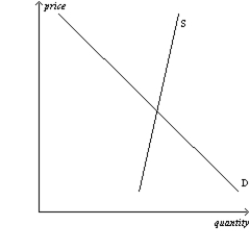
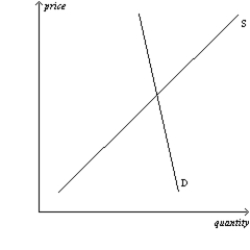 Panel (c)
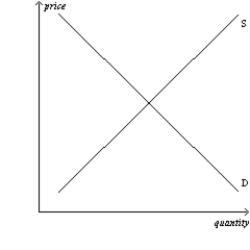 -Refer to Figure 6-30. In which market will the majority of the tax burden fall on buyers?
Panel (c)
-Refer to Figure 6-30. In which market will the majority of the tax burden fall on buyers? (Multiple Choice)
4.8/5 (83)
(83) Figure 6-25 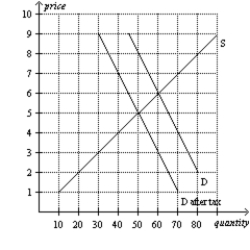 -Refer to Figure 6-25. The amount of the tax per unit is
 (Multiple Choice)
4.9/5 (65)
(65) Figure 6-34 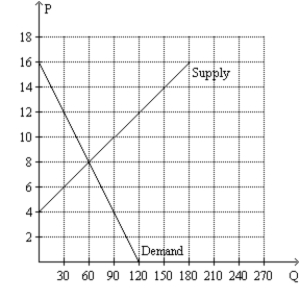 -Refer to Figure 6-34. If the government imposes a tax of $6 per unit in this market, who will bear the greater burden of the tax - the buyers, the sellers, or will the burden be shared equally?
 (Essay)
4.7/5 (70)
(70) The price paid by buyers in a market will increase if the government
(Multiple Choice)
4.7/5 (90)
(90) Figure 6-34
-Refer to Figure 6-34. If the government imposes a tax of $6 per unit in this market, how many units will be bought and sold in the market after the tax is imposed?
-Refer to Figure 6-34. If the government imposes a tax of $6 per unit in this market, how many units will be bought and sold in the market after the tax is imposed? (Essay)
4.8/5 (92)
(92) Figure 6-9 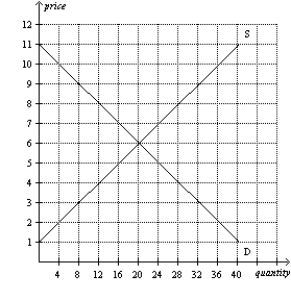 -Refer to Figure 6-9. At which price would a price ceiling be nonbinding?
 (Multiple Choice)
5.0/5 (101)
(101) A large majority of economists favor eliminating the minimum wage.
(True/False)
4.7/5 (86)
(86) Scenario 6-1
Suppose that demand in the market for good X is given by the equation  and that supply in the market for good X is given by the equation
 -Refer to Scenario 6-1. If the government set a price floor at $7, would there be a shortage or surplus, and how large would be the shortage/surplus?
and that supply in the market for good X is given by the equation
-Refer to Scenario 6-1. If the government set a price floor at $7, would there be a shortage or surplus, and how large would be the shortage/surplus? (Essay)
4.8/5 (77)
(77) A binding price floor (i)
Causes a surplus.
(ii)
Causes a shortage.(iii)
Is set at a price above the equilibrium price.(iv)
Is set at a price below the equilibrium price.
(Multiple Choice)
4.9/5 (97)
(97) 
Filters
- Essay(0)
- Multiple Choice(0)
- Short Answer(0)
- True False(0)
- Matching(0)