



 Chat with AI
Exam 6: Supply, Demand, and Government Policies

Exam 1: Ten Principles of Economics455 Questions
Exam 2: Thinking Like an Economist645 Questions
Exam 3: Interdependence and the Gains From Trade550 Questions
Exam 4: The Market Forces of Supply and Demand693 Questions
Exam 5: Elasticity and Its Application625 Questions
Exam 6: Supply, Demand, and Government Policies671 Questions
Exam 7: Consumers, Producers, and the Efficiency of Markets547 Questions
Exam 8: Application: The Costs of Taxation507 Questions
Exam 9: Application: International Trade521 Questions
Exam 10: Externalities543 Questions
Exam 11: Public Goods and Common Resources453 Questions
Exam 12: The Design of the Tax System563 Questions
Exam 13: The Costs of Production649 Questions
Exam 14: Firms in Competitive Markets608 Questions
Exam 15: Monopoly662 Questions
Exam 16: Monopolistic Competition649 Questions
Exam 17: Oligopoly522 Questions
Exam 18: The Markets for the Factors of Production592 Questions
Exam 19: Earnings and Discrimination511 Questions
Exam 20: Income Inequality and Poverty478 Questions
Exam 21: The Theory of Consumer Choice568 Questions
Exam 22: Frontiers in Microeconomics461 Questions
Select questions type


When OPEC raised the price of crude oil in the 1970s, it caused the
(Multiple Choice)
4.8/5  (85)
(85) 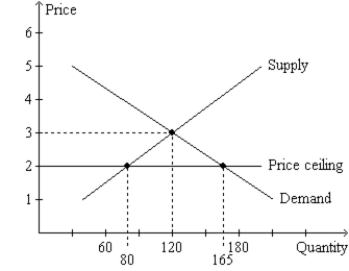 -Refer to Figure 6-2. The price ceiling
Figure 6-24 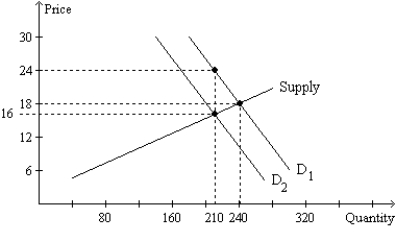 -Refer to Figure 6-24. Suppose sellers, rather than buyers, were required to pay this tax (in the same amount per unit as shown in the graph). Relative to the tax on buyers, the tax on sellers would result in
 (Multiple Choice)
4.8/5 (73)
(73) If the government removes a $1 tax on sellers of gasoline and imposes the same $1 tax on buyers of gasoline, then the price paid by buyers will
(Multiple Choice)
4.9/5 (82)
(82) Regardless of whether a tax is levied on sellers or buyers, taxes discourage market activity.
(True/False)
4.8/5 (86)
(86) Table 6-5 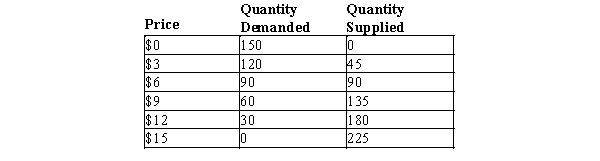 -Refer to Table 6-5. Which of the following price ceilings would be binding in this market?
 (Multiple Choice)
4.9/5 (86)
(86) Figure 6-20 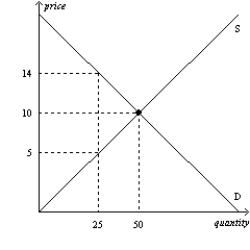 -Refer to Figure 6-20. Suppose a tax of $5 per unit is imposed on this market. Which of the following is correct?
 (Multiple Choice)
4.9/5 (80)
(80) The price paid by buyers in a market will decrease if the government
(Multiple Choice)
4.7/5 (72)
(72) Figure 6-24
-Refer to Figure 6-24. The per-unit burden of the tax on buyers of the good is
-Refer to Figure 6-24. The per-unit burden of the tax on buyers of the good is (Multiple Choice)
4.8/5 (79)
(79) Consider the US market for chocolate, a market in which the government has imposed a price ceiling. Which of the following events could convert the price ceiling from a nonbinding to a binding price ceiling?
(Multiple Choice)
4.9/5 (84)
(84) When a binding price floor is imposed on a market for a good, some people who want to sell the good cannot do so.
(True/False)
4.8/5 (60)
(60) Figure 6-5 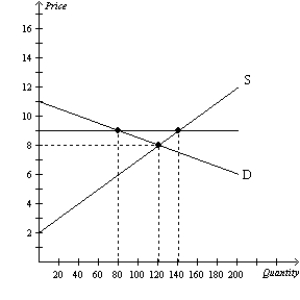 -Refer to Figure 6-5. If the solid horizontal line on the graph represents a price floor, then the price floor is
 (Multiple Choice)
4.9/5 (67)
(67) When OPEC raised the price of crude oil in the 1970s, it caused the United States'
(Multiple Choice)
4.9/5 (84)
(84) Figure 6-18
The vertical distance between points A and B represents the tax in the market. 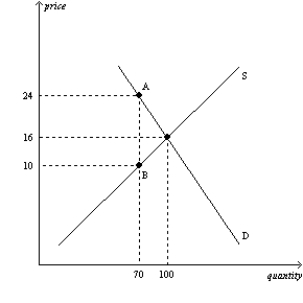 -Refer to Figure 6-18. The per-unit burden of the tax on buyers is
 (Multiple Choice)
4.9/5 (79)
(79) Figure 6-23 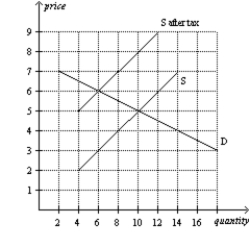 -If a tax is levied on the buyers of dog food, then
 (Multiple Choice)
4.9/5 (73)
(73) If the government levies a $500 tax per car on sellers of cars, then the price received by sellers of cars would
(Multiple Choice)
4.9/5 (76)
(76) Suppose the government has imposed a price ceiling on laptop computers. Which of the following events could transform the price ceiling from one that is not binding into one that is binding?
(Multiple Choice)
4.8/5 (68)
(68) Who bears the majority of a tax burden depends on the relative elasticity of supply and demand.
(True/False)
4.8/5 (70)
(70) 
Filters
- Essay(0)
- Multiple Choice(0)
- Short Answer(0)
- True False(0)
- Matching(0)