



 Chat with AI
Exam 1: Organization of the Human Body

Exam 1: Organization of the Human Body105 Questions
Exam 2: Introductory Chemistry99 Questions
Exam 3: Cells112 Questions
Exam 4: Tissues106 Questions
Exam 5: The Integumentary System110 Questions
Exam 6: The Skeletal System92 Questions
Exam 7: Joints88 Questions
Exam 8: The Muscular System99 Questions
Exam 9: Nervous Tissue79 Questions
Exam 10: Central Nervous System, Spinal Nerves, and Cranial Nerves96 Questions
Exam 11: Autonomic Nervous System82 Questions
Exam 12: Somatic Senses and Special Sense102 Questions
Exam 13: The Endocrine System97 Questions
Exam 14: The Cardiovascular System: Blood92 Questions
Exam 15: The Cardiovascular System: Heart69 Questions
Exam 16: The Cardiovascular System: Blood Vessels and Circulation95 Questions
Exam 17: The Lymphatic System and Immunity91 Questions
Exam 18: The Respiratory System102 Questions
Exam 19: The Digestive System97 Questions
Exam 20: Nutrition and Metabolism85 Questions
Exam 21: The Urinary System90 Questions
Exam 22: Fluid, Electrolyte, and Acid-Base Balance81 Questions
Exam 23: The Reproductive Systems95 Questions
Exam 24: Development and Inheritance90 Questions
Select questions type


Pathology is the science that deals with why, when and where diseases occur and how they are transmitted within a defined human population.
(True/False)
4.8/5  (83)
(83) The splitting of proteins into amino acids which are then used to make new proteins is an example of the life process called
(Multiple Choice)
4.9/5 (77)
(77) Which of the following is NOT a change associated with aging?
(Multiple Choice)
4.8/5 (90)
(90) All of the following are found inferior to the diaphragm EXCEPT the
(Multiple Choice)
4.8/5 (79)
(79) Maintenance of relatively stable conditions in the internal environment of the human body is called _____.
(Short Answer)
4.8/5 (84)
(84) The component of a feedback system that monitors changes in the controlled condition is called the _____.
(Short Answer)
4.9/5 (76)
(76) The science that deals with the treatment of disease using drugs is called
(Multiple Choice)
4.9/5 (73)
(73) Name and briefly describe the common planes used to describe anatomy of body parts that have been sectioned.
(Essay)
5.0/5 (91)
(91) Which of the labeled planes in the diagram is a coronal (or frontal plane)? 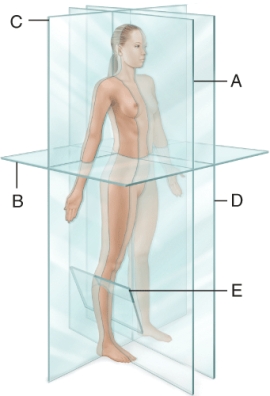
(Multiple Choice)
4.8/5 (72)
(72) The umbilical region of the abdominopelvic cavity is _____ to the pubic region.
(Short Answer)
4.7/5 (73)
(73) Blood pressure, which is the force of flowing blood against the walls of the arteries, is maintained within a narrow range by a _____ feedback system.
(Short Answer)
4.8/5 (84)
(84) Which of the following directional terms best describes structures found toward the back region of the body?
(Multiple Choice)
4.9/5 (72)
(72) The abdominal and pelvic cavities combine to form the _____ cavity.
(Short Answer)
4.9/5 (67)
(67) The endocrine system would be the most likely control system for a homeostatic process that requires a rapidly induced change.
(True/False)
4.8/5 (90)
(90) All of the following are functions of the cardiovascular system EXCEPT
(Multiple Choice)
4.8/5 (59)
(59) In the anatomical position, the ring finger is ___ to the little finger.
(Multiple Choice)
4.9/5 (70)
(70) The organs found inside the thoracic and abdominopelvic cavities are commonly referred to as
(Multiple Choice)
4.7/5 (79)
(79) 
Filters
- Essay(0)
- Multiple Choice(0)
- Short Answer(0)
- True False(0)
- Matching(0)