



 Chat with AI
Exam 3: Cells

Exam 1: Organization of the Human Body105 Questions
Exam 2: Introductory Chemistry99 Questions
Exam 3: Cells112 Questions
Exam 4: Tissues106 Questions
Exam 5: The Integumentary System110 Questions
Exam 6: The Skeletal System92 Questions
Exam 7: Joints88 Questions
Exam 8: The Muscular System99 Questions
Exam 9: Nervous Tissue79 Questions
Exam 10: Central Nervous System, Spinal Nerves, and Cranial Nerves96 Questions
Exam 11: Autonomic Nervous System82 Questions
Exam 12: Somatic Senses and Special Sense102 Questions
Exam 13: The Endocrine System97 Questions
Exam 14: The Cardiovascular System: Blood92 Questions
Exam 15: The Cardiovascular System: Heart69 Questions
Exam 16: The Cardiovascular System: Blood Vessels and Circulation95 Questions
Exam 17: The Lymphatic System and Immunity91 Questions
Exam 18: The Respiratory System102 Questions
Exam 19: The Digestive System97 Questions
Exam 20: Nutrition and Metabolism85 Questions
Exam 21: The Urinary System90 Questions
Exam 22: Fluid, Electrolyte, and Acid-Base Balance81 Questions
Exam 23: The Reproductive Systems95 Questions
Exam 24: Development and Inheritance90 Questions
Select questions type


When translation of a particular protein is complete, termination of protein synthesis is indicated by the presence of a/an
(Multiple Choice)
4.8/5  (80)
(80) The synthesis of plasma membrane proteins occurs in ribosomes attached to the outer surface of the
(Multiple Choice)
4.9/5 (84)
(84) When solutes move from an area of high concentration to an area of low concentration, they are moving down their _____.
(Short Answer)
5.0/5 (90)
(90) Pinocytosis and phagocytosis involve structural changes in the
(Multiple Choice)
4.9/5 (68)
(68) In passive transport, the net result is that solutes move from an area of low solute concentration to an area of higher solute concentration.
(True/False)
4.9/5 (76)
(76) The study of the processes and problems associated with aging is called
(Multiple Choice)
4.9/5 (67)
(67) Which diagram and picture in the figure best represents the results obtained when placing red blood cells into a normal saline solution (0.9% NaCl)? 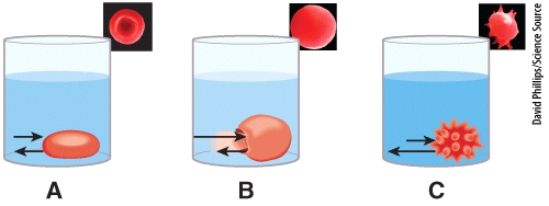
(Multiple Choice)
4.9/5 (77)
(77) During interphase, a cell replicates its DNA and does most of its growing.
(True/False)
4.8/5 (81)
(81) Which of the following statements BEST describes essential characteristic(s)of active transport?
(Multiple Choice)
4.9/5 (87)
(87) Based on the structural features of the cells shown in the diagram, which cell is most likely to be capable of locomotion? 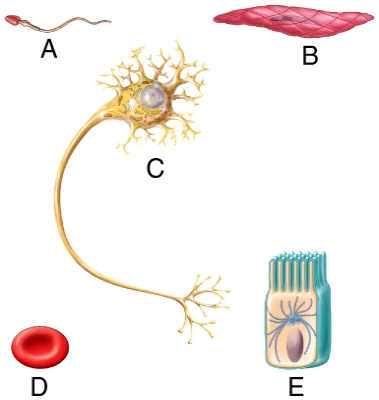
(Multiple Choice)
4.8/5 (75)
(75) The cellular organelle primarily responsible for transforming the chemical energy found in nutrients into ATP is the
(Multiple Choice)
4.8/5 (76)
(76) The movement of solute molecules across a plasma membrane from an area of low solute concentration to an area of high solute concentration requires
(Multiple Choice)
4.7/5 (71)
(71) The shrinkage that occurs when cells are placed into a hypertonic solution is called _____.
(Short Answer)
4.9/5 (90)
(90) Which of the following statements are TRUE for the plasma membrane?
(Multiple Choice)
4.8/5 (68)
(68) 
Filters
- Essay(0)
- Multiple Choice(0)
- Short Answer(0)
- True False(0)
- Matching(0)