



 Chat with AI
Exam 3: Cells

Exam 1: Organization of the Human Body105 Questions
Exam 2: Introductory Chemistry99 Questions
Exam 3: Cells112 Questions
Exam 4: Tissues106 Questions
Exam 5: The Integumentary System110 Questions
Exam 6: The Skeletal System92 Questions
Exam 7: Joints88 Questions
Exam 8: The Muscular System99 Questions
Exam 9: Nervous Tissue79 Questions
Exam 10: Central Nervous System, Spinal Nerves, and Cranial Nerves96 Questions
Exam 11: Autonomic Nervous System82 Questions
Exam 12: Somatic Senses and Special Sense102 Questions
Exam 13: The Endocrine System97 Questions
Exam 14: The Cardiovascular System: Blood92 Questions
Exam 15: The Cardiovascular System: Heart69 Questions
Exam 16: The Cardiovascular System: Blood Vessels and Circulation95 Questions
Exam 17: The Lymphatic System and Immunity91 Questions
Exam 18: The Respiratory System102 Questions
Exam 19: The Digestive System97 Questions
Exam 20: Nutrition and Metabolism85 Questions
Exam 21: The Urinary System90 Questions
Exam 22: Fluid, Electrolyte, and Acid-Base Balance81 Questions
Exam 23: The Reproductive Systems95 Questions
Exam 24: Development and Inheritance90 Questions
Select questions type


Solute molecules can be transported from an area of low solute concentration to an area of higher solute concentration by _____ transport.
(Short Answer)
5.0/5  (70)
(70) The organelle that contains as many as 60 different digestive enzymes is called the
(Multiple Choice)
4.8/5 (65)
(65) Protein synthesis begins with a DNA code in the nucleus. DNA is copied as an mRNA strand. The mRNA goes to the ribosome where tRNA brings in the appropriate amino acids. These amino acids bond to form a protein. The process continues until the stop codon is read.
(True/False)
4.9/5 (89)
(89) During which phase of cell division labeled in the diagram is cytokinesis completed? 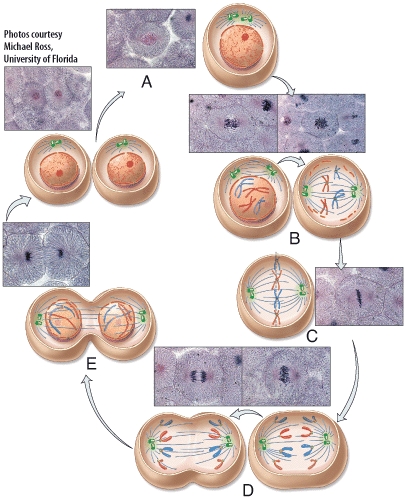
(Multiple Choice)
4.8/5 (87)
(87) Which of the following statements is NOT TRUE with regard to the cytoplasm?
(Multiple Choice)
4.9/5 (81)
(81) Peripheral proteins penetrate all the way through the phospholipid bilayer of the plasma membrane.
(True/False)
4.9/5 (68)
(68) An organelle located near the nucleus that consists of two cylindrical structures composed of clusters of microtubules is called the
(Multiple Choice)
4.8/5 (93)
(93) Passive transport requires the use of cellular energy (e.g. ATP)but active transport does not.
(True/False)
4.8/5 (79)
(79) Usually only one mutation is needed to convert a non-cancerous adenoma into a cancerous carcinoma.
(True/False)
4.9/5 (88)
(88) Which of the following organelles are commonly referred to as the "powerhouses" of a cell?
(Multiple Choice)
4.7/5 (86)
(86) The multistep process by which cancer develops is referred to as
(Multiple Choice)
4.8/5 (82)
(82) Which of the labeled cells in the diagram best represents the type of absorptive cells that line the small intestine? 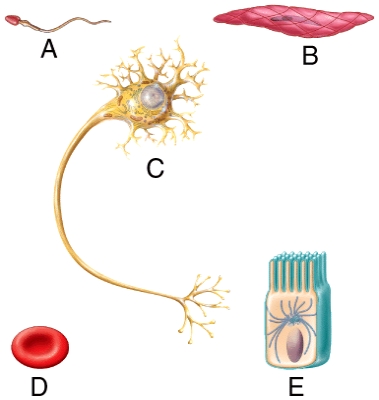
(Multiple Choice)
4.8/5 (77)
(77) A group of nucleotides on a DNA molecule that codes for a particular protein is called a/an _____.
(Short Answer)
4.9/5 (90)
(90) The branch of medicine dealing with medical issues of aging is called
(Multiple Choice)
4.7/5 (80)
(80) Which of following organelles is primarily involved in the modification (e.g. glycosylation), sorting, and packaging of proteins?
(Multiple Choice)
4.8/5 (85)
(85) During somatic cell division, the process in which the cytoplasm and its organelles are divided is referred to as
(Multiple Choice)
4.9/5 (75)
(75) 
Filters
- Essay(0)
- Multiple Choice(0)
- Short Answer(0)
- True False(0)
- Matching(0)