



 Chat with AI
Exam 19: The Digestive System

Exam 1: Organization of the Human Body105 Questions
Exam 2: Introductory Chemistry99 Questions
Exam 3: Cells112 Questions
Exam 4: Tissues106 Questions
Exam 5: The Integumentary System110 Questions
Exam 6: The Skeletal System92 Questions
Exam 7: Joints88 Questions
Exam 8: The Muscular System99 Questions
Exam 9: Nervous Tissue79 Questions
Exam 10: Central Nervous System, Spinal Nerves, and Cranial Nerves96 Questions
Exam 11: Autonomic Nervous System82 Questions
Exam 12: Somatic Senses and Special Sense102 Questions
Exam 13: The Endocrine System97 Questions
Exam 14: The Cardiovascular System: Blood92 Questions
Exam 15: The Cardiovascular System: Heart69 Questions
Exam 16: The Cardiovascular System: Blood Vessels and Circulation95 Questions
Exam 17: The Lymphatic System and Immunity91 Questions
Exam 18: The Respiratory System102 Questions
Exam 19: The Digestive System97 Questions
Exam 20: Nutrition and Metabolism85 Questions
Exam 21: The Urinary System90 Questions
Exam 22: Fluid, Electrolyte, and Acid-Base Balance81 Questions
Exam 23: The Reproductive Systems95 Questions
Exam 24: Development and Inheritance90 Questions
Select questions type


Most substances absorbed into the blood in the small intestine are carried to the liver by the
(Multiple Choice)
4.8/5  (73)
(73) The layer of the GI tract wall containing networks of enteric neurons that control the secretory activity of the GI tract is called the
(Multiple Choice)
4.9/5 (87)
(87) Teeth containing three or more blunt cusps used to crush and grind food are called premolars.
(True/False)
4.8/5 (82)
(82) Which of the labeled regions of the large intestine is the rectum in which feces collects prior to defecation? 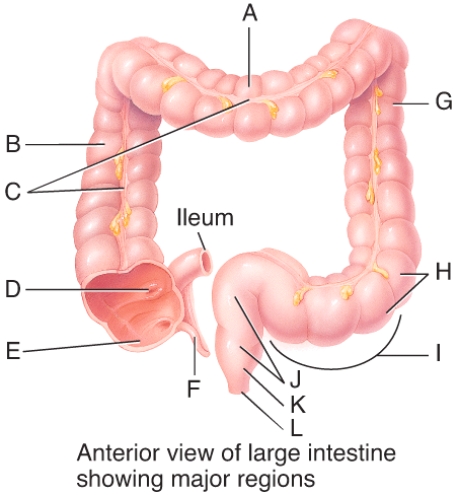
(Multiple Choice)
4.9/5 (77)
(77) Which of the following organs does not release substances into the duodenum?
(Multiple Choice)
4.9/5 (83)
(83) The exocrine portion of the pancreas consists of the acini that make up 1% of the mass of the pancreas.
(True/False)
4.9/5 (92)
(92) Teeth are primarily composed of a bone-like substance called
(Multiple Choice)
4.8/5 (89)
(89) Which of the labeled absorptive processes in the figure occur by passive transport without using cellular energy? 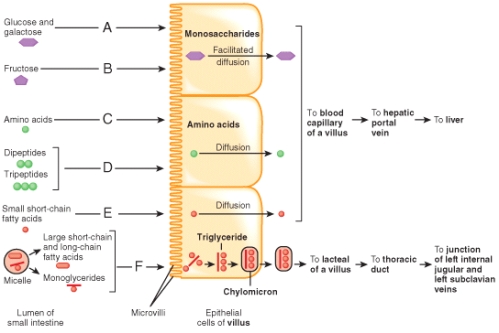
(Multiple Choice)
5.0/5 (94)
(94) When empty, the mucosa of the stomach contains large folds called
(Multiple Choice)
4.9/5 (79)
(79) The final portion of the small intestine, which is mostly found in the lower right quadrant, is called the
(Multiple Choice)
4.8/5 (74)
(74) Name and describe the six basic processes performed by the digestive system.
(Essay)
4.8/5 (94)
(94) 
Filters
- Essay(0)
- Multiple Choice(0)
- Short Answer(0)
- True False(0)
- Matching(0)