



 Chat with AI
Exam 19: The Digestive System

Exam 1: Organization of the Human Body105 Questions
Exam 2: Introductory Chemistry99 Questions
Exam 3: Cells112 Questions
Exam 4: Tissues106 Questions
Exam 5: The Integumentary System110 Questions
Exam 6: The Skeletal System92 Questions
Exam 7: Joints88 Questions
Exam 8: The Muscular System99 Questions
Exam 9: Nervous Tissue79 Questions
Exam 10: Central Nervous System, Spinal Nerves, and Cranial Nerves96 Questions
Exam 11: Autonomic Nervous System82 Questions
Exam 12: Somatic Senses and Special Sense102 Questions
Exam 13: The Endocrine System97 Questions
Exam 14: The Cardiovascular System: Blood92 Questions
Exam 15: The Cardiovascular System: Heart69 Questions
Exam 16: The Cardiovascular System: Blood Vessels and Circulation95 Questions
Exam 17: The Lymphatic System and Immunity91 Questions
Exam 18: The Respiratory System102 Questions
Exam 19: The Digestive System97 Questions
Exam 20: Nutrition and Metabolism85 Questions
Exam 21: The Urinary System90 Questions
Exam 22: Fluid, Electrolyte, and Acid-Base Balance81 Questions
Exam 23: The Reproductive Systems95 Questions
Exam 24: Development and Inheritance90 Questions
Select questions type


All of the following organs are part of the gastrointestinal tract except the
(Multiple Choice)
4.9/5  (86)
(86) The dentin of the root of a tooth is covered by bonelike substance called
(Multiple Choice)
4.9/5 (85)
(85) Both hormones and nerve impulses are used to control the phases of digestion.
(True/False)
4.9/5 (86)
(86) The intestinal hormone that induces a feeling of satiety (full to satisfaction)is
(Multiple Choice)
4.9/5 (79)
(79) Which of the following is not likely to cause of "emotional eating"?
(Multiple Choice)
4.9/5 (92)
(92) Aging tends to cause a decrease or loss of many digestive functions.
(True/False)
4.9/5 (76)
(76) The uvula prevents the entry of food and fluid into the nasal cavity during swallowing.
(True/False)
4.9/5 (73)
(73) The portion of peritoneum that anchors the small intestines to the posterior abdominal wall is called the
(Multiple Choice)
4.8/5 (77)
(77) The major events of chemical digestion and absorption of foods occur in the
(Multiple Choice)
4.8/5 (78)
(78) Which of the following events would have to occur to allow the bolus of food to go from the region labeled E in the diagram to the region labeled F? 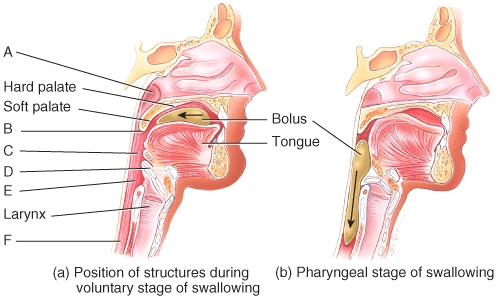
(Multiple Choice)
4.7/5 (89)
(89) Food has emotional, social and psychological functions as well as its nutritional value.
(True/False)
4.9/5 (76)
(76) Which of the following substances can be absorbed in the stomach?
(Multiple Choice)
4.9/5 (83)
(83) Which of the following cranial nerves carry electrical signals that stimulate the gastric glands to secrete gastric juice during the cephalic stage of digestion?
(Multiple Choice)
4.7/5 (65)
(65) Name and briefly describe the location of the different salivary glands.
(Essay)
4.7/5 (73)
(73) The structure (labeled D in the diagram)that is used to prevent the movement of food into the respiratory system during swallowing is called the 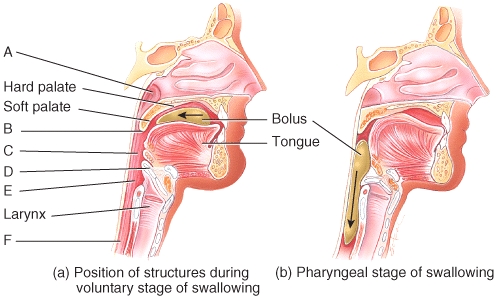
(Multiple Choice)
4.8/5 (69)
(69) Insoluble fiber and soluble fiber have opposite effects on intestinal motility but both reduce the risk of developing serious digestive disorders.
(True/False)
4.9/5 (92)
(92) The ability of the GI tract to mix and move material along its length is called
(Multiple Choice)
4.8/5 (71)
(71) The form of the hepatitis that is commonly referred to as "infectious hepatitis" is
(Multiple Choice)
4.8/5 (72)
(72) 
Filters
- Essay(0)
- Multiple Choice(0)
- Short Answer(0)
- True False(0)
- Matching(0)