



 Chat with AI
Exam 21: The Urinary System

Exam 1: Organization of the Human Body105 Questions
Exam 2: Introductory Chemistry99 Questions
Exam 3: Cells112 Questions
Exam 4: Tissues106 Questions
Exam 5: The Integumentary System110 Questions
Exam 6: The Skeletal System92 Questions
Exam 7: Joints88 Questions
Exam 8: The Muscular System99 Questions
Exam 9: Nervous Tissue79 Questions
Exam 10: Central Nervous System, Spinal Nerves, and Cranial Nerves96 Questions
Exam 11: Autonomic Nervous System82 Questions
Exam 12: Somatic Senses and Special Sense102 Questions
Exam 13: The Endocrine System97 Questions
Exam 14: The Cardiovascular System: Blood92 Questions
Exam 15: The Cardiovascular System: Heart69 Questions
Exam 16: The Cardiovascular System: Blood Vessels and Circulation95 Questions
Exam 17: The Lymphatic System and Immunity91 Questions
Exam 18: The Respiratory System102 Questions
Exam 19: The Digestive System97 Questions
Exam 20: Nutrition and Metabolism85 Questions
Exam 21: The Urinary System90 Questions
Exam 22: Fluid, Electrolyte, and Acid-Base Balance81 Questions
Exam 23: The Reproductive Systems95 Questions
Exam 24: Development and Inheritance90 Questions
Select questions type


An inherited disorder characterized by the formation of cysts in the kidney tubules is referred to as
(Multiple Choice)
4.9/5  (83)
(83) The urethra is the tube connecting a kidney with the urinary bladder.
(True/False)
4.8/5 (91)
(91) A physician that specializes in the branch of medicine focusing on problems of the male and female urinary system and the male reproductive system is called a/an
(Multiple Choice)
4.9/5 (83)
(83) All of the following are solutes normally found in urine EXCEPT
(Multiple Choice)
4.7/5 (62)
(62) The renal corpuscle filters components of blood plasma into the glomerular capsule.
(True/False)
4.8/5 (75)
(75) The tubular structure that connects a kidney to the urinary bladder is the
(Multiple Choice)
4.7/5 (67)
(67) Vasoconstriction of the efferent arteriole (labeled on the left side of the diagram)would result in all of the following EXCEPT 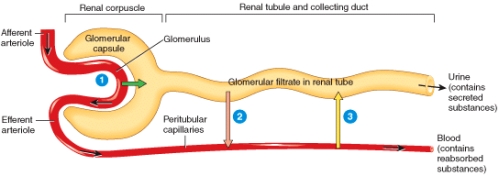
(Multiple Choice)
4.9/5 (83)
(83) Describe the differences between tubular reabsorption and tubular secretion.
(Essay)
4.8/5 (59)
(59) The kidneys help regulate blood pressure by adjusting blood volume.
(True/False)
4.8/5 (78)
(78) Which of the following structures found in the kidney is the site where filtration of the blood occurs?
(Multiple Choice)
4.8/5 (80)
(80) Tubular secretion can be used to eliminate _____ from the blood at a faster rate than it enters the filtrate.
(Multiple Choice)
4.9/5 (80)
(80) Tubular secretion involves the movement of solutes from the tubular fluid into the peritubular capillaries.
(True/False)
4.8/5 (76)
(76) Constriction of the efferent arteriole increases blood pressure in the glomerulus, which increases GFR.
(True/False)
4.9/5 (81)
(81) "Scanty" urine production of about 50 to 250 ml per day is called
(Multiple Choice)
4.8/5 (77)
(77) Which of the following answer selections contains the correct labels for the numbers contained in the blue circles in the diagram? 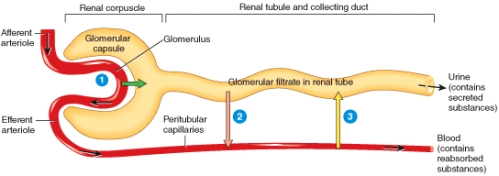
(Multiple Choice)
4.8/5 (75)
(75) The glomerular filtration rate in a normal adult male is about
(Multiple Choice)
4.9/5 (68)
(68) When ADH secretion from the posterior pituitary gland is maximal, the kidneys will produce
(Multiple Choice)
4.8/5 (75)
(75) 
Filters
- Essay(0)
- Multiple Choice(0)
- Short Answer(0)
- True False(0)
- Matching(0)