



 Chat with AI
Exam 21: The Urinary System

Exam 1: Organization of the Human Body105 Questions
Exam 2: Introductory Chemistry99 Questions
Exam 3: Cells112 Questions
Exam 4: Tissues106 Questions
Exam 5: The Integumentary System110 Questions
Exam 6: The Skeletal System92 Questions
Exam 7: Joints88 Questions
Exam 8: The Muscular System99 Questions
Exam 9: Nervous Tissue79 Questions
Exam 10: Central Nervous System, Spinal Nerves, and Cranial Nerves96 Questions
Exam 11: Autonomic Nervous System82 Questions
Exam 12: Somatic Senses and Special Sense102 Questions
Exam 13: The Endocrine System97 Questions
Exam 14: The Cardiovascular System: Blood92 Questions
Exam 15: The Cardiovascular System: Heart69 Questions
Exam 16: The Cardiovascular System: Blood Vessels and Circulation95 Questions
Exam 17: The Lymphatic System and Immunity91 Questions
Exam 18: The Respiratory System102 Questions
Exam 19: The Digestive System97 Questions
Exam 20: Nutrition and Metabolism85 Questions
Exam 21: The Urinary System90 Questions
Exam 22: Fluid, Electrolyte, and Acid-Base Balance81 Questions
Exam 23: The Reproductive Systems95 Questions
Exam 24: Development and Inheritance90 Questions
Select questions type


Which of the following processes is used by the nephron to move chemicals from tubular fluid back into the blood (labeled 2 in the diagram)? 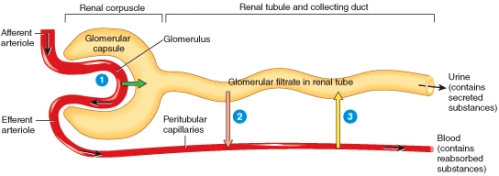
(Multiple Choice)
4.8/5  (73)
(73) An increase in the osmolarity of body fluids due to dehydration is sensed by osmoreceptors in the _____ leading to the release of _____ from the posterior pituitary gland.
(Multiple Choice)
4.9/5 (71)
(71) The collecting area of the kidney consists of the regions labeled H, I, and J in the diagram. Which of the following answer selections properly indicates the names of these regions? 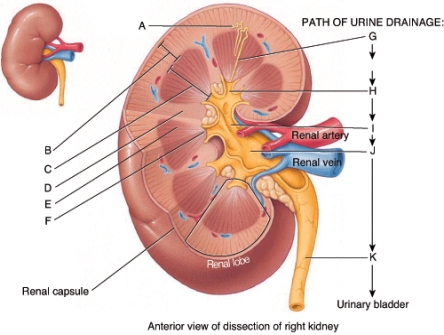
(Multiple Choice)
4.9/5 (87)
(87) The opening and closing of the internal urethral sphincter is involuntary.
(True/False)
4.9/5 (93)
(93) Urinary tract infections and dysuria are less common in the elderly.
(True/False)
4.9/5 (69)
(69) The terminal portion of the urinary system consists of a small tube that extends from the urinary bladder to the exterior of the body called the
(Multiple Choice)
4.7/5 (72)
(72) The filtrate formed in the glomerular capsule moves into the proximal convoluted tubule and then the nephron loop. It then travels through the distal convoluted tubule to the collecting tubules, which empty into the calyces and finally the renal pelvis. From there, urine goes through the ureters to urinary bladder and eventually out the urethra.
(True/False)
4.9/5 (91)
(91) The blood pressure in the glomerulus can be increased by vasoconstriction of the afferent arteriole.
(True/False)
4.9/5 (79)
(79) Which of the following represents the correct order of anatomical structures found in a nephron?
(Multiple Choice)
4.9/5 (86)
(86) From the collecting ducts of the nephrons, urine drains directly into the
(Multiple Choice)
4.7/5 (73)
(73) After the tubular fluid reaches the renal pelvis, its composition will not significantly change and it will be excreted from the body as urine.
(True/False)
4.9/5 (101)
(101) On average, a normal adult excretes _____ liters of urine per day.
(Multiple Choice)
4.8/5 (85)
(85) Which of the labeled structures in the kidney represent the point where changes in the urine composition cease to occur? 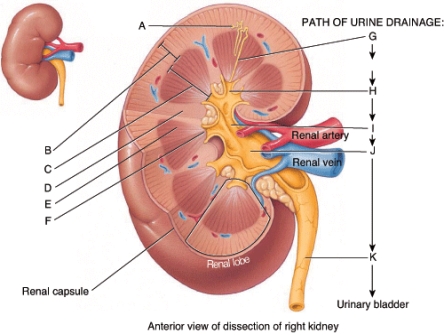
(Multiple Choice)
4.9/5 (78)
(78) The two most important hormonal regulators of ion secretion and reabsorption are angiotensin II and antidiuretic hormone.
(True/False)
4.9/5 (82)
(82) The process of expelling urine from the urinary bladder through the urethra is called
(Multiple Choice)
4.8/5 (75)
(75) 
Filters
- Essay(0)
- Multiple Choice(0)
- Short Answer(0)
- True False(0)
- Matching(0)