



 Chat with AI
Exam 1: The Human Organism

Exam 1: The Human Organism140 Questions
Exam 2: The Chemical Basis of Life207 Questions
Exam 3: Cell Biology230 Questions
Exam 4: Tissues208 Questions
Exam 5: Integumentary System175 Questions
Exam 6: Skeletal System: Bones and Bone Tissue178 Questions
Exam 7: Skeletal System: Gross Anatomy179 Questions
Exam 8: Joint and Movement149 Questions
Exam 9: Muscular System: Histology and Physiology231 Questions
Exam 10: Muscular System: Gross Anatomy168 Questions
Exam 11: Functional Organization of Nervous Tissue192 Questions
Exam 12: Spinal Cord and Spinal Nerves141 Questions
Exam 13: Brain and Cranial Nerves176 Questions
Exam 14: Integration of Nervous System Functions149 Questions
Exam 15: The Special Senses220 Questions
Exam 16: Autonomic Nervous System120 Questions
Exam 17: Functional Organization of the Endocrine System90 Questions
Exam 18: Endocrine Glands183 Questions
Exam 19: Cardiovascular System: Blood151 Questions
Exam 20: Cardiovascular System: the Heart167 Questions
Exam 21: Cardiovascular System: Blood Vessels and Circulation226 Questions
Exam 22: Lymphatic System and Immunity193 Questions
Exam 23: Respiratory System182 Questions
Exam 24: Digestive System249 Questions
Exam 25: Nutrition, Metabolism, and Temperature Regulation190 Questions
Exam 26: Urinary System170 Questions
Exam 27: Water, Electrolyte, and Acid-Base Balance109 Questions
Exam 28: Reproductive System169 Questions
Exam 29: Development, Growth, Aging, and Genetics197 Questions
Select questions type


Microscopic examination of a frozen tissue specimen is an application of which of the following disciplines?
(Multiple Choice)
4.9/5  (71)
(71) During exercise, one generates excess heat and the body temperature rises. As a response, blood vessels dilate in the skin, warm blood flows closer to the body surface, and heat is lost. This is an example of ________.
(Multiple Choice)
4.7/5 (83)
(83) Which of the following is not a characteristic of homeostatic variables?
(Multiple Choice)
4.7/5 (85)
(85) Which of the following lists examples of body structures from the simplest to the most complex?
(Multiple Choice)
4.8/5 (68)
(68) If the esophagus were cut from superior to inferior, as it occurs in the thoracic cavity, this would be considered a ________ section.
(Multiple Choice)
4.8/5 (69)
(69) Scientists believe that any significant change in the composition of the microbiome of the human integumentary system may increase a person's susceptibility to autoimmune diseases.
(True/False)
4.9/5 (82)
(82)  -This is a sagittal section through the abdominopelvic cavity. What serous membrane does "C" represent?
 (Multiple Choice)
4.8/5 (83)
(83) 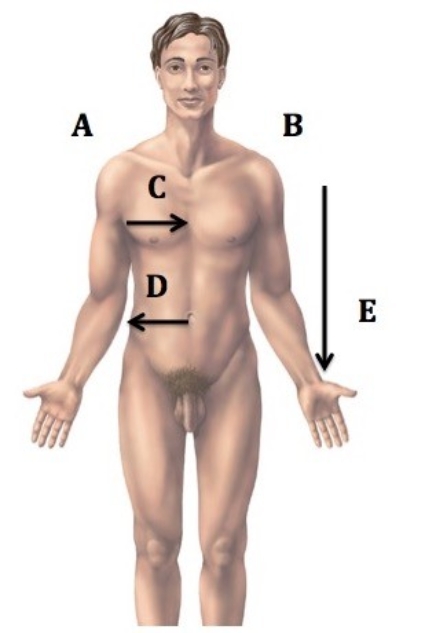 -Directional terms are important in the study of anatomy. What does "D" represent?
 (Multiple Choice)
4.8/5 (67)
(67) The thoracic cavity is divided into right and left parts by a median partition called the sternum.
(True/False)
4.8/5 (77)
(77) The plane that cuts the body lengthwise and separates the body into anterior and posterior portions is called ________.
(Multiple Choice)
4.8/5 (89)
(89) "Cutting off your nose" would be a section in the ________ plane.
(Multiple Choice)
4.8/5 (85)
(85) Many undergraduate anatomy programs study cats and rats in laboratory settings. Use of these animals is ideal because they are inexpensive, and although they are physically smaller, the internal structures are identical to humans.
(True/False)
4.8/5 (87)
(87) 
Filters
- Essay(0)
- Multiple Choice(0)
- Short Answer(0)
- True False(0)
- Matching(0)