



 Chat with AI
Exam 5: Capacity

Exam 1: Creating Customer Value128 Questions
Exam 2: Supply Chain Management170 Questions
Exam 3: Supply Chain Sustainability and Humanitarian Logistics132 Questions
Exam 4: Process Configuration132 Questions
Exam 5: Capacity143 Questions
Exam 6: Waiting Lines165 Questions
Exam 7: Inventory Management218 Questions
Exam 8: Quality and Process Improvement153 Questions
Exam 9: Lean Systems112 Questions
Exam 10: Location and Layout216 Questions
Exam 11: Managing Demand and Forecasting189 Questions
Exam 12: Operations Planning and Scheduling134 Questions
Exam 13: Resource Planning174 Questions
Select questions type


capacity plans focus on workforce size, overtime budgets, and inventories.
(Short Answer)
4.9/5  (83)
(83) A(n) ______ is an operation that has the lowest effective capacity of any operation in the process, and thus limits the system's output.
(Short Answer)
4.9/5 (75)
(75) ______ is the amount of reserve capacity that a firm maintains to handle a sudden increase in demand or temporary losses of production capacity.
(Short Answer)
4.9/5 (71)
(71) Table
The North Bend Manufacturing Company is producing two types of products, A and B. Demand forecasts for next year and other production- related information are provided in the following table:
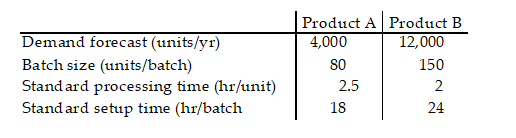 Both products A and B are produced at the same operation called MASAC.27A.
-Using the information in Table 5.3, what is the total number of hours required for MASAC27A equipment for the next year?
Both products A and B are produced at the same operation called MASAC.27A.
-Using the information in Table 5.3, what is the total number of hours required for MASAC27A equipment for the next year? (Multiple Choice)
4.9/5 (82)
(82) Table
The North Bend Manufacturing Company is producing two types of products, A and B. Demand forecasts for next year and other production- related information are provided in the following table:
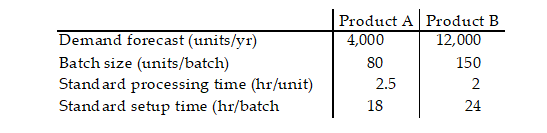 Both products A and B are produced at the same operation called MASAC.27A.
-Use the information in Table 5.3 to help answer this question. Additionally, the company works 250 days every year and operates 2 shifts, each of which covers 8 hours. If a 25 percent capacity cushion is maintained, how many machines does the company need next year to fully cover the demand?
Both products A and B are produced at the same operation called MASAC.27A.
-Use the information in Table 5.3 to help answer this question. Additionally, the company works 250 days every year and operates 2 shifts, each of which covers 8 hours. If a 25 percent capacity cushion is maintained, how many machines does the company need next year to fully cover the demand? (Multiple Choice)
4.8/5 (92)
(92) The higher that process variability is, the more expensive and difficult the process is to manage.
(True/False)
4.7/5 (85)
(85) Wait time is not part of the throughput time for a specific item as it moves through a process.
(True/False)
5.0/5 (88)
(88) ______ capacity is the maximum output that a process or facility can achieve under ideal conditions.
(Short Answer)
4.9/5 (83)
(83) Table
High Tech, Inc. is producing two types of products: A and B. Both are produced at the same sawing operation. Because of demand uncertainties, the operations manager obtained three demand forecasts (pessimistic, expected, and optimistic). The demand forecasts, batch sizes (units/batch), processing times (hr/unit), and setup times (hr/batch) follow.
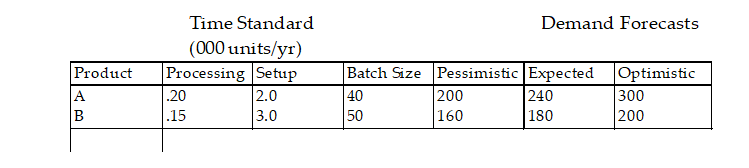 The sawing machines operate on two 8- hour shifts, 5 days per week, and 50 weeks per year. The manager wants to maintain a 10 percent capacity cushion.
-Using the information from Table 5.2, what is the minimum number of machines needed (assuming no reliance on short- term options)?
The sawing machines operate on two 8- hour shifts, 5 days per week, and 50 weeks per year. The manager wants to maintain a 10 percent capacity cushion.
-Using the information from Table 5.2, what is the minimum number of machines needed (assuming no reliance on short- term options)? (Multiple Choice)
4.8/5 (75)
(75) In a tire manufacturing plant, measuring capacity based on the number of tires produced per day is an example of an input measure of capacity.
(True/False)
4.8/5 (75)
(75) The theory of constraints is an approach to management that focuses on whatever impedes progress toward the goal of maximizing the flow of total value- added funds or sales less discounts and variable costs.
(True/False)
4.8/5 (81)
(81) What is the meaning of diseconomies of scale, and what are two ways for a firm to avoid them?
(Essay)
4.8/5 (81)
(81) Fixing time is the additional time needed to change over from one service or product to the next, which in turn increases the overload at the workstation being changed over.
(True/False)
4.8/5 (74)
(74) Identify the three interrelated factors that implicitly determine process choice. The text refers to these factors as the "Process Management Triangle."
(Essay)
5.0/5 (89)
(89) A bottleneck is an operation that has the lowest effective capacity of any operation in the process.
(True/False)
4.8/5 (71)
(71) In a dental office, measuring capacity based on the number of patients that receive service over a typical day is an example of an output measure of capacity.
(True/False)
4.7/5 (90)
(90) Explain the relationship between throughput time and the level of work- in- process (WIP) inventory in a production process.
(Essay)
4.9/5 (79)
(79) Define the following two terms: peak capacity and effective capacity.
(Essay)
4.8/5 (87)
(87) More complex waiting- line problems must be analyzed with simulation.
(True/False)
4.9/5 (83)
(83) 
Filters
- Essay(0)
- Multiple Choice(0)
- Short Answer(0)
- True False(0)
- Matching(0)