



 Chat with AI
Exam 5: Capacity

Exam 1: Creating Customer Value128 Questions
Exam 2: Supply Chain Management170 Questions
Exam 3: Supply Chain Sustainability and Humanitarian Logistics132 Questions
Exam 4: Process Configuration132 Questions
Exam 5: Capacity143 Questions
Exam 6: Waiting Lines165 Questions
Exam 7: Inventory Management218 Questions
Exam 8: Quality and Process Improvement153 Questions
Exam 9: Lean Systems112 Questions
Exam 10: Location and Layout216 Questions
Exam 11: Managing Demand and Forecasting189 Questions
Exam 12: Operations Planning and Scheduling134 Questions
Exam 13: Resource Planning174 Questions
Select questions type


Random variation is introduced by chance and results from small changes or differences in equipment operations, people's behaviour, or environmental conditions.
(True/False)
4.9/5  (83)
(83) Table 5.2
High Tech, Inc. is producing two types of products: A and B. Both are produced at the same sawing operation. Because of demand uncertainties, the operations manager obtained three demand forecasts (pessimistic, expected, and optimistic). The demand forecasts, batch sizes (units/batch), processing times (hr/unit), and setup times (hr/batch) follow.
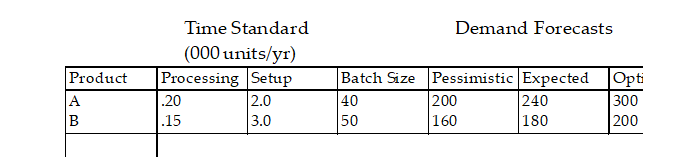 The sawing machines operate on two 8-hour shifts, 5 days per week, and 50 weeks per year. The manager wants to maintain a 10 percent capacity cushion.
-Using the information from Table 5.2, what is the maximum number of machines needed (assuming no reliance on short- term option)?
The sawing machines operate on two 8-hour shifts, 5 days per week, and 50 weeks per year. The manager wants to maintain a 10 percent capacity cushion.
-Using the information from Table 5.2, what is the maximum number of machines needed (assuming no reliance on short- term option)? (Multiple Choice)
4.8/5 (79)
(79) ______ is the degree to which equipment, space, or labor is currently being used.
(Short Answer)
4.8/5 (81)
(81) A decision tree is a schematic model of alternatives available to the decision maker, along with their possible consequences.
(True/False)
4.8/5 (76)
(76) Process Management Triangle is made up of capacity utilization, quality and variability.
(True/False)
4.7/5 (63)
(63) The first step in the application of the Theory of Constraints (TOC) is to identify the bottlenecks.
(True/False)
4.9/5 (70)
(70) In a manufacturing company, measuring capacity based on the number of machine- hours required to process a specific batch of production is an example of an output measure of capacity.
(True/False)
4.8/5 (77)
(77) An expansionist strategy in regard to capacity is best characterized by
(Multiple Choice)
4.9/5 (77)
(77) What factors should be considered when selecting the appropriate capacity cushion? How does the choice of capacity cushion relate to other decisions in operations management? To other functional areas?
(Essay)
4.9/5 (77)
(77) Which one of the following factors usually calls for a LARGER capacity cushion?
(Multiple Choice)
5.0/5 (81)
(81) Give four principal reasons why economies of scale can occur when output increases.
(Essay)
4.9/5 (69)
(69) The maximum output that can reasonably be sustained under normal conditions is the capacity cushion for a process.
(True/False)
4.9/5 (62)
(62) Many alternative strategies are available for the timing and sizing decision in capacity expansion. Which one of the following statements regarding these strategies is best?
(Multiple Choice)
4.9/5 (76)
(76) If a system is well balanced, which one of the following changes usually calls for a larger- capacity cushion?
(Multiple Choice)
4.9/5 (93)
(93) Musk L. Flexor owns a hot tub store that is experiencing significant growth. Flexor is trying to decide whether to expand its capacity, which currently is at $750,000 in sales per quarter. He is thinking about expanding to the $850,000 level. The before- tax profit from additional sales is 20 percent. Sales are seasonal, with peaks in the spring and summer quarters. Forecasts of capacity requirements, expressed in sales per quarter, for next year (year 2) are:
 Demand in year 3 and beyond is expected to exceed $850,000 per quarter. Flexor is considering expansion at the end of the fourth quarter of this year (year 1). How much would before- tax profits in year 2 increase because of this expansion?
 (Multiple Choice)
4.8/5 (86)
(86) Larry's Wickets, Inc. is producing two types of products: A and B. Both are produced at the same machining operation. Because of demand uncertainties, the operations manager obtained three demand forecasts (pessimistic, expected, and optimistic). The demand forecasts, batch sizes (units/batch), processing times (hr/unit), and setup times (hr/batch) follow. 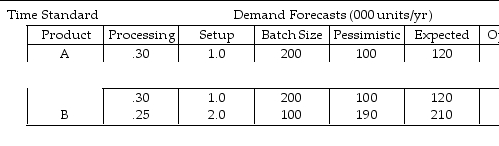 The machines operate on two 8- hour shifts, 5 days per week, and 50 weeks per year. The manager wants to maintain a 20 percent capacity cushion.
a. What is the minimum number of hours required of the machining equipment for the next year?
b. How many hours of capacity can the company expect from each machine?
c. What is the minimum number of machines needed (assuming no reliance on short- term options)?
d. What is the maximum number of machines needed (assuming no reliance on short- term options)?
The machines operate on two 8- hour shifts, 5 days per week, and 50 weeks per year. The manager wants to maintain a 20 percent capacity cushion.
a. What is the minimum number of hours required of the machining equipment for the next year?
b. How many hours of capacity can the company expect from each machine?
c. What is the minimum number of machines needed (assuming no reliance on short- term options)?
d. What is the maximum number of machines needed (assuming no reliance on short- term options)? (Essay)
4.8/5 (80)
(80) Table 5.2
High Tech, Inc. is producing two types of products: A and B. Both are produced at the same sawing operation. Because of demand uncertainties, the operations manager obtained three demand forecasts (pessimistic, expected, and optimistic). The demand forecasts, batch sizes (units/batch), processing times (hr/unit), and setup times (hr/batch) follow.
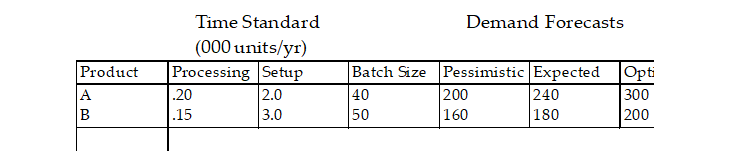 The sawing machines operate on two 8-hour shifts, 5 days per week, and 50 weeks per year. The manager wants to maintain a 10 percent capacity cushion.
-Using the information from Table 5.2, what is the minimum total number of hours required of sawing equipment for the next year?
The sawing machines operate on two 8-hour shifts, 5 days per week, and 50 weeks per year. The manager wants to maintain a 10 percent capacity cushion.
-Using the information from Table 5.2, what is the minimum total number of hours required of sawing equipment for the next year? (Multiple Choice)
5.0/5 (81)
(81) Diseconomies of scale refers to situations where the average cost per unit decreases as the facility's size increases.
(True/False)
4.8/5 (81)
(81) Which one of the following statements about capacity cushion is best?
(Multiple Choice)
4.9/5 (76)
(76) The ______ time for a specific item as it moves through a process can be found by adding the operations, movement and wait times.
(Short Answer)
4.8/5 (70)
(70) 
Filters
- Essay(0)
- Multiple Choice(0)
- Short Answer(0)
- True False(0)
- Matching(0)