



 Chat with AI
Exam 5: Capacity

Exam 1: Creating Customer Value128 Questions
Exam 2: Supply Chain Management170 Questions
Exam 3: Supply Chain Sustainability and Humanitarian Logistics132 Questions
Exam 4: Process Configuration132 Questions
Exam 5: Capacity143 Questions
Exam 6: Waiting Lines165 Questions
Exam 7: Inventory Management218 Questions
Exam 8: Quality and Process Improvement153 Questions
Exam 9: Lean Systems112 Questions
Exam 10: Location and Layout216 Questions
Exam 11: Managing Demand and Forecasting189 Questions
Exam 12: Operations Planning and Scheduling134 Questions
Exam 13: Resource Planning174 Questions
Select questions type


The throughput time for a specific item as it moves through a process includes
(Multiple Choice)
4.8/5  (81)
(81) Short- term capacity plans focus on workforce size, overtime budgets, and inventories.
(True/False)
4.8/5 (97)
(97) Decision trees can be useful for evaluation capacity expansion alternatives.
(True/False)
4.8/5 (92)
(92) Economies of scale is a concept that states that the average unit cost of a good or service will increase with increasing output rate.
(True/False)
4.7/5 (90)
(90) John Owen owns a drugstore that is experiencing significant growth. Owen is trying to decide whether to expand its capacity, which currently is $200,000 in sales per quarter. Sales are seasonal. Forecasts of capacity requirements, expressed in sales per quarter for the next year, follow.
 Owen is considering expanding capacity to the $250,000 level in sales per quarter. The before- tax profit margin from additional sales is 15 percent. How much would before- tax profits increase next year because of this expansion?
 (Multiple Choice)
4.8/5 (85)
(85) Effective capacity is the maximum output that a process or facility can achieve under ideal conditions.
(True/False)
4.8/5 (94)
(94) Which one of the following statements about capacity is best?
(Multiple Choice)
4.8/5 (71)
(71) Which one of the following factors usually motivates a SMALLER capacity cushion?
(Multiple Choice)
5.0/5 (83)
(83) Table 5.2
High Tech, Inc. is producing two types of products: A and B. Both are produced at the same sawing operation. Because of demand uncertainties, the operations manager obtained three demand forecasts (pessimistic, expected, and optimistic). The demand forecasts, batch sizes (units/batch), processing times (hr/unit), and setup times (hr/batch) follow.
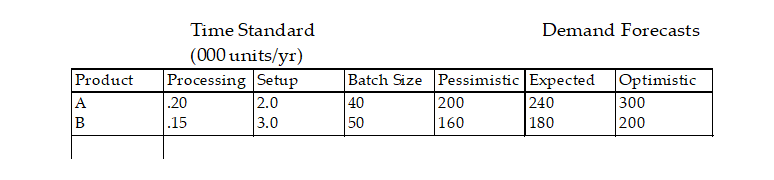 The sawing machines operate on two 8- hour shifts, 5 days per week, and 50 weeks per year. The manager wants to maintain a 10 percent capacity cushion.
-Using the information from Table 5.2, if the operation currently has 18 machines and the manager is willing to expand capacity by 20 percent through short- term options, what is the capacity gap (in terms of number of machines) if you assume the optimistic demand forecasts?
The sawing machines operate on two 8- hour shifts, 5 days per week, and 50 weeks per year. The manager wants to maintain a 10 percent capacity cushion.
-Using the information from Table 5.2, if the operation currently has 18 machines and the manager is willing to expand capacity by 20 percent through short- term options, what is the capacity gap (in terms of number of machines) if you assume the optimistic demand forecasts? (Multiple Choice)
4.8/5 (80)
(80) Define each of the following capacity strategies: expansionist, and wait- and- see.
(Essay)
4.9/5 (73)
(73) Provided each measure is expressed in the appropriate units, Little's Law provides a mathematical expression that states capacity utilization equals the ratio of work- in- process inventory divided by the output rate of a process.
(True/False)
4.9/5 (69)
(69) Sleep Tight Motel has the opportunity to purchase an adjacent plot of land. Building on this land would increase their capacity from the current sales level of $515,000/year to $600,000/year. Sleep Tight experiences a 20 percent before- tax profit margin. It wishes to estimate the additional before- tax profits that the expansion will produce. Using the following information, how much more before- tax cash flow would be realized just in the year 10 alone? Year Capacity Requirement (Annual Sales) 1 \ 515,000 2 \ 517,000 3 \ 520,000 4 \ 525,000 5 \ 540,000 6 \ 560,000 7 \ 565,000 8 \ 575,000 9 \ 600,000 \ 620,000 10
(Multiple Choice)
4.9/5 (83)
(83) Equipment breakdowns are an example of an internal, random form of variability.
(True/False)
4.8/5 (82)
(82) Mr. Grant is considering a capacity expansion for his store. The annual sales projected for the next five years follow. The current capacity is equivalent to $200,000 sales. Assume a 20 percent pretax profit margin. 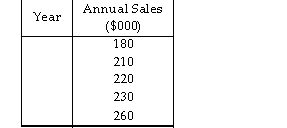 If Grant expands his capacity to $225,000 now, what would be the increase in his pretax cash flows for each of the next five years?
 (Essay)
4.8/5 (70)
(70) The maximum output that a process or facility can achieve under ideal conditions is referred to as the
(Multiple Choice)
4.8/5 (88)
(88) A company's production facility, consisting of two identical machines, currently caters only to product A. The annual demand for the product is 4000 units. Management has now decided to introduce another product, B, which uses the same facilities as that of product A. Product B has an annual demand of 2000 units. In view of the uncertainties involved in producing two products, management desires to have an overall 10 percent capacity cushion. Given the following additional information, how many more machines are required? (Assume 8 hours/shift, 2 shifts/day, 250 days/year, and that no overtime is allowed.) Product Processing Time perUnit (inhours) Setup Time per Batch (in hours) Batch Size (units) A 2.0 8 100 2.8 16 200
(Multiple Choice)
4.7/5 (97)
(97) Table
Mr. Lee is considering a capacity expansion for his supermarket. The annual sales projected for the next five years follow. The current capacity is equivalent to sales. Assume a 20 percent pretax profit margin.
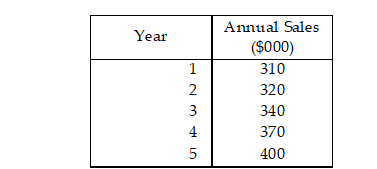 -Using the information in Table 5.4, if Lee expands the capacity to an equivalent of $360,000 sales now (year 0), and then expands the capacity to an equivalent of $400,000 sales at the beginning of year 4, how much would pretax cash flow increase in total for all years (years 1 through 5)?
 (Multiple Choice)
4.9/5 (83)
(83) Which one of the following statements explaining some aspect of economies of scale is best?
(Multiple Choice)
4.9/5 (88)
(88) 
Filters
- Essay(0)
- Multiple Choice(0)
- Short Answer(0)
- True False(0)
- Matching(0)