



 Chat with AI
Exam 1: Economics: Foundations and Models

Exam 1: Economics: Foundations and Models459 Questions
Exam 2: Trade-Offs, Comparative Advantage, and the Market System492 Questions
Exam 3: Where Prices Come From: the Interaction of Demand and Supply476 Questions
Exam 4: Economic Efficiency, Government Price Setting, and Taxes420 Questions
Exam 5: Externalities, Environmental Policy, and Public Goods262 Questions
Exam 6: Elasticity: the Responsiveness of Demand and Supply293 Questions
Exam 7: The Economics of Health Care337 Questions
Exam 8: Firms, the Stock Market, and Corporate Governance512 Questions
Exam 9: Comparative Advantage and the Gains From International Trade377 Questions
Exam 10: Consumer Choice and Behavioral Economics304 Questions
Exam 11: Technology, Production, and Costs326 Questions
Exam 12: Firms in Perfectly Competitive Markets296 Questions
Exam 13: Monopolistic Competition: the Competitive Model in a More Realistic Setting272 Questions
Exam 14: Oligopoly: Firms in Less Competitive Markets256 Questions
Exam 15: Monopoly and Antitrust Policy279 Questions
Exam 16: Pricing Strategy258 Questions
Exam 17: The Markets for Labor and Other Factors of Production279 Questions
Exam 18: Public Choice, Taxes, and the Distribution of Income258 Questions
Exam 19: Gdp: Measuring Total Production and Income260 Questions
Exam 20: Unemployment and Inflation290 Questions
Exam 21: Economic Growth, the Financial System, and Business Cycles251 Questions
Exam 22: Long-Run Economic Growth: Sources and Policies261 Questions
Exam 23: Aggregate Expenditure and Output in the Short Run305 Questions
Exam 24: Aggregate Demand and Aggregate Supply Analysis286 Questions
Exam 25: Money, Banks, and the Federal Reserve System278 Questions
Exam 26: Monetary Policy280 Questions
Exam 27: Fiscal Policy313 Questions
Exam 28: Inflation, Unemployment, and Federal Reserve Policy257 Questions
Exam 29: Macroeconomics in an Open Economy277 Questions
Exam 30: The International Financial System258 Questions
Select questions type


If a straight line passes through the point x = 12 and y = 4 and also through the point x = 4 and y = 8, the slope of this line is
(Multiple Choice)
4.8/5  (93)
(93) Very few businesses, and virtually no nonprofit organizations, hire economists.
(True/False)
4.7/5 (87)
(87) An office supply store sells a ream of printer paper at a fixed price of $4.50. Which of the following is a term used by economists to describe the money received from the sale of an additional ream of paper?
(Multiple Choice)
4.9/5 (75)
(75) The town of Harmonia gives away all 500 tickets to its annual Founder's Day Free Concert-in-the-Park to local residents. Each year, more than 500 people wish to attend the concert, so some of the residents who receive the free tickets sell them for as much as $75 each. Is a transaction where someone pays a resident $75 for a "free ticket" economically efficient?
(Multiple Choice)
4.9/5 (80)
(80) The Coffee Nook, a small cafe near campus, sells cappuccinos for $2.50 and Russian tea cakes for $1.00 each. What is the opportunity cost of buying a Russian tea cake?
(Multiple Choice)
4.7/5 (83)
(83) The prime minister of the tiny island nation of Wowza has proposed that the speed limit on its only highway be reduced by 10 miles per hour on Thursdays. Enacting this proposal would be optimal
(Multiple Choice)
4.8/5 (73)
(73) Examining the conditions that could lead to a recession in an economy is an example of a macroeconomic topic.
(True/False)
4.8/5 (80)
(80) Which of the following is an example of an activity undertaken by an entrepreneur?
(Multiple Choice)
4.8/5 (81)
(81) Allison's Auto Art is a company that applies pinstripes to vehicles. Allison's cost for a basic 1-color pinstriping job is $35, and she charges $95 for this service. For a total price of $175, Allison will apply a fancier 3-color pinstripe application to an automobile, a service that adds an additional $40 to the total cost of the package. What is the marginal cost of moving up from the 1-color application to the 3-color application?
(Multiple Choice)
4.9/5 (76)
(76) Table 1-4
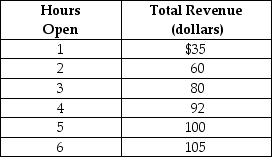 Eva runs a small bakery in the village of Roggerli. She is debating whether she should extend her hours of operation. Eva figures that her sales revenue will depend on the number of additional hours the bakery is open as shown in the table above. She would have to hire a worker for those hours at a wage rate of $12 per hour.
-Refer to Table 1-4. What is Eva's marginal benefit if she decides to stay open for two hours instead of one hour?
Eva runs a small bakery in the village of Roggerli. She is debating whether she should extend her hours of operation. Eva figures that her sales revenue will depend on the number of additional hours the bakery is open as shown in the table above. She would have to hire a worker for those hours at a wage rate of $12 per hour.
-Refer to Table 1-4. What is Eva's marginal benefit if she decides to stay open for two hours instead of one hour? (Multiple Choice)
4.9/5 (74)
(74) If the marginal cost for the state of Montana to increase the speed limit on its interstate highways to 100 mph is estimated to be $500 per day, then Montana should increase the speed limit to 100 mph
(Multiple Choice)
5.0/5 (82)
(82) Selling tickets to graduation ceremonies has long been a tradition among students at institutions that limit the number of guests. Suppose your classmate, Heidi, purchased two tickets for $40 each. Is this transaction economically efficient?
(Multiple Choice)
4.8/5 (74)
(74) In the market for factors of production, firms earn income by selling goods and services to households.
(True/False)
4.8/5 (66)
(66) Jewelry manufacturers produce a range of products such as rings, necklaces, bracelets, and brooches. What fundamental economic question are they addressing by offering this range of items?
(Multiple Choice)
4.7/5 (81)
(81) Table 1-6
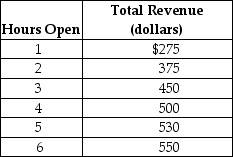 Ivan runs a custom jewelry shop in Sparkle City. He is debating whether he should extend his hours of operation. Ivan figures that his sales revenue will depend on the number of additional hours the jewelry shop is open as shown in the table above. He would have to hire a worker for those hours at a wage rate of $25 per hour.
-Refer to Table 1-6. Using marginal analysis, how many hours should Ivan extend his hours of operations?
Ivan runs a custom jewelry shop in Sparkle City. He is debating whether he should extend his hours of operation. Ivan figures that his sales revenue will depend on the number of additional hours the jewelry shop is open as shown in the table above. He would have to hire a worker for those hours at a wage rate of $25 per hour.
-Refer to Table 1-6. Using marginal analysis, how many hours should Ivan extend his hours of operations? (Multiple Choice)
4.8/5 (79)
(79) 
Filters
- Essay(0)
- Multiple Choice(0)
- Short Answer(0)
- True False(0)
- Matching(0)