



 Chat with AI
Exam 1: Economics: Foundations and Models

Exam 1: Economics: Foundations and Models459 Questions
Exam 2: Trade-Offs, Comparative Advantage, and the Market System492 Questions
Exam 3: Where Prices Come From: the Interaction of Demand and Supply476 Questions
Exam 4: Economic Efficiency, Government Price Setting, and Taxes420 Questions
Exam 5: Externalities, Environmental Policy, and Public Goods262 Questions
Exam 6: Elasticity: the Responsiveness of Demand and Supply293 Questions
Exam 7: The Economics of Health Care337 Questions
Exam 8: Firms, the Stock Market, and Corporate Governance512 Questions
Exam 9: Comparative Advantage and the Gains From International Trade377 Questions
Exam 10: Consumer Choice and Behavioral Economics304 Questions
Exam 11: Technology, Production, and Costs326 Questions
Exam 12: Firms in Perfectly Competitive Markets296 Questions
Exam 13: Monopolistic Competition: the Competitive Model in a More Realistic Setting272 Questions
Exam 14: Oligopoly: Firms in Less Competitive Markets256 Questions
Exam 15: Monopoly and Antitrust Policy279 Questions
Exam 16: Pricing Strategy258 Questions
Exam 17: The Markets for Labor and Other Factors of Production279 Questions
Exam 18: Public Choice, Taxes, and the Distribution of Income258 Questions
Exam 19: Gdp: Measuring Total Production and Income260 Questions
Exam 20: Unemployment and Inflation290 Questions
Exam 21: Economic Growth, the Financial System, and Business Cycles251 Questions
Exam 22: Long-Run Economic Growth: Sources and Policies261 Questions
Exam 23: Aggregate Expenditure and Output in the Short Run305 Questions
Exam 24: Aggregate Demand and Aggregate Supply Analysis286 Questions
Exam 25: Money, Banks, and the Federal Reserve System278 Questions
Exam 26: Monetary Policy280 Questions
Exam 27: Fiscal Policy313 Questions
Exam 28: Inflation, Unemployment, and Federal Reserve Policy257 Questions
Exam 29: Macroeconomics in an Open Economy277 Questions
Exam 30: The International Financial System258 Questions
Select questions type


Scenario 1-4
Suppose a cigar manufacturer currently sells 1,500 cigars per week and makes a profit of $3,000 per week. The plant foreman observes, "Although the last 500 cigars we produced and sold increased our revenue by $7,500 and our costs by $7,000, we are only making an overall profit of $3,000 per week so I think we need to cut back on production
-Refer to Scenario 1-4. Using marginal analysis terminology, what is another economic term for the incremental cost of producing the last 500 cigars?
(Multiple Choice)
4.9/5  (80)
(80) The Coffee Nook, a small cafe near campus, sells cappuccinos for $2.50 and Russian tea cakes for $1.00 each. What is the opportunity cost of buying a cappuccino?
(Multiple Choice)
4.9/5 (82)
(82) The sales revenue a seller receives from the sale of an additional unit of goods is called the marginal cost.
(True/False)
4.8/5 (68)
(68) Table 1-1
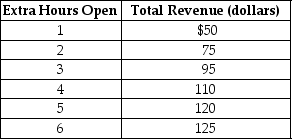 Lydia runs a small nail salon in the town of New Hope. She is debating whether she should extend her hours of operation. Lydia figures that her sales revenue will depend on the number of extra hours the nail salon is open as shown in the table above. She would have to hire a worker for those extra hours at a wage rate of $10 per hour.
-Refer to Table 1-1. Using marginal analysis, by how many hours should Lydia extend her nail salon's hours of operations?
Lydia runs a small nail salon in the town of New Hope. She is debating whether she should extend her hours of operation. Lydia figures that her sales revenue will depend on the number of extra hours the nail salon is open as shown in the table above. She would have to hire a worker for those extra hours at a wage rate of $10 per hour.
-Refer to Table 1-1. Using marginal analysis, by how many hours should Lydia extend her nail salon's hours of operations? (Multiple Choice)
4.9/5 (88)
(88) Suppose when the price of laptops fall, college students buy more laptops. This implies that
(Multiple Choice)
4.8/5 (80)
(80) How can the influence of a third variable be shown on a two-dimensional graph?
(Multiple Choice)
4.7/5 (78)
(78) A grocery store sells a bag of potatoes at a fixed price of $2.30. Which of the following is a term used by economists to describe the money received from the sale of an additional bag of potatoes?
(Multiple Choice)
4.8/5 (75)
(75) The economic analysis of minimum wage involves both normative and positive analysis. Consider the following consequences of a minimum wage:
a. The minimum wage law causes unemployment.
b. A minimum wage law benefits some groups and hurts others.
c. In some cities such as San Francisco and New York, it would be impossible for low-skilled workers to live comfortably in the city without minimum wage laws.
d. The gains to winners of a minimum wage law should be valued more highly than the losses to losers because the latter primarily comprises businesses.
Which of the consequences above are positive statements and which are normative statements?
(Multiple Choice)
4.9/5 (84)
(84) The three fundamental questions that any economy must address are:
(Multiple Choice)
4.7/5 (81)
(81) Consider the following statements:
a. Consumers buy more MP3 players from an electronics store that sells MP3 players at a lower price than other rival electronics stores in the area.
b. Schools take steps to increase security since they believe it is more costly to allow vandalism than to hire additional security guards.
c. Citrus growers produce more oranges when the selling price of oranges falls.
Which of the above statements demonstrates that economic agents respond to incentives?
(Multiple Choice)
4.9/5 (84)
(84) If it costs Danitra $225 to create 4 necklaces and $275 to create 5 necklaces, then the marginal cost of producing the 5th necklace is $50.
(True/False)
4.8/5 (72)
(72) 
Filters
- Essay(0)
- Multiple Choice(0)
- Short Answer(0)
- True False(0)
- Matching(0)