



 Chat with AI
Exam 1: Economics: Foundations and Models

Exam 1: Economics: Foundations and Models459 Questions
Exam 2: Trade-Offs, Comparative Advantage, and the Market System492 Questions
Exam 3: Where Prices Come From: the Interaction of Demand and Supply476 Questions
Exam 4: Economic Efficiency, Government Price Setting, and Taxes420 Questions
Exam 5: Externalities, Environmental Policy, and Public Goods262 Questions
Exam 6: Elasticity: the Responsiveness of Demand and Supply293 Questions
Exam 7: The Economics of Health Care337 Questions
Exam 8: Firms, the Stock Market, and Corporate Governance512 Questions
Exam 9: Comparative Advantage and the Gains From International Trade377 Questions
Exam 10: Consumer Choice and Behavioral Economics304 Questions
Exam 11: Technology, Production, and Costs326 Questions
Exam 12: Firms in Perfectly Competitive Markets296 Questions
Exam 13: Monopolistic Competition: the Competitive Model in a More Realistic Setting272 Questions
Exam 14: Oligopoly: Firms in Less Competitive Markets256 Questions
Exam 15: Monopoly and Antitrust Policy279 Questions
Exam 16: Pricing Strategy258 Questions
Exam 17: The Markets for Labor and Other Factors of Production279 Questions
Exam 18: Public Choice, Taxes, and the Distribution of Income258 Questions
Exam 19: Gdp: Measuring Total Production and Income260 Questions
Exam 20: Unemployment and Inflation290 Questions
Exam 21: Economic Growth, the Financial System, and Business Cycles251 Questions
Exam 22: Long-Run Economic Growth: Sources and Policies261 Questions
Exam 23: Aggregate Expenditure and Output in the Short Run305 Questions
Exam 24: Aggregate Demand and Aggregate Supply Analysis286 Questions
Exam 25: Money, Banks, and the Federal Reserve System278 Questions
Exam 26: Monetary Policy280 Questions
Exam 27: Fiscal Policy313 Questions
Exam 28: Inflation, Unemployment, and Federal Reserve Policy257 Questions
Exam 29: Macroeconomics in an Open Economy277 Questions
Exam 30: The International Financial System258 Questions
Select questions type


When production reflects consumer preferences, ________ occurs.
(Multiple Choice)
4.8/5  (74)
(74) Table 1-8
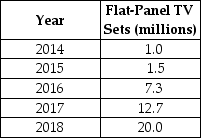 -Refer to Table 1-8. The table above shows the sales of flat-panel television sets in Central America. Present the information using a bar graph.
 (Essay)
4.9/5 (82)
(82) When voluntary exchange takes place, both parties gain from the exchange.
(True/False)
4.9/5 (88)
(88) "The distribution of income should be left to the market" is an example of a positive economic statement.
(True/False)
4.9/5 (79)
(79) The term "market" refers only to trading arrangements that have been approved by the government.
(True/False)
4.9/5 (82)
(82) Which of the following is not an example of an efficiency-equity trade-off faced by economic agents?
(Multiple Choice)
4.8/5 (73)
(73) If the price of milk was $1.25 a gallon and it is now $2.25 a gallon, what is the percentage change in price?
(Multiple Choice)
4.9/5 (84)
(84) The highest-valued alternative that must be given up to engage in an activity is the definition of
(Multiple Choice)
4.8/5 (93)
(93) Figure 1.1  -Refer to Figure 1-1. Using the information in the figure above, calculate the percentage change in revenue from alcoholic beverage sales between 2012 and 2016.
 (Multiple Choice)
4.8/5 (79)
(79) The revenue received from the sale of ________ of a product is a marginal benefit to the firm.
(Multiple Choice)
4.9/5 (78)
(78) Holding all other personal characteristics-such as age, gender, and income-constant, economists would expect that
(Multiple Choice)
4.7/5 (72)
(72) The government makes all economic decisions in a centrally planned economy.
(True/False)
4.9/5 (71)
(71) What is an economic variable? Give an example of an economic variable.
(Essay)
4.8/5 (72)
(72) The U.S. Bureau of Labor Statistics forecasts that by 2024, total employment in U.S. manufacturing will
(Multiple Choice)
4.8/5 (76)
(76) In economics, the accumulated skills and training that workers have is known as
(Multiple Choice)
4.9/5 (77)
(77) 
Filters
- Essay(0)
- Multiple Choice(0)
- Short Answer(0)
- True False(0)
- Matching(0)