



 Chat with AI
Exam 1: Economics: Foundations and Models

Exam 1: Economics: Foundations and Models459 Questions
Exam 2: Trade-Offs, Comparative Advantage, and the Market System492 Questions
Exam 3: Where Prices Come From: the Interaction of Demand and Supply476 Questions
Exam 4: Economic Efficiency, Government Price Setting, and Taxes420 Questions
Exam 5: Externalities, Environmental Policy, and Public Goods262 Questions
Exam 6: Elasticity: the Responsiveness of Demand and Supply293 Questions
Exam 7: The Economics of Health Care337 Questions
Exam 8: Firms, the Stock Market, and Corporate Governance512 Questions
Exam 9: Comparative Advantage and the Gains From International Trade377 Questions
Exam 10: Consumer Choice and Behavioral Economics304 Questions
Exam 11: Technology, Production, and Costs326 Questions
Exam 12: Firms in Perfectly Competitive Markets296 Questions
Exam 13: Monopolistic Competition: the Competitive Model in a More Realistic Setting272 Questions
Exam 14: Oligopoly: Firms in Less Competitive Markets256 Questions
Exam 15: Monopoly and Antitrust Policy279 Questions
Exam 16: Pricing Strategy258 Questions
Exam 17: The Markets for Labor and Other Factors of Production279 Questions
Exam 18: Public Choice, Taxes, and the Distribution of Income258 Questions
Exam 19: Gdp: Measuring Total Production and Income260 Questions
Exam 20: Unemployment and Inflation290 Questions
Exam 21: Economic Growth, the Financial System, and Business Cycles251 Questions
Exam 22: Long-Run Economic Growth: Sources and Policies261 Questions
Exam 23: Aggregate Expenditure and Output in the Short Run305 Questions
Exam 24: Aggregate Demand and Aggregate Supply Analysis286 Questions
Exam 25: Money, Banks, and the Federal Reserve System278 Questions
Exam 26: Monetary Policy280 Questions
Exam 27: Fiscal Policy313 Questions
Exam 28: Inflation, Unemployment, and Federal Reserve Policy257 Questions
Exam 29: Macroeconomics in an Open Economy277 Questions
Exam 30: The International Financial System258 Questions
Select questions type


DeShawn's Detailing is a service that details cars at the customers' homes or places of work. DeShawn's cost for a basic detailing package is $40, and he charges $75 for this service. For a total price of $90, DeShawn will also detail the car's engine, a service that adds an additional $20 to the total cost of the package. What is DeShawn's marginal benefit if he sells a basic detailing package?
(Multiple Choice)
4.9/5  (81)
(81) All of the following questions or statements regarding tariffs are positive statements except:
(Multiple Choice)
4.8/5 (73)
(73) "An increase in the price of gasoline will increase the demand for hybrid vehicles." This statement is an example of a positive economic statement.
(True/False)
4.9/5 (83)
(83) According to the Centers for Disease Control and Prevention, ________ in 2015 in which less than 20 percent of the population was considered obese.
(Multiple Choice)
4.7/5 (66)
(66) Suppose that to increase sales of hybrid vehicles, auto manufacturers are offering large cash incentives. This is an example of a macroeconomic topic.
(True/False)
4.7/5 (85)
(85) Cassie's Quilts alters, reconstructs, and restores heirloom quilts. Cassie has just spent $800 purchasing, cleaning, and reconstructing an antique quilt which she expects to sell for $1,500 once she is finished. After having spent $800, Cassie discovers that she would need some special period fabric that would cost her $200 in material and time in order to complete the task. Alternatively, she can sell the quilt "as is" now for $900. What is the marginal cost of completing the task?
(Multiple Choice)
4.7/5 (84)
(84) The revenue received from the sale of an additional unit of a product
(Multiple Choice)
5.0/5 (95)
(95) In market economies, income distribution is always going to be completely equitable.
(True/False)
4.9/5 (84)
(84) Scenario 1-4
Suppose a cigar manufacturer currently sells 1,500 cigars per week and makes a profit of $3,000 per week. The plant foreman observes, "Although the last 500 cigars we produced and sold increased our revenue by $7,500 and our costs by $7,000, we are only making an overall profit of $3,000 per week so I think we need to cut back on production
-Refer to Scenario 1-4. Had the firm not produced and sold the last 500 cigars, would its profit be higher or lower, and if so by how much?
(Multiple Choice)
4.9/5 (85)
(85) How are the fundamental economic decisions determined in Canada?
(Multiple Choice)
4.8/5 (87)
(87) When goods and services are produced at the lowest possible cost, ________ occurs.
(Multiple Choice)
4.8/5 (81)
(81) In the market for factors of production, firms earn income by selling factors of production to households.
(True/False)
4.8/5 (78)
(78) Table 1-4
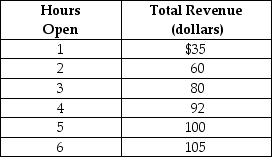 Eva runs a small bakery in the village of Roggerli. She is debating whether she should extend her hours of operation. Eva figures that her sales revenue will depend on the number of additional hours the bakery is open as shown in the table above. She would have to hire a worker for those hours at a wage rate of $12 per hour.
-Refer to Table 1-4. What is Eva's marginal cost if she decides to stay open for two hours instead of one hour?
Eva runs a small bakery in the village of Roggerli. She is debating whether she should extend her hours of operation. Eva figures that her sales revenue will depend on the number of additional hours the bakery is open as shown in the table above. She would have to hire a worker for those hours at a wage rate of $12 per hour.
-Refer to Table 1-4. What is Eva's marginal cost if she decides to stay open for two hours instead of one hour? (Multiple Choice)
4.8/5 (91)
(91) Pookie's Pinball Palace restores old Pinball machines. Pookie has just spent $300 purchasing and cleaning a 1960s-era machine which he expects to sell for $2,000 once he is finished with the restoration. After having spent $300, Pookie discovers that he will need to rewire the entire machine at a cost of $1,100 in order to finish the restoration. Alternatively, he can sell the machine "as is" now for $1,000. What is his marginal benefit if he sells the machine "as is" now?
(Multiple Choice)
5.0/5 (78)
(78) Suppose the U.S. government encouraged new medical school graduates to take over existing practices from doctors wishing to retire by paying both the new and retiring doctors $100,000. These doctors would be exemplifying the economic idea that
(Multiple Choice)
4.9/5 (90)
(90) 
Filters
- Essay(0)
- Multiple Choice(0)
- Short Answer(0)
- True False(0)
- Matching(0)