



 Chat with AI
Exam 1: Economics: Foundations and Models

Exam 1: Economics: Foundations and Models459 Questions
Exam 2: Trade-Offs, Comparative Advantage, and the Market System492 Questions
Exam 3: Where Prices Come From: the Interaction of Demand and Supply476 Questions
Exam 4: Economic Efficiency, Government Price Setting, and Taxes420 Questions
Exam 5: Externalities, Environmental Policy, and Public Goods262 Questions
Exam 6: Elasticity: the Responsiveness of Demand and Supply293 Questions
Exam 7: The Economics of Health Care337 Questions
Exam 8: Firms, the Stock Market, and Corporate Governance512 Questions
Exam 9: Comparative Advantage and the Gains From International Trade377 Questions
Exam 10: Consumer Choice and Behavioral Economics304 Questions
Exam 11: Technology, Production, and Costs326 Questions
Exam 12: Firms in Perfectly Competitive Markets296 Questions
Exam 13: Monopolistic Competition: the Competitive Model in a More Realistic Setting272 Questions
Exam 14: Oligopoly: Firms in Less Competitive Markets256 Questions
Exam 15: Monopoly and Antitrust Policy279 Questions
Exam 16: Pricing Strategy258 Questions
Exam 17: The Markets for Labor and Other Factors of Production279 Questions
Exam 18: Public Choice, Taxes, and the Distribution of Income258 Questions
Exam 19: Gdp: Measuring Total Production and Income260 Questions
Exam 20: Unemployment and Inflation290 Questions
Exam 21: Economic Growth, the Financial System, and Business Cycles251 Questions
Exam 22: Long-Run Economic Growth: Sources and Policies261 Questions
Exam 23: Aggregate Expenditure and Output in the Short Run305 Questions
Exam 24: Aggregate Demand and Aggregate Supply Analysis286 Questions
Exam 25: Money, Banks, and the Federal Reserve System278 Questions
Exam 26: Monetary Policy280 Questions
Exam 27: Fiscal Policy313 Questions
Exam 28: Inflation, Unemployment, and Federal Reserve Policy257 Questions
Exam 29: Macroeconomics in an Open Economy277 Questions
Exam 30: The International Financial System258 Questions
Select questions type


Figure 1-6 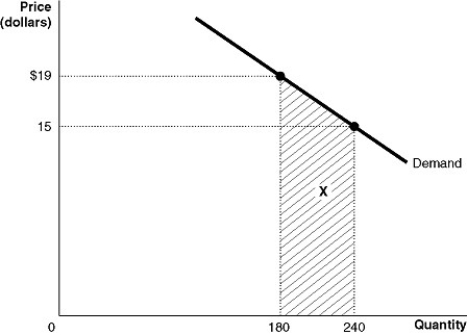 -Refer to Figure 1-6. Calculate the area of the trapezoid X.
 (Multiple Choice)
4.8/5  (83)
(83) Automobile manufacturers produce a range of automobiles such as sports utility vehicles, luxury sedans, pickup trucks, and compact cars. What fundamental economic question are they addressing by making this range of products?
(Multiple Choice)
4.7/5 (83)
(83) Of the following examples, which would most likely be performed by an economist working for the Federal Reserve Bank of San Francisco?
(Multiple Choice)
4.8/5 (71)
(71) Assume that an additional $50,000 in benefits will be received each year if a town hires an additional police officer whose only job would be to catch drivers who drive over the speed limit on its only street. What must the additional cost of this additional police officer be to make this hiring economically rational?
(Essay)
4.9/5 (87)
(87) Table 1-2
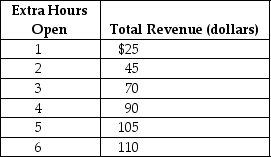 Thuy Anh runs a small flower shop in the town of Florabunda. She is debating whether she should extend her hours of operation. Thuy Anh figures that her sales revenue will depend on the number of extra hours the flower shop is open as shown in the table above. She would have to hire a worker for those extra hours at a wage rate of $16 per hour.
-Refer to Table 1-2. What is Thuy Anh's marginal cost if she decides to stay open for an extra three hours instead of two hours?
Thuy Anh runs a small flower shop in the town of Florabunda. She is debating whether she should extend her hours of operation. Thuy Anh figures that her sales revenue will depend on the number of extra hours the flower shop is open as shown in the table above. She would have to hire a worker for those extra hours at a wage rate of $16 per hour.
-Refer to Table 1-2. What is Thuy Anh's marginal cost if she decides to stay open for an extra three hours instead of two hours? (Multiple Choice)
4.8/5 (93)
(93) Holding all other personal characteristics-such as age, gender, and income-constant, economists would expect that
(Multiple Choice)
4.9/5 (79)
(79) Arlene quits her $125,000-a-year job to take care of her ailing parents. What is the opportunity cost of her decision?
(Multiple Choice)
4.9/5 (89)
(89) Ford assembles some cars in Mexico because the lower wages the company pays to Mexican workers and the lower prices it pays for auto parts in Mexico reduces Ford's costs. This is an example of Ford reacting to which of the three key economic ideas?
(Multiple Choice)
4.9/5 (76)
(76) What is a household? How do households interact with firms in a market?
(Essay)
4.9/5 (76)
(76) The prevalence of Alzheimer's dementia is very high among residents living in nursing homes. A student concludes that it is likely that living in a nursing home causes Alzheimer's dementia. What is the flaw in the student's reasoning?
(Multiple Choice)
4.8/5 (82)
(82) The basic economic problem of ________ has always existed and will continue to exist.
(Multiple Choice)
4.7/5 (84)
(84) Suppose that to move more people off the wait list for organ donations, surgeons and hospitals are developing a market for organ swapping. This is an example of a macroeconomic topic.
(True/False)
5.0/5 (83)
(83) ________ involves undertaking an activity until its marginal benefits equal marginal costs.
(Multiple Choice)
4.9/5 (86)
(86) Scenario 1-2
Suppose a hat manufacturer currently sells 2,000 hats per week and makes a profit of $5,000 per week. The plant owner observes, "Although the last 300 hats we produced and sold increased our revenue by $1,000 and our costs by $1,100, we are still making an overall profit of $5,000 per week so I think we're on the right track. We are producing the optimal number of hats."
-Refer to Scenario 1-2. Using marginal analysis terminology, another economic term for the incremental cost of producing the last 300 hats is
(Multiple Choice)
4.8/5 (76)
(76) When voluntary exchange takes place, neither party gains from the exchange.
(True/False)
4.8/5 (73)
(73) 
Filters
- Essay(0)
- Multiple Choice(0)
- Short Answer(0)
- True False(0)
- Matching(0)