



 Chat with AI
Exam 15: Monopoly and Antitrust Policy

Exam 1: Economics: Foundations and Models459 Questions
Exam 2: Trade-Offs, Comparative Advantage, and the Market System492 Questions
Exam 3: Where Prices Come From: the Interaction of Demand and Supply476 Questions
Exam 4: Economic Efficiency, Government Price Setting, and Taxes420 Questions
Exam 5: Externalities, Environmental Policy, and Public Goods262 Questions
Exam 6: Elasticity: the Responsiveness of Demand and Supply293 Questions
Exam 7: The Economics of Health Care337 Questions
Exam 8: Firms, the Stock Market, and Corporate Governance512 Questions
Exam 9: Comparative Advantage and the Gains From International Trade377 Questions
Exam 10: Consumer Choice and Behavioral Economics304 Questions
Exam 11: Technology, Production, and Costs326 Questions
Exam 12: Firms in Perfectly Competitive Markets296 Questions
Exam 13: Monopolistic Competition: the Competitive Model in a More Realistic Setting272 Questions
Exam 14: Oligopoly: Firms in Less Competitive Markets256 Questions
Exam 15: Monopoly and Antitrust Policy279 Questions
Exam 16: Pricing Strategy258 Questions
Exam 17: The Markets for Labor and Other Factors of Production279 Questions
Exam 18: Public Choice, Taxes, and the Distribution of Income258 Questions
Exam 19: Gdp: Measuring Total Production and Income260 Questions
Exam 20: Unemployment and Inflation290 Questions
Exam 21: Economic Growth, the Financial System, and Business Cycles251 Questions
Exam 22: Long-Run Economic Growth: Sources and Policies261 Questions
Exam 23: Aggregate Expenditure and Output in the Short Run305 Questions
Exam 24: Aggregate Demand and Aggregate Supply Analysis286 Questions
Exam 25: Money, Banks, and the Federal Reserve System278 Questions
Exam 26: Monetary Policy280 Questions
Exam 27: Fiscal Policy313 Questions
Exam 28: Inflation, Unemployment, and Federal Reserve Policy257 Questions
Exam 29: Macroeconomics in an Open Economy277 Questions
Exam 30: The International Financial System258 Questions
Select questions type


In 1935, the U.S. Patent and Trademark Office issued Parker Brothers a trademark on the use of the name Monopoly for a board game. Hasbro bought Parker Brothers in 1991. Which of the following statements is true regarding the trademark on the name Monopoly for a board game?
(Multiple Choice)
4.9/5  (78)
(78) Figure 15-2  Figure 15-2 above shows the demand and cost curves facing a monopolist.
-Refer to Figure 15-2. To maximize profit, the firm will produce at output level
Figure 15-2 above shows the demand and cost curves facing a monopolist.
-Refer to Figure 15-2. To maximize profit, the firm will produce at output level (Multiple Choice)
4.9/5 (89)
(89) A monopoly is a firm that is the only seller of a good or service that does not have a close substitute.
(True/False)
4.9/5 (78)
(78) Table 15-4
 Shakti Inc. has been granted a patent for its Arnica toothache balm. Table 15-4 shows the demand and the total cost schedule for the firm.
-Refer to Table 15-4. What is Shakti's profit-maximizing output?
Shakti Inc. has been granted a patent for its Arnica toothache balm. Table 15-4 shows the demand and the total cost schedule for the firm.
-Refer to Table 15-4. What is Shakti's profit-maximizing output? (Multiple Choice)
4.9/5 (86)
(86) Figure 15-12  Figure 15-12 shows the cost and demand curves for a monopolist.
-Refer to Figure 15-12. If this industry was organized as a perfectly competitive industry, the market output and market price would be
Figure 15-12 shows the cost and demand curves for a monopolist.
-Refer to Figure 15-12. If this industry was organized as a perfectly competitive industry, the market output and market price would be (Multiple Choice)
4.9/5 (76)
(76) A possible advantage of a horizontal merger for the economy is that
(Multiple Choice)
4.9/5 (85)
(85) Holding everything else constant, government approval of horizontal mergers is more likely to be granted if the "market" that firms are in are broadly defined rather than narrowly defined.
(True/False)
4.8/5 (81)
(81) Explain why market power leads to a deadweight loss. Is the total deadweight loss from market power in the United States large or small?
(Essay)
4.9/5 (71)
(71) Some economists believe that the economy benefits from firms having market power. Which of the following is an argument that has been made to support this position?
(Multiple Choice)
4.8/5 (85)
(85) When a proposed merger between two companies is reviewed by the government, the relevant market is defined by
(Multiple Choice)
4.8/5 (89)
(89) Figure 15-2 Figure 15-2 above shows the demand and cost curves facing a monopolist.
-Refer to Figure 15-2. The firm's profit-maximizing price is
Figure 15-2 above shows the demand and cost curves facing a monopolist.
-Refer to Figure 15-2. The firm's profit-maximizing price is (Multiple Choice)
4.8/5 (85)
(85) Suppose that a perfectly competitive industry becomes a monopoly. What effect will this have on consumer surplus, producer surplus, and deadweight loss?
(Essay)
4.9/5 (91)
(91) A natural monopoly is characterized by large fixed costs relative to variable costs.
(True/False)
4.9/5 (90)
(90) If a firm is a natural monopoly, competition from other firms cannot be counted on to force price down to the level where the company earns zero economic profit. How are prices usually set in natural monopoly markets in the United States?
(Multiple Choice)
4.9/5 (86)
(86) Table 15-2
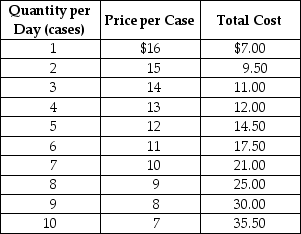 The government of a small developing country has granted exclusive rights to Linden Enterprises for the production of plastic syringes. Table 15-2 shows the cost and demand data for this government-protected monopolist.
-Refer to Table 15-2. What is the profit-maximizing quantity and price for the monopolist?
The government of a small developing country has granted exclusive rights to Linden Enterprises for the production of plastic syringes. Table 15-2 shows the cost and demand data for this government-protected monopolist.
-Refer to Table 15-2. What is the profit-maximizing quantity and price for the monopolist? (Multiple Choice)
4.9/5 (87)
(87) Research has shown that most economic profits from selling a prescription drug are eliminated 20 years after the drug is first offered for sale. The main reason for the elimination of profits is
(Multiple Choice)
4.9/5 (69)
(69) Because a monopoly's demand curve is the same as the market demand curve for its product
(Multiple Choice)
4.9/5 (70)
(70) "Being the only seller in the market, the monopolist can choose any price and quantity it desires." Evaluate this statement: Is it true or false? Explain your answer.
(Essay)
4.7/5 (95)
(95) 
Filters
- Essay(0)
- Multiple Choice(0)
- Short Answer(0)
- True False(0)
- Matching(0)