



 Chat with AI
Exam 15: Monopoly and Antitrust Policy

Exam 1: Economics: Foundations and Models459 Questions
Exam 2: Trade-Offs, Comparative Advantage, and the Market System492 Questions
Exam 3: Where Prices Come From: the Interaction of Demand and Supply476 Questions
Exam 4: Economic Efficiency, Government Price Setting, and Taxes420 Questions
Exam 5: Externalities, Environmental Policy, and Public Goods262 Questions
Exam 6: Elasticity: the Responsiveness of Demand and Supply293 Questions
Exam 7: The Economics of Health Care337 Questions
Exam 8: Firms, the Stock Market, and Corporate Governance512 Questions
Exam 9: Comparative Advantage and the Gains From International Trade377 Questions
Exam 10: Consumer Choice and Behavioral Economics304 Questions
Exam 11: Technology, Production, and Costs326 Questions
Exam 12: Firms in Perfectly Competitive Markets296 Questions
Exam 13: Monopolistic Competition: the Competitive Model in a More Realistic Setting272 Questions
Exam 14: Oligopoly: Firms in Less Competitive Markets256 Questions
Exam 15: Monopoly and Antitrust Policy279 Questions
Exam 16: Pricing Strategy258 Questions
Exam 17: The Markets for Labor and Other Factors of Production279 Questions
Exam 18: Public Choice, Taxes, and the Distribution of Income258 Questions
Exam 19: Gdp: Measuring Total Production and Income260 Questions
Exam 20: Unemployment and Inflation290 Questions
Exam 21: Economic Growth, the Financial System, and Business Cycles251 Questions
Exam 22: Long-Run Economic Growth: Sources and Policies261 Questions
Exam 23: Aggregate Expenditure and Output in the Short Run305 Questions
Exam 24: Aggregate Demand and Aggregate Supply Analysis286 Questions
Exam 25: Money, Banks, and the Federal Reserve System278 Questions
Exam 26: Monetary Policy280 Questions
Exam 27: Fiscal Policy313 Questions
Exam 28: Inflation, Unemployment, and Federal Reserve Policy257 Questions
Exam 29: Macroeconomics in an Open Economy277 Questions
Exam 30: The International Financial System258 Questions
Select questions type


Figure 15-19 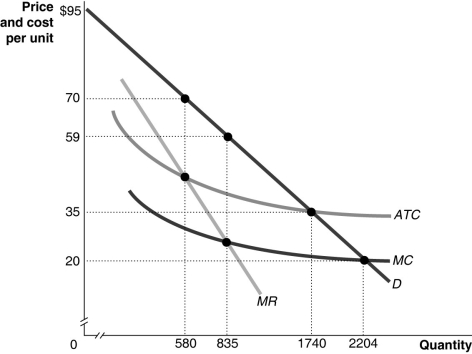 -Refer to Figure 15-19 to answer the following questions.
a. What quantity will this monopoly produce and what price will it charge?
b. Suppose the monopoly is regulated. If the regulatory agency wants to achieve economic efficiency, what price should it require the monopoly to charge?
c. To achieve economic efficiency, what quantity will the regulated monopoly produce?
d. Will the regulated monopoly make a profit if it charges the price that will achieve economic efficiency?
e. Suppose the government decides to regulate the monopoly by imposing a price ceiling of $35. What quantity will the monopoly produce and what price will the monopoly charge?
f. With the price ceiling of $35, what profit will the monopoly earn?
-Refer to Figure 15-19 to answer the following questions.
a. What quantity will this monopoly produce and what price will it charge?
b. Suppose the monopoly is regulated. If the regulatory agency wants to achieve economic efficiency, what price should it require the monopoly to charge?
c. To achieve economic efficiency, what quantity will the regulated monopoly produce?
d. Will the regulated monopoly make a profit if it charges the price that will achieve economic efficiency?
e. Suppose the government decides to regulate the monopoly by imposing a price ceiling of $35. What quantity will the monopoly produce and what price will the monopoly charge?
f. With the price ceiling of $35, what profit will the monopoly earn? (Essay)
4.8/5  (83)
(83) If a monopolist's price is $50 and average total cost is $43, then the average profit is $7.
(True/False)
4.9/5 (98)
(98) Consider an industry that is made up of nine firms each with a market share (percent of sales) as follows:
a. Firm A: 30%
b. Firm B: 20%
c. Firms C, D, and E: 10% each
d. Firms F, G, H, and J: 5% each
What is the value of the four-firm concentration ratio and how is the industry categorized?
(Multiple Choice)
4.9/5 (78)
(78) Figure 15-14 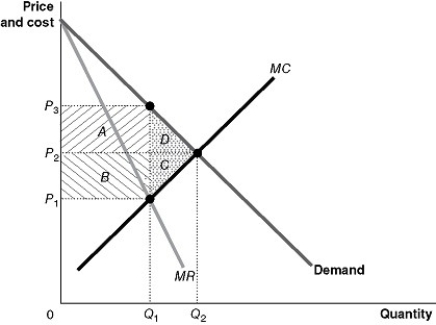 -Refer to Figure 15-14. From the monopoly graph above, identify the following:
a. The profit maximizing price
b. The profit maximizing quantity
c. The area representing deadweight loss
d. The area representing the transfer of consumer surplus to the monopoly
-Refer to Figure 15-14. From the monopoly graph above, identify the following:
a. The profit maximizing price
b. The profit maximizing quantity
c. The area representing deadweight loss
d. The area representing the transfer of consumer surplus to the monopoly (Essay)
4.8/5 (72)
(72) The possibility that the economy may benefit from having market power, rather than being very competitive, is closely identified with which famous economist?
(Multiple Choice)
4.9/5 (75)
(75) How do the price and quantity of a monopoly compare to that of a perfectly competitive industry?
(Essay)
4.7/5 (77)
(77) Economists played a key role in the development of merger guidelines by the Department of Justice and the Federal Trade Commission in 1982. These guidelines have three main parts. What are these parts?
(Multiple Choice)
4.9/5 (76)
(76) Consider two industries, industry W and industry X. In industry W there are five companies, each with a market share of 20% of total sales. In industry X, there are six companies. One company has a 50% market share and each of the other five firms has a market share of 10%.
a. Calculate the four-firm concentration ratio for each industry.
b. Calculate the Herfindahl-Hirschman Index (HHI) for each industry.
c. What do the values of the two concentration measures imply about the degree of market power in the two industries?
(Essay)
4.8/5 (84)
(84) Which of following is the best example of a monopoly if we use a broader definition of monopoly?
(Multiple Choice)
4.9/5 (72)
(72) a. What is the difference between a horizontal merger and a vertical merger?
b. Which type of merger, horizontal or vertical, would the government be most concerned with? Why?
c. Could a horizontal merger be welfare improving?
(Essay)
4.9/5 (85)
(85) In evaluating the degree of economic efficiency in a market, we can state that the size of the deadweight loss in a market will be smaller
(Multiple Choice)
4.9/5 (89)
(89) In the United States, barriers to entry in professional team sports (for example, football and baseball) result from
(Multiple Choice)
4.9/5 (73)
(73) A firm that is the only seller of a good or service that does not have a close substitute is called
(Multiple Choice)
4.8/5 (83)
(83) Figure 15-3  Figure 15-3 above shows the demand and cost curves facing a monopolist.
-Refer to Figure 15-3. What happens to the monopolist represented in the diagram in the long run, if costs and demand stay the same?
Figure 15-3 above shows the demand and cost curves facing a monopolist.
-Refer to Figure 15-3. What happens to the monopolist represented in the diagram in the long run, if costs and demand stay the same? (Multiple Choice)
4.9/5 (71)
(71) For which of the following firms is patent protection of vital importance?
(Multiple Choice)
4.9/5 (80)
(80) A monopoly is a firm that is the only seller of a good or service that does not have
(Multiple Choice)
4.9/5 (76)
(76) Arnold Harberger was the first economist to estimate the loss of economic efficiency due to market power. Harberger found that
(Multiple Choice)
4.9/5 (87)
(87) Figure 15-1  -Refer to Figure 15-1. Which of the following statements about the firm depicted in the diagram is true?
 (Multiple Choice)
4.8/5 (80)
(80) 
Filters
- Essay(0)
- Multiple Choice(0)
- Short Answer(0)
- True False(0)
- Matching(0)