



 Chat with AI
Exam 15: Monopoly and Antitrust Policy

Exam 1: Economics: Foundations and Models459 Questions
Exam 2: Trade-Offs, Comparative Advantage, and the Market System492 Questions
Exam 3: Where Prices Come From: the Interaction of Demand and Supply476 Questions
Exam 4: Economic Efficiency, Government Price Setting, and Taxes420 Questions
Exam 5: Externalities, Environmental Policy, and Public Goods262 Questions
Exam 6: Elasticity: the Responsiveness of Demand and Supply293 Questions
Exam 7: The Economics of Health Care337 Questions
Exam 8: Firms, the Stock Market, and Corporate Governance512 Questions
Exam 9: Comparative Advantage and the Gains From International Trade377 Questions
Exam 10: Consumer Choice and Behavioral Economics304 Questions
Exam 11: Technology, Production, and Costs326 Questions
Exam 12: Firms in Perfectly Competitive Markets296 Questions
Exam 13: Monopolistic Competition: the Competitive Model in a More Realistic Setting272 Questions
Exam 14: Oligopoly: Firms in Less Competitive Markets256 Questions
Exam 15: Monopoly and Antitrust Policy279 Questions
Exam 16: Pricing Strategy258 Questions
Exam 17: The Markets for Labor and Other Factors of Production279 Questions
Exam 18: Public Choice, Taxes, and the Distribution of Income258 Questions
Exam 19: Gdp: Measuring Total Production and Income260 Questions
Exam 20: Unemployment and Inflation290 Questions
Exam 21: Economic Growth, the Financial System, and Business Cycles251 Questions
Exam 22: Long-Run Economic Growth: Sources and Policies261 Questions
Exam 23: Aggregate Expenditure and Output in the Short Run305 Questions
Exam 24: Aggregate Demand and Aggregate Supply Analysis286 Questions
Exam 25: Money, Banks, and the Federal Reserve System278 Questions
Exam 26: Monetary Policy280 Questions
Exam 27: Fiscal Policy313 Questions
Exam 28: Inflation, Unemployment, and Federal Reserve Policy257 Questions
Exam 29: Macroeconomics in an Open Economy277 Questions
Exam 30: The International Financial System258 Questions
Select questions type


Suppose a monopoly is producing its profit-maximizing output level. Now suppose the government imposes a lump-sum tax on the monopoly, independent of its output. As a result the monopolist will increase the price of its product to cover its higher cost.
(True/False)
4.8/5  (90)
(90) The reason that the Fisherman's Friend restaurant in Stonington, Maine had a monopoly on selling seafood dinners in that town is most likely due to
(Multiple Choice)
4.7/5 (98)
(98) The market demand curve facing a monopolist is more elastic than the market demand curve facing a monopolistic competitor.
(True/False)
4.7/5 (71)
(71) Network externalities refer to the situation where the usefulness of a product increases with the number of consumers who use it.
(True/False)
4.8/5 (70)
(70) The Herfindahl-Hirschman Index is one factor used to determine whether a merger between two firms should be allowed. Which of the following statements regarding the value of the Index for a given industry is true?
(Multiple Choice)
5.0/5 (85)
(85) Figure 15-16  Figure 15-16 shows the market demand and cost curves facing a natural monopoly.
-Refer to Figure 15-16. Suppose the government regulates this industry in order to remove the inefficiency implied by the behavior of the profit-maximizing owners. If regulators require that the firm produces the economically efficient output level, what is this level and what price will be charged?
Figure 15-16 shows the market demand and cost curves facing a natural monopoly.
-Refer to Figure 15-16. Suppose the government regulates this industry in order to remove the inefficiency implied by the behavior of the profit-maximizing owners. If regulators require that the firm produces the economically efficient output level, what is this level and what price will be charged? (Multiple Choice)
4.9/5 (79)
(79) Figure 15-18 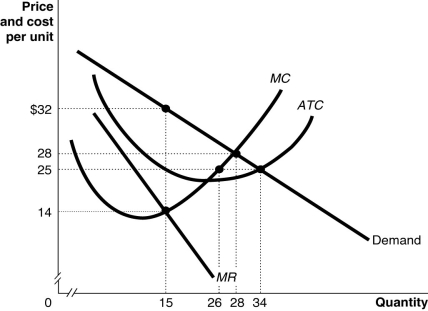 -Refer to Figure 15-18 to answer the following questions.
a. What quantity will this monopoly produce and what price will it charge?
b. Suppose the government decides to regulate this monopoly and imposes a price ceiling of $25. Now what quantity will the monopoly produce and what price will it charge?
c. Will every consumer who is willing to pay the ceiling price of $25 be able to buy the product? Briefly explain.
-Refer to Figure 15-18 to answer the following questions.
a. What quantity will this monopoly produce and what price will it charge?
b. Suppose the government decides to regulate this monopoly and imposes a price ceiling of $25. Now what quantity will the monopoly produce and what price will it charge?
c. Will every consumer who is willing to pay the ceiling price of $25 be able to buy the product? Briefly explain. (Essay)
4.9/5 (87)
(87) Figure 15-7 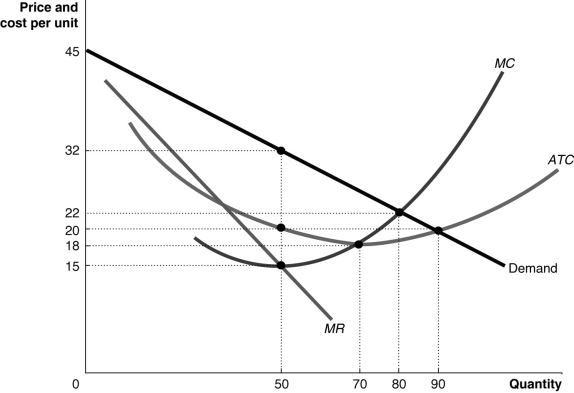 -Refer to Figure 15-7. Use the figure above to answer the following questions.
a. What is the profit-maximizing quantity and what price will the monopolist charge?
b. What is the total revenue at the profit-maximizing output level?
c. What is the total cost at the profit-maximizing output level?
d. What is the profit?
e. What is the profit per unit (average profit) at the profit-maximizing output level?
f. If this industry was organized as a perfectly competitive industry, what would be the profit-maximizing price and quantity?
-Refer to Figure 15-7. Use the figure above to answer the following questions.
a. What is the profit-maximizing quantity and what price will the monopolist charge?
b. What is the total revenue at the profit-maximizing output level?
c. What is the total cost at the profit-maximizing output level?
d. What is the profit?
e. What is the profit per unit (average profit) at the profit-maximizing output level?
f. If this industry was organized as a perfectly competitive industry, what would be the profit-maximizing price and quantity? (Essay)
4.9/5 (86)
(86) Figure 15-12  Figure 15-12 shows the cost and demand curves for a monopolist.
-Refer to Figure 15-12. Assume the firm maximizes its profits. What is the amount of the consumer surplus?
Figure 15-12 shows the cost and demand curves for a monopolist.
-Refer to Figure 15-12. Assume the firm maximizes its profits. What is the amount of the consumer surplus? (Multiple Choice)
4.9/5 (75)
(75) The National Football League has long-term leases with the stadiums in major cities. Control of these stadiums is an entry barrier to a potential new football league.
(True/False)
4.9/5 (83)
(83) Relative to a perfectly competitive market, a monopoly results in
(Multiple Choice)
4.8/5 (87)
(87) Which antitrust law prohibited firms from buying stock in competitors and from having directors serve on the boards of competing firms?
(Multiple Choice)
4.8/5 (80)
(80) Figure 15-2  Figure 15-2 above shows the demand and cost curves facing a monopolist.
-Refer to Figure 15-2. If the firm's average total cost curve is ATC2, the firm will
Figure 15-2 above shows the demand and cost curves facing a monopolist.
-Refer to Figure 15-2. If the firm's average total cost curve is ATC2, the firm will (Multiple Choice)
4.8/5 (71)
(71) When the government wants to give an exclusive right to one firm to produce a product, it
(Multiple Choice)
4.9/5 (77)
(77) Figure 15-15  Figure 15-15 shows the cost and demand curves for the Erickson Power Company.
-Refer to Figure 15-15. The profit-maximizing price is
Figure 15-15 shows the cost and demand curves for the Erickson Power Company.
-Refer to Figure 15-15. The profit-maximizing price is (Multiple Choice)
4.7/5 (67)
(67) If we use a narrow definition of monopoly, then a monopoly is defined as a firm
(Multiple Choice)
4.8/5 (75)
(75) 
Filters
- Essay(0)
- Multiple Choice(0)
- Short Answer(0)
- True False(0)
- Matching(0)