



 Chat with AI
Exam 15: Monopoly and Antitrust Policy

Exam 1: Economics: Foundations and Models459 Questions
Exam 2: Trade-Offs, Comparative Advantage, and the Market System492 Questions
Exam 3: Where Prices Come From: the Interaction of Demand and Supply476 Questions
Exam 4: Economic Efficiency, Government Price Setting, and Taxes420 Questions
Exam 5: Externalities, Environmental Policy, and Public Goods262 Questions
Exam 6: Elasticity: the Responsiveness of Demand and Supply293 Questions
Exam 7: The Economics of Health Care337 Questions
Exam 8: Firms, the Stock Market, and Corporate Governance512 Questions
Exam 9: Comparative Advantage and the Gains From International Trade377 Questions
Exam 10: Consumer Choice and Behavioral Economics304 Questions
Exam 11: Technology, Production, and Costs326 Questions
Exam 12: Firms in Perfectly Competitive Markets296 Questions
Exam 13: Monopolistic Competition: the Competitive Model in a More Realistic Setting272 Questions
Exam 14: Oligopoly: Firms in Less Competitive Markets256 Questions
Exam 15: Monopoly and Antitrust Policy279 Questions
Exam 16: Pricing Strategy258 Questions
Exam 17: The Markets for Labor and Other Factors of Production279 Questions
Exam 18: Public Choice, Taxes, and the Distribution of Income258 Questions
Exam 19: Gdp: Measuring Total Production and Income260 Questions
Exam 20: Unemployment and Inflation290 Questions
Exam 21: Economic Growth, the Financial System, and Business Cycles251 Questions
Exam 22: Long-Run Economic Growth: Sources and Policies261 Questions
Exam 23: Aggregate Expenditure and Output in the Short Run305 Questions
Exam 24: Aggregate Demand and Aggregate Supply Analysis286 Questions
Exam 25: Money, Banks, and the Federal Reserve System278 Questions
Exam 26: Monetary Policy280 Questions
Exam 27: Fiscal Policy313 Questions
Exam 28: Inflation, Unemployment, and Federal Reserve Policy257 Questions
Exam 29: Macroeconomics in an Open Economy277 Questions
Exam 30: The International Financial System258 Questions
Select questions type


BHP Billiton is a Canadian company that owns mines in Canada that
(Multiple Choice)
4.8/5  (93)
(93) Consider an industry that is made up of six firms with the following market shares: Firm A - 50%, Firm B - 20%, Firms C and D - 10% each, and Firms E and F - 5% each. What is the value of the Herfindahl-Hirschman Index?
(Multiple Choice)
4.9/5 (94)
(94) Identify the type of merger in each of the following situations and indicate how the post-merger concentration ratio for the industry is affected.
a. A steel company merges with a coal and iron ore mining company.b. Staples, a retailer of office supplies, acquires Office Depot, another retailer of office supplies.c. An oil company merges with pipeline, shipping, and railroad companies as well as refineries and gas stations.
(Essay)
4.7/5 (80)
(80) If you own the only bookstore in a small town, do you have a monopoly?
(Essay)
4.8/5 (86)
(86) The Aluminum Company of America (Alcoa) had a monopoly until the 1940s because
(Multiple Choice)
4.8/5 (86)
(86) Figure 15-5 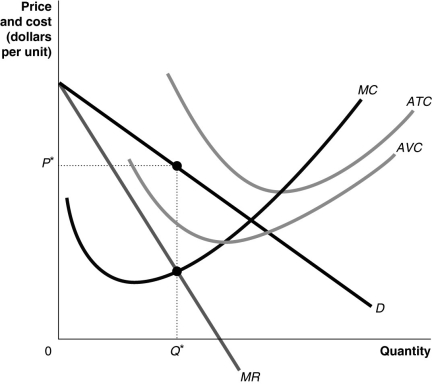 -Refer to Figure 15-5. If the monopolist charges price P* for output Q*, in order to maximize profit or minimize loss in the short run, it should
 (Multiple Choice)
4.9/5 (94)
(94) Unlike a perfect competitor, a monopolist faces the market demand curve.
(True/False)
4.9/5 (84)
(84) Natural monopolies in the United States are generally regulated by
(Multiple Choice)
4.9/5 (75)
(75) A monopolist's profit-maximizing price and output correspond to the point on a graph
(Multiple Choice)
4.9/5 (67)
(67) Figure 15-17  Your college decides to offer a psychology course as a MOOC that can be taken by students anywhere in the world, whether they are actually enrolled in your college or not. The demand and cost situation for the MOOC is shown in the figure.
-Refer to Figure 15-17. The dean of the college argues: "I think the course should be priced to maximize the profit the college earns, so these funds can be used to pay some other expenses." Which price should the dean favor?
Your college decides to offer a psychology course as a MOOC that can be taken by students anywhere in the world, whether they are actually enrolled in your college or not. The demand and cost situation for the MOOC is shown in the figure.
-Refer to Figure 15-17. The dean of the college argues: "I think the course should be priced to maximize the profit the college earns, so these funds can be used to pay some other expenses." Which price should the dean favor? (Multiple Choice)
4.9/5 (76)
(76) The first important law regulating monopolies in the United States was
(Multiple Choice)
4.9/5 (70)
(70) Figure 15-17 Your college decides to offer a psychology course as a MOOC that can be taken by students anywhere in the world, whether they are actually enrolled in your college or not. The demand and cost situation for the MOOC is shown in the figure.
-Refer to Figure 15-17. You are a member of a student government and are asked to recommend a price for the course and you argue: "I think the college should charge a price so that it just breaks even on the course." How much profit (or loss) will the college make on the course if it charges this price?
Your college decides to offer a psychology course as a MOOC that can be taken by students anywhere in the world, whether they are actually enrolled in your college or not. The demand and cost situation for the MOOC is shown in the figure.
-Refer to Figure 15-17. You are a member of a student government and are asked to recommend a price for the course and you argue: "I think the college should charge a price so that it just breaks even on the course." How much profit (or loss) will the college make on the course if it charges this price? (Multiple Choice)
4.9/5 (81)
(81) Joe Santos owns the only pizza parlor in a small town that is also home to a McDonald's, a Taco Bell, and a Kentucky Fried Chicken. Using a broad definition of a monopoly, Joe has a monopoly if the menu items sold at the other restaurants are not considered close substitutes for the food sold at the pizza parlor.
(True/False)
4.9/5 (79)
(79) What is the relationship between marginal revenue and average revenue for a monopolist and is it the same for a perfect competitor?
(Essay)
4.7/5 (82)
(82) A monopoly is characterized by all of the following except
(Multiple Choice)
4.9/5 (77)
(77) a. What is the defining characteristic of a natural monopoly?
b. Should the government break up a natural monopoly into two or more firms to make the industry more competitive?
c. Suppose the government wants to ensure that some of the benefits of declining average total cost are passed on to consumers. To achieve this goal, it requires that the natural monopoly set its price equal to marginal cost. Is this a feasible goal? Explain.
d. What is an alternative to marginal cost pricing that ensures that consumers reap some of the benefits of declining average total cost?
(Essay)
4.8/5 (83)
(83) A snack shop inside a hotel in a busy city has a monopoly on food sales if it is the only food vendor in the hotel that is open 24 hours a day.
(True/False)
5.0/5 (78)
(78) 
Filters
- Essay(0)
- Multiple Choice(0)
- Short Answer(0)
- True False(0)
- Matching(0)