



 Chat with AI
Exam 15: Monopoly and Antitrust Policy

Exam 1: Economics: Foundations and Models459 Questions
Exam 2: Trade-Offs, Comparative Advantage, and the Market System492 Questions
Exam 3: Where Prices Come From: the Interaction of Demand and Supply476 Questions
Exam 4: Economic Efficiency, Government Price Setting, and Taxes420 Questions
Exam 5: Externalities, Environmental Policy, and Public Goods262 Questions
Exam 6: Elasticity: the Responsiveness of Demand and Supply293 Questions
Exam 7: The Economics of Health Care337 Questions
Exam 8: Firms, the Stock Market, and Corporate Governance512 Questions
Exam 9: Comparative Advantage and the Gains From International Trade377 Questions
Exam 10: Consumer Choice and Behavioral Economics304 Questions
Exam 11: Technology, Production, and Costs326 Questions
Exam 12: Firms in Perfectly Competitive Markets296 Questions
Exam 13: Monopolistic Competition: the Competitive Model in a More Realistic Setting272 Questions
Exam 14: Oligopoly: Firms in Less Competitive Markets256 Questions
Exam 15: Monopoly and Antitrust Policy279 Questions
Exam 16: Pricing Strategy258 Questions
Exam 17: The Markets for Labor and Other Factors of Production279 Questions
Exam 18: Public Choice, Taxes, and the Distribution of Income258 Questions
Exam 19: Gdp: Measuring Total Production and Income260 Questions
Exam 20: Unemployment and Inflation290 Questions
Exam 21: Economic Growth, the Financial System, and Business Cycles251 Questions
Exam 22: Long-Run Economic Growth: Sources and Policies261 Questions
Exam 23: Aggregate Expenditure and Output in the Short Run305 Questions
Exam 24: Aggregate Demand and Aggregate Supply Analysis286 Questions
Exam 25: Money, Banks, and the Federal Reserve System278 Questions
Exam 26: Monetary Policy280 Questions
Exam 27: Fiscal Policy313 Questions
Exam 28: Inflation, Unemployment, and Federal Reserve Policy257 Questions
Exam 29: Macroeconomics in an Open Economy277 Questions
Exam 30: The International Financial System258 Questions
Select questions type


Table 15-1
 A monopoly producer of foreign language translation software faces a demand and cost structure as given in Table 15-1.
-Refer to Table 15-1. What is the marginal revenue from the sale of the 12th unit?
A monopoly producer of foreign language translation software faces a demand and cost structure as given in Table 15-1.
-Refer to Table 15-1. What is the marginal revenue from the sale of the 12th unit? (Multiple Choice)
4.7/5  (76)
(76) Table 15-4
 Shakti Inc. has been granted a patent for its Arnica toothache balm. Table 15-4 shows the demand and the total cost schedule for the firm.
-Refer to Table 15-4. What is the economically efficient output level?
Shakti Inc. has been granted a patent for its Arnica toothache balm. Table 15-4 shows the demand and the total cost schedule for the firm.
-Refer to Table 15-4. What is the economically efficient output level? (Multiple Choice)
4.8/5 (91)
(91) A profit-maximizing monopoly produces a lower output level than would be produced if the
industry was perfectly competitive.
(True/False)
4.8/5 (86)
(86) Figure 15-13 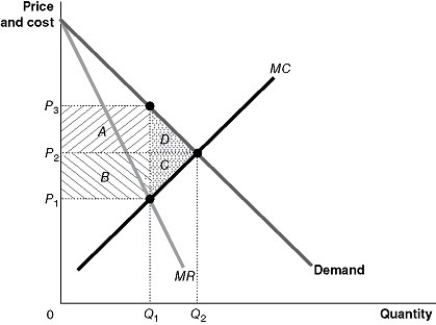 -Refer to Figure 15-13. From the monopoly graph above, identify the area representing the deadweight loss.
Would the deadweight loss be larger if the demand curve was more elastic or less elastic?
-Refer to Figure 15-13. From the monopoly graph above, identify the area representing the deadweight loss.
Would the deadweight loss be larger if the demand curve was more elastic or less elastic? (Essay)
4.8/5 (84)
(84) Table 15-1
A monopoly producer of foreign language translation software faces a demand and cost structure as given in Table 15-1.
-Refer to Table 15-1. What is the firm's profit-maximizing output and what is the price charged to sell this output?
A monopoly producer of foreign language translation software faces a demand and cost structure as given in Table 15-1.
-Refer to Table 15-1. What is the firm's profit-maximizing output and what is the price charged to sell this output? (Multiple Choice)
4.9/5 (73)
(73) Figure 15-10  -Refer to Figure 15-10. What is the area that represents consumer surplus under a monopoly?
 (Multiple Choice)
4.7/5 (79)
(79) Beginning in 1965, the head of the Antitrust Division of the U.S. Department of Justice began to change antitrust policy. How did antitrust policy change?
(Multiple Choice)
4.9/5 (85)
(85) Figure 15-4  Figure 15-4 shows the demand and cost curves for a monopolist.
-Refer to Figure 15-4. What is the price charged for the profit-maximizing output level?
Figure 15-4 shows the demand and cost curves for a monopolist.
-Refer to Figure 15-4. What is the price charged for the profit-maximizing output level? (Multiple Choice)
4.9/5 (93)
(93) Table 15-4
Shakti Inc. has been granted a patent for its Arnica toothache balm. Table 15-4 shows the demand and the total cost schedule for the firm.
-Refer to Table 15-4. What is the amount of the deadweight loss generated by Shakti when it produces the monopoly output?
Shakti Inc. has been granted a patent for its Arnica toothache balm. Table 15-4 shows the demand and the total cost schedule for the firm.
-Refer to Table 15-4. What is the amount of the deadweight loss generated by Shakti when it produces the monopoly output? (Multiple Choice)
4.8/5 (82)
(82) Market power in the United States causes a huge loss of economic efficiency.
(True/False)
4.9/5 (67)
(67) Long-run economic profits would most likely exist in which market structure?
(Multiple Choice)
4.9/5 (85)
(85) Wendell can sell five motor homes per week at a price of $22,000. If he lowers the price of motor homes to $20,000 per week he will sell six motor homes. What is the marginal revenue of the sixth motor home?
(Multiple Choice)
4.8/5 (71)
(71) Figure 15-8  Figure 15-8 reflects the cost and revenue structure for a monopoly that has been in business for a very long time.
-Refer to Figure 15-8. Use the figure above to answer the following questions.
a. Identify the curves labeled A and B. Identify the curve which contains both point Y and point Z. Identify the curve which contains both point V and point W.
b. What is the profit-maximizing quantity and what price will the monopolist charge?
c. What area represents total revenue at the profit-maximizing output level?
d. What area represents total cost at the profit-maximizing output level?
e. What area represents profit?
f. What is the profit per unit (average profit) at the profit-maximizing output level?
g. If this industry was organized as a perfectly competitive industry, what would be the profit-maximizing price and quantity?
h. What area represents the deadweight loss as a result of a monopoly?
Figure 15-8 reflects the cost and revenue structure for a monopoly that has been in business for a very long time.
-Refer to Figure 15-8. Use the figure above to answer the following questions.
a. Identify the curves labeled A and B. Identify the curve which contains both point Y and point Z. Identify the curve which contains both point V and point W.
b. What is the profit-maximizing quantity and what price will the monopolist charge?
c. What area represents total revenue at the profit-maximizing output level?
d. What area represents total cost at the profit-maximizing output level?
e. What area represents profit?
f. What is the profit per unit (average profit) at the profit-maximizing output level?
g. If this industry was organized as a perfectly competitive industry, what would be the profit-maximizing price and quantity?
h. What area represents the deadweight loss as a result of a monopoly? (Essay)
4.9/5 (74)
(74) A merger between firms at different stages of production of a good
(Multiple Choice)
4.8/5 (85)
(85) The first important federal law passed to regulate monopolies in the United States was the
(Multiple Choice)
4.7/5 (77)
(77) A local electricity-generating company has a monopoly that is protected by an entry barrier that takes the form of
(Multiple Choice)
4.8/5 (78)
(78) Equilibrium in a perfectly competitive market results in the greatest amount of economic surplus, or total benefit to society, from the production of a good. Why, then, did Joseph Schumpeter argue that an economy may benefit more from firms that have market power than from firms that are perfectly competitive?
(Essay)
5.0/5 (78)
(78) 
Filters
- Essay(0)
- Multiple Choice(0)
- Short Answer(0)
- True False(0)
- Matching(0)