



 Chat with AI
Exam 18: Public Choice, Taxes, and the Distribution of Income

Exam 1: Economics: Foundations and Models459 Questions
Exam 2: Trade-Offs, Comparative Advantage, and the Market System492 Questions
Exam 3: Where Prices Come From: the Interaction of Demand and Supply476 Questions
Exam 4: Economic Efficiency, Government Price Setting, and Taxes420 Questions
Exam 5: Externalities, Environmental Policy, and Public Goods262 Questions
Exam 6: Elasticity: the Responsiveness of Demand and Supply293 Questions
Exam 7: The Economics of Health Care337 Questions
Exam 8: Firms, the Stock Market, and Corporate Governance512 Questions
Exam 9: Comparative Advantage and the Gains From International Trade377 Questions
Exam 10: Consumer Choice and Behavioral Economics304 Questions
Exam 11: Technology, Production, and Costs326 Questions
Exam 12: Firms in Perfectly Competitive Markets296 Questions
Exam 13: Monopolistic Competition: the Competitive Model in a More Realistic Setting272 Questions
Exam 14: Oligopoly: Firms in Less Competitive Markets256 Questions
Exam 15: Monopoly and Antitrust Policy279 Questions
Exam 16: Pricing Strategy258 Questions
Exam 17: The Markets for Labor and Other Factors of Production279 Questions
Exam 18: Public Choice, Taxes, and the Distribution of Income258 Questions
Exam 19: Gdp: Measuring Total Production and Income260 Questions
Exam 20: Unemployment and Inflation290 Questions
Exam 21: Economic Growth, the Financial System, and Business Cycles251 Questions
Exam 22: Long-Run Economic Growth: Sources and Policies261 Questions
Exam 23: Aggregate Expenditure and Output in the Short Run305 Questions
Exam 24: Aggregate Demand and Aggregate Supply Analysis286 Questions
Exam 25: Money, Banks, and the Federal Reserve System278 Questions
Exam 26: Monetary Policy280 Questions
Exam 27: Fiscal Policy313 Questions
Exam 28: Inflation, Unemployment, and Federal Reserve Policy257 Questions
Exam 29: Macroeconomics in an Open Economy277 Questions
Exam 30: The International Financial System258 Questions
Select questions type


Figure 18-3 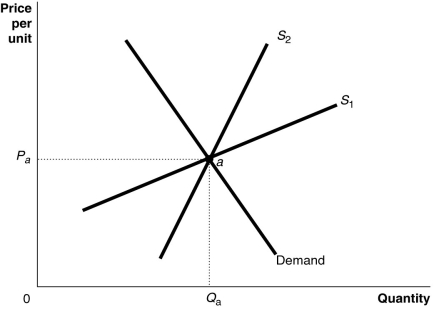 -Refer to Figure 18-3. The figure above shows a demand curve and two supply curves, one more elastic than the other. Use Figure 18-3 to answer the following questions.
a. Suppose the government imposes an excise tax of $1.00 on every unit sold. Use the graph to illustrate the impact of this tax when the supply curve is S1 and when the supply curve is S2.
b. If the government imposes an excise tax of $1.00 on every unit sold, will the consumer pay more of the tax if the supply curve is S1 or S2? Refer to the graphs in your answer.
c. If an excise tax of $1.00 on every unit sold is imposed, will the revenue collected by the government be greater if the supply curve is S1 or S2?
d. If the government imposes an excise tax of $1.00 on every unit sold, will the deadweight loss be greater if the supply curve is S1 or S2?
-Refer to Figure 18-3. The figure above shows a demand curve and two supply curves, one more elastic than the other. Use Figure 18-3 to answer the following questions.
a. Suppose the government imposes an excise tax of $1.00 on every unit sold. Use the graph to illustrate the impact of this tax when the supply curve is S1 and when the supply curve is S2.
b. If the government imposes an excise tax of $1.00 on every unit sold, will the consumer pay more of the tax if the supply curve is S1 or S2? Refer to the graphs in your answer.
c. If an excise tax of $1.00 on every unit sold is imposed, will the revenue collected by the government be greater if the supply curve is S1 or S2?
d. If the government imposes an excise tax of $1.00 on every unit sold, will the deadweight loss be greater if the supply curve is S1 or S2? (Essay)
4.9/5  (78)
(78) Holding all other factors constant, income earned from capital is more unequally distributed than income earned from labor.
(True/False)
4.9/5 (57)
(57) Figure 18-2  Figure 18-2 shows a demand curve and two sets of supply curves, one set more elastic than the other.
-Refer to Figure 18-2. If the government imposes an excise tax of $1.00 on every unit sold, the government's revenue from the tax
Figure 18-2 shows a demand curve and two sets of supply curves, one set more elastic than the other.
-Refer to Figure 18-2. If the government imposes an excise tax of $1.00 on every unit sold, the government's revenue from the tax (Multiple Choice)
4.8/5 (87)
(87) The government of Silverado raises revenue to operate the city's hospital, open to all residents, through a general income tax paid by its residents. This method of raising revenue is consistent with the benefits-received principle, even if some residents use the hospital more than others.
(True/False)
4.8/5 (74)
(74) Absolute poverty measures vary from country to country. For example, in 2017, the poverty line in the United States for a family of four was an annual income of $24,600 but economists often use a much lower threshold income of $1.25 per day when calculating the rate of poverty in poor countries. Using this $1.25-per-day measure of the poverty line, which of the following regions had the largest percentage decrease in the percentage of the population in poverty from 1970 to 2010?
(Multiple Choice)
4.7/5 (78)
(78) Explain the effect of price elasticities of supply and demand on tax incidence.
(Essay)
4.8/5 (77)
(77)  -Refer to Figure 18-1. Area F + G represents
The voting paradox suggests that the "voting market," as represented by elections
(Multiple Choice)
4.8/5 (72)
(72) How would the elimination of a sales tax affect the market for a product that had been subject to the tax?
(Multiple Choice)
4.9/5 (73)
(73) A tax imposed by a state or local government on retail sales of most products is
(Multiple Choice)
4.9/5 (87)
(87) Figure 18-6  Figure 18-6 shows the Lorenz curves for Islandia and Syldavia.
-Refer to Figure 18-6. If area X = 2,060, area Y = 240, and area Z = 2,700, calculate the Gini coefficient for Islandia.
Figure 18-6 shows the Lorenz curves for Islandia and Syldavia.
-Refer to Figure 18-6. If area X = 2,060, area Y = 240, and area Z = 2,700, calculate the Gini coefficient for Islandia. (Multiple Choice)
4.7/5 (86)
(86) The complexity of the U.S. federal income tax system results in significant annual deadweight losses. The opportunity cost of the hours taxpayers spend on record keeping and completing their tax returns amounts to billions of dollars.
a. If the tax system was simplified, how would this benefit the economy?
b. Why hasn't the tax system been simplified?
(Essay)
4.7/5 (87)
(87) The government of Silverado raises revenue through a general income tax paid by all its residents to operate the city's marina. The marina is used by private boat owners. This method of raising revenue to operate the marina is
(Multiple Choice)
4.8/5 (69)
(69) During the past 30 years, income inequality in the United States has increased in part due to rapid technological change. How does technological change contribute to income inequality?
(Multiple Choice)
4.7/5 (81)
(81) Many state governments use lotteries to raise revenue. If a lottery is viewed as a tax, is it most likely a progressive tax or a regressive tax? What information would you need to determine whether the burden of a lottery is progressive or regressive?
(Essay)
4.8/5 (90)
(90) Horizontal equity means that two people in identical economic situations should pay the same amount of taxes.
(True/False)
4.9/5 (96)
(96) 
Filters
- Essay(0)
- Multiple Choice(0)
- Short Answer(0)
- True False(0)
- Matching(0)