



 Chat with AI
Exam 18: Public Choice, Taxes, and the Distribution of Income

Exam 1: Economics: Foundations and Models459 Questions
Exam 2: Trade-Offs, Comparative Advantage, and the Market System492 Questions
Exam 3: Where Prices Come From: the Interaction of Demand and Supply476 Questions
Exam 4: Economic Efficiency, Government Price Setting, and Taxes420 Questions
Exam 5: Externalities, Environmental Policy, and Public Goods262 Questions
Exam 6: Elasticity: the Responsiveness of Demand and Supply293 Questions
Exam 7: The Economics of Health Care337 Questions
Exam 8: Firms, the Stock Market, and Corporate Governance512 Questions
Exam 9: Comparative Advantage and the Gains From International Trade377 Questions
Exam 10: Consumer Choice and Behavioral Economics304 Questions
Exam 11: Technology, Production, and Costs326 Questions
Exam 12: Firms in Perfectly Competitive Markets296 Questions
Exam 13: Monopolistic Competition: the Competitive Model in a More Realistic Setting272 Questions
Exam 14: Oligopoly: Firms in Less Competitive Markets256 Questions
Exam 15: Monopoly and Antitrust Policy279 Questions
Exam 16: Pricing Strategy258 Questions
Exam 17: The Markets for Labor and Other Factors of Production279 Questions
Exam 18: Public Choice, Taxes, and the Distribution of Income258 Questions
Exam 19: Gdp: Measuring Total Production and Income260 Questions
Exam 20: Unemployment and Inflation290 Questions
Exam 21: Economic Growth, the Financial System, and Business Cycles251 Questions
Exam 22: Long-Run Economic Growth: Sources and Policies261 Questions
Exam 23: Aggregate Expenditure and Output in the Short Run305 Questions
Exam 24: Aggregate Demand and Aggregate Supply Analysis286 Questions
Exam 25: Money, Banks, and the Federal Reserve System278 Questions
Exam 26: Monetary Policy280 Questions
Exam 27: Fiscal Policy313 Questions
Exam 28: Inflation, Unemployment, and Federal Reserve Policy257 Questions
Exam 29: Macroeconomics in an Open Economy277 Questions
Exam 30: The International Financial System258 Questions
Select questions type


The median voter theorem will be an accurate predictor of the outcomes of elections
(Multiple Choice)
4.8/5  (75)
(75) There is a difference between who is legally required to send a tax payment to the government and who bears the burden of the tax. Which of the following would have the most impact on who bears the burden of an excise tax?
(Multiple Choice)
4.8/5 (80)
(80) Last year, Anthony Millanti earned exactly $30,000 of taxable income. Assume that the income tax system used to determine Anthony's tax liability is progressive. The table below lists the tax brackets and the marginal tax rates that apply to each bracket.
a. Draw a new table that lists the amounts of income tax that Anthony is obligated to pay for each tax bracket, and the total tax he owes the government. (Assume that there are no allowable tax deductions, tax credits, personal exemptions, or any other deductions that Anthony can use to reduce his tax liability).
b. Determine Anthony's average tax rate.

(Essay)
4.7/5 (77)
(77) Absolute poverty measures vary from country to country. For example, in 2017, the poverty line in the United States for a family of four was an annual income of $24,600 but economists often use a much lower threshold income of $1.25 per day when calculating the rate of poverty in poor countries. Using this $1.25-per-day measure of the poverty line, which of the following regions had the smallest percentage decrease in the percentage of the population in poverty from 1970 to 2010?
(Multiple Choice)
4.9/5 (86)
(86) Which of the following tax systems would help reduce income inequality the most?
(Multiple Choice)
4.9/5 (64)
(64) The federal government and some state governments levy taxes on specific goods such as gasoline, cigarettes, and beer. These are known as
(Multiple Choice)
4.8/5 (69)
(69) In reference to the federal income tax system, a tax bracket is
(Multiple Choice)
4.8/5 (74)
(74) The proposition that the outcome of a majority vote is likely to represent the preferences of the voter who is in the political middle is called
(Multiple Choice)
4.9/5 (84)
(84) Congressman Flack votes for a program that will benefit the constituents of Congressman Walpole. Which of the following explanations for Flack's vote is most consistent with the public choice model?
(Multiple Choice)
4.8/5 (86)
(86) According to the benefits-received principle, those who receive the benefits from a government program should pay the taxes that support the program.
(True/False)
4.8/5 (73)
(73) Which of the following statements about rent seeking is false?
(Multiple Choice)
5.0/5 (70)
(70) Policymakers focus on marginal tax rate changes when making changes in the tax code because the marginal tax rate
(Multiple Choice)
4.8/5 (85)
(85) At the state and local levels in the United States, the largest source of tax revenue is
(Multiple Choice)
4.9/5 (75)
(75) When the demand for a product is less elastic than the supply
(Multiple Choice)
4.8/5 (73)
(73) Table 18-1
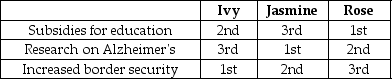 Suppose $1 billion is available in the budget and Congress is considering allocating the funds to one of the following three alternatives: 1) Subsidies for education, 2) Research on Alzheimer's or 3) Increased border security. Table 18-1 shows three voters' rankings of the alternatives.
-Refer to Table 18-1. Suppose a series of votes are taken in which each pair of alternatives is considered in turn. If the vote is between allocating funds to research on Alzheimer's and increased border security
Suppose $1 billion is available in the budget and Congress is considering allocating the funds to one of the following three alternatives: 1) Subsidies for education, 2) Research on Alzheimer's or 3) Increased border security. Table 18-1 shows three voters' rankings of the alternatives.
-Refer to Table 18-1. Suppose a series of votes are taken in which each pair of alternatives is considered in turn. If the vote is between allocating funds to research on Alzheimer's and increased border security (Multiple Choice)
4.9/5 (84)
(84) Measures of poverty (for example, the poverty line) and the distribution of income (for example, the Lorenz curve and the Gini coefficient) are misleading for which of the following two reasons?
(Multiple Choice)
4.7/5 (75)
(75) 
Filters
- Essay(0)
- Multiple Choice(0)
- Short Answer(0)
- True False(0)
- Matching(0)