



 Chat with AI
Exam 18: Public Choice, Taxes, and the Distribution of Income

Exam 1: Economics: Foundations and Models459 Questions
Exam 2: Trade-Offs, Comparative Advantage, and the Market System492 Questions
Exam 3: Where Prices Come From: the Interaction of Demand and Supply476 Questions
Exam 4: Economic Efficiency, Government Price Setting, and Taxes420 Questions
Exam 5: Externalities, Environmental Policy, and Public Goods262 Questions
Exam 6: Elasticity: the Responsiveness of Demand and Supply293 Questions
Exam 7: The Economics of Health Care337 Questions
Exam 8: Firms, the Stock Market, and Corporate Governance512 Questions
Exam 9: Comparative Advantage and the Gains From International Trade377 Questions
Exam 10: Consumer Choice and Behavioral Economics304 Questions
Exam 11: Technology, Production, and Costs326 Questions
Exam 12: Firms in Perfectly Competitive Markets296 Questions
Exam 13: Monopolistic Competition: the Competitive Model in a More Realistic Setting272 Questions
Exam 14: Oligopoly: Firms in Less Competitive Markets256 Questions
Exam 15: Monopoly and Antitrust Policy279 Questions
Exam 16: Pricing Strategy258 Questions
Exam 17: The Markets for Labor and Other Factors of Production279 Questions
Exam 18: Public Choice, Taxes, and the Distribution of Income258 Questions
Exam 19: Gdp: Measuring Total Production and Income260 Questions
Exam 20: Unemployment and Inflation290 Questions
Exam 21: Economic Growth, the Financial System, and Business Cycles251 Questions
Exam 22: Long-Run Economic Growth: Sources and Policies261 Questions
Exam 23: Aggregate Expenditure and Output in the Short Run305 Questions
Exam 24: Aggregate Demand and Aggregate Supply Analysis286 Questions
Exam 25: Money, Banks, and the Federal Reserve System278 Questions
Exam 26: Monetary Policy280 Questions
Exam 27: Fiscal Policy313 Questions
Exam 28: Inflation, Unemployment, and Federal Reserve Policy257 Questions
Exam 29: Macroeconomics in an Open Economy277 Questions
Exam 30: The International Financial System258 Questions
Select questions type


Figure 18-4 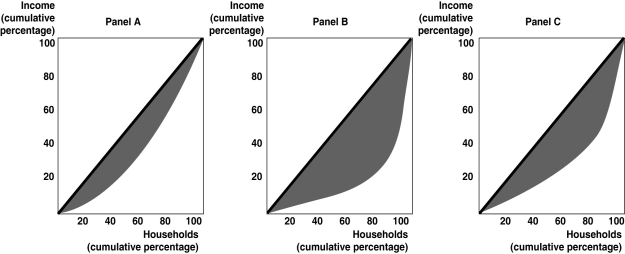 -Refer to Figure 18-4. Rank the above panels in terms of most unequal income distribution to least unequal income distribution.
 (Multiple Choice)
4.9/5  (82)
(82) If the government is most interested in minimizing excess burden of an excise tax, should it impose the tax on goods whose demand curves are elastic or inelastic?
(Essay)
4.9/5 (89)
(89) According to projections for 2017 by the Tax Policy Center, the 20 percent of U.S. taxpayers who make the highest incomes
(Multiple Choice)
4.8/5 (66)
(66) If the government wants to minimize the welfare loss of a tax, it should tax goods with more inelastic demand curves or supply curves.
(True/False)
4.9/5 (79)
(79) Figure 18-7  Figure 18-7 shows the Lorenz curve for a hypothetical country.
-Refer to Figure 18-7. The second highest 20 percent of households
Figure 18-7 shows the Lorenz curve for a hypothetical country.
-Refer to Figure 18-7. The second highest 20 percent of households (Multiple Choice)
4.8/5 (93)
(93) Some economists who use the public choice model to explain the ways government intervenes in the economy believe that regulatory capture results when an agency or commission is given authority over a particular industry or product. Which of the following is the best example of regulatory capture?
(Multiple Choice)
4.9/5 (90)
(90) Table 18-10
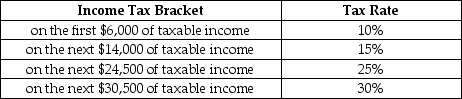 Table 18-10 shows the income tax brackets and tax rates for single taxpayers in Bauxhall.
-Refer to Table 18-10. A tax exemption is granted for the first $10,000 earned per year. Suppose you earn $75,000.
a. What is the amount of taxes you will pay?
b. What is your average tax rate?
c. What is your marginal tax rate?
Table 18-10 shows the income tax brackets and tax rates for single taxpayers in Bauxhall.
-Refer to Table 18-10. A tax exemption is granted for the first $10,000 earned per year. Suppose you earn $75,000.
a. What is the amount of taxes you will pay?
b. What is your average tax rate?
c. What is your marginal tax rate? (Essay)
4.7/5 (84)
(84) Table 18-1
 Suppose $1 billion is available in the budget and Congress is considering allocating the funds to one of the following three alternatives: 1) Subsidies for education, 2) Research on Alzheimer's or 3) Increased border security. Table 18-1 shows three voters' rankings of the alternatives.
-Refer to Table 18-1. Suppose a series of votes are taken in which each pair of alternatives is considered in turn. If the vote is between allocating funds to education subsidies and increased border security
Suppose $1 billion is available in the budget and Congress is considering allocating the funds to one of the following three alternatives: 1) Subsidies for education, 2) Research on Alzheimer's or 3) Increased border security. Table 18-1 shows three voters' rankings of the alternatives.
-Refer to Table 18-1. Suppose a series of votes are taken in which each pair of alternatives is considered in turn. If the vote is between allocating funds to education subsidies and increased border security (Multiple Choice)
4.8/5 (74)
(74) According to the median voter theorem, the outcome of a majority vote is likely to represent the preferences of the voter who is in the political middle.
(True/False)
4.8/5 (75)
(75) When members of Congress vote to pass new legislation, they will
(Multiple Choice)
5.0/5 (92)
(92) Figure 18-2  Figure 18-2 shows a demand curve and two sets of supply curves, one set more elastic than the other.
-Refer to Figure 18-2. If the government imposes an excise tax of $1.00 on every unit sold, the producer's burden of the tax
Figure 18-2 shows a demand curve and two sets of supply curves, one set more elastic than the other.
-Refer to Figure 18-2. If the government imposes an excise tax of $1.00 on every unit sold, the producer's burden of the tax (Multiple Choice)
4.9/5 (80)
(80) If official poverty statistics for the United States included transfer payments individuals receive from the government, such as Social Security payments and other non-cash benefits such as food stamps
(Multiple Choice)
4.8/5 (84)
(84) A study by the Congressional Budget Office (CBO) regarding the corporate income tax included the following statement: "A corporation may write its check to the Internal Revenue Service for payment of the corporate income tax, but the money must come from somewhere..." The comments that followed this statement argued that
(Multiple Choice)
4.9/5 (75)
(75) All Gini coefficients must lie between 0 and 1. The lower the value,
(Multiple Choice)
4.9/5 (82)
(82) Why is a typical person likely to gather more information when buying a new car than when voting for a member of Congress?
(Multiple Choice)
4.7/5 (87)
(87) If you pay $14,000 in taxes on an income of $125,000, and $17,400 in taxes on an income of $144,000, what is your marginal tax rate? Show your work.
(Essay)
4.9/5 (80)
(80) 
Filters
- Essay(0)
- Multiple Choice(0)
- Short Answer(0)
- True False(0)
- Matching(0)