



 Chat with AI
Exam 18: Public Choice, Taxes, and the Distribution of Income

Exam 1: Economics: Foundations and Models459 Questions
Exam 2: Trade-Offs, Comparative Advantage, and the Market System492 Questions
Exam 3: Where Prices Come From: the Interaction of Demand and Supply476 Questions
Exam 4: Economic Efficiency, Government Price Setting, and Taxes420 Questions
Exam 5: Externalities, Environmental Policy, and Public Goods262 Questions
Exam 6: Elasticity: the Responsiveness of Demand and Supply293 Questions
Exam 7: The Economics of Health Care337 Questions
Exam 8: Firms, the Stock Market, and Corporate Governance512 Questions
Exam 9: Comparative Advantage and the Gains From International Trade377 Questions
Exam 10: Consumer Choice and Behavioral Economics304 Questions
Exam 11: Technology, Production, and Costs326 Questions
Exam 12: Firms in Perfectly Competitive Markets296 Questions
Exam 13: Monopolistic Competition: the Competitive Model in a More Realistic Setting272 Questions
Exam 14: Oligopoly: Firms in Less Competitive Markets256 Questions
Exam 15: Monopoly and Antitrust Policy279 Questions
Exam 16: Pricing Strategy258 Questions
Exam 17: The Markets for Labor and Other Factors of Production279 Questions
Exam 18: Public Choice, Taxes, and the Distribution of Income258 Questions
Exam 19: Gdp: Measuring Total Production and Income260 Questions
Exam 20: Unemployment and Inflation290 Questions
Exam 21: Economic Growth, the Financial System, and Business Cycles251 Questions
Exam 22: Long-Run Economic Growth: Sources and Policies261 Questions
Exam 23: Aggregate Expenditure and Output in the Short Run305 Questions
Exam 24: Aggregate Demand and Aggregate Supply Analysis286 Questions
Exam 25: Money, Banks, and the Federal Reserve System278 Questions
Exam 26: Monetary Policy280 Questions
Exam 27: Fiscal Policy313 Questions
Exam 28: Inflation, Unemployment, and Federal Reserve Policy257 Questions
Exam 29: Macroeconomics in an Open Economy277 Questions
Exam 30: The International Financial System258 Questions
Select questions type


If your income is $40,000 and you pay taxes of $4,650, what is your average tax rate? Show your work.
(Essay)
4.8/5  (74)
(74) Table 18-7
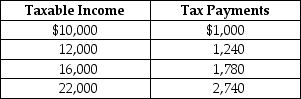 Table 18-7 shows the amount of taxes paid on various levels of income.
-Refer to Table 18-7. The tax system is
Table 18-7 shows the amount of taxes paid on various levels of income.
-Refer to Table 18-7. The tax system is (Multiple Choice)
4.9/5 (70)
(70) Table 18-2
 -Refer to Table 18-2. The table above lists three policy alternatives that the U.S. Senate will vote on, along with the ranking of these alternates. The Senate must decide which of these alternatives should receive an additional $1 billion of funding, and there is enough money in the federal budget for only one of these alternatives. If a series of votes is taken in which each pair of alternatives is considered (homeland security and education; homeland security and medical research; education and medical research) which of the following will result from these votes?
 (Multiple Choice)
4.8/5 (75)
(75) The Gini coefficient for the United States in 1980 was 0.403. In 2016, the coefficient was equal to 0.481. This means that
(Multiple Choice)
4.7/5 (77)
(77) A situation where a member of Congress votes to approve a bill in exchange for favorable votes from other members on other bills is called
(Multiple Choice)
4.9/5 (95)
(95) Figure 18-6  Figure 18-6 shows the Lorenz curves for Islandia and Syldavia.
-Refer to Figure 18-6. Which country has the more unequal distribution of income?
Figure 18-6 shows the Lorenz curves for Islandia and Syldavia.
-Refer to Figure 18-6. Which country has the more unequal distribution of income? (Multiple Choice)
4.8/5 (80)
(80) A regressive tax is a tax for which people with lower incomes
(Multiple Choice)
4.8/5 (84)
(84) Economists caution that conventional statistics used to estimate the extent of poverty in the United States fail to account for benefits people receive that, if considered, would reduce the amount of poverty. Which of the following is an example of these benefits?
(Multiple Choice)
4.9/5 (76)
(76) A CBO study estimated that the excess burden from the corporate income tax ________ of the revenues raised by the tax. This estimate would make the corporate income tax ________ imposed by the federal government.
(Multiple Choice)
4.8/5 (79)
(79) Employees ________ income tax on their wages and salaries, and ________ income tax on the amount employers spend providing them with health insurance.
(Multiple Choice)
4.8/5 (85)
(85) If you pay $3,000 in taxes on an income of $28,000, and $4,450 in taxes on an income of $38,000, what is your marginal tax rate? Show your work.
(Essay)
4.9/5 (80)
(80) An income tax system is ________ if marginal tax rates increase as income increases.
(Multiple Choice)
4.8/5 (87)
(87) Figure 18-2  Figure 18-2 shows a demand curve and two sets of supply curves, one set more elastic than the other.
-Refer to Figure 18-2. If the government imposes an excise tax of $1.00 on every unit sold, the consumer's burden of the tax
Figure 18-2 shows a demand curve and two sets of supply curves, one set more elastic than the other.
-Refer to Figure 18-2. If the government imposes an excise tax of $1.00 on every unit sold, the consumer's burden of the tax (Multiple Choice)
4.9/5 (84)
(84) Of the following sources of tax revenue for state and local governments, which was the smallest in 2016?
(Multiple Choice)
4.9/5 (83)
(83) Congressman Gallstone seeks support from his colleagues for a bill he sponsors that will establish a new national park in his district. He offers to support Congresswoman Disrail's proposal to build a new library in her district in exchange for her vote for his national park bill. This is an example of
(Multiple Choice)
4.9/5 (79)
(79) For the top 1 percent of income distribution, the share of total income earned by households in this group was about ________ percent in 2016.
(Multiple Choice)
4.8/5 (86)
(86) "For a given supply curve, the excess burden of a tax will be greater when the demand for a product is less elastic than when the demand is more elastic." This statement is
(Multiple Choice)
4.8/5 (73)
(73) If you pay $2,000 in taxes on an income of $20,000, and a tax of $3,500 on an income of $30,000, then over this range of income the tax is
(Multiple Choice)
4.8/5 (68)
(68) 
Filters
- Essay(0)
- Multiple Choice(0)
- Short Answer(0)
- True False(0)
- Matching(0)