



 Chat with AI
Exam 18: Public Choice, Taxes, and the Distribution of Income

Exam 1: Economics: Foundations and Models459 Questions
Exam 2: Trade-Offs, Comparative Advantage, and the Market System492 Questions
Exam 3: Where Prices Come From: the Interaction of Demand and Supply476 Questions
Exam 4: Economic Efficiency, Government Price Setting, and Taxes420 Questions
Exam 5: Externalities, Environmental Policy, and Public Goods262 Questions
Exam 6: Elasticity: the Responsiveness of Demand and Supply293 Questions
Exam 7: The Economics of Health Care337 Questions
Exam 8: Firms, the Stock Market, and Corporate Governance512 Questions
Exam 9: Comparative Advantage and the Gains From International Trade377 Questions
Exam 10: Consumer Choice and Behavioral Economics304 Questions
Exam 11: Technology, Production, and Costs326 Questions
Exam 12: Firms in Perfectly Competitive Markets296 Questions
Exam 13: Monopolistic Competition: the Competitive Model in a More Realistic Setting272 Questions
Exam 14: Oligopoly: Firms in Less Competitive Markets256 Questions
Exam 15: Monopoly and Antitrust Policy279 Questions
Exam 16: Pricing Strategy258 Questions
Exam 17: The Markets for Labor and Other Factors of Production279 Questions
Exam 18: Public Choice, Taxes, and the Distribution of Income258 Questions
Exam 19: Gdp: Measuring Total Production and Income260 Questions
Exam 20: Unemployment and Inflation290 Questions
Exam 21: Economic Growth, the Financial System, and Business Cycles251 Questions
Exam 22: Long-Run Economic Growth: Sources and Policies261 Questions
Exam 23: Aggregate Expenditure and Output in the Short Run305 Questions
Exam 24: Aggregate Demand and Aggregate Supply Analysis286 Questions
Exam 25: Money, Banks, and the Federal Reserve System278 Questions
Exam 26: Monetary Policy280 Questions
Exam 27: Fiscal Policy313 Questions
Exam 28: Inflation, Unemployment, and Federal Reserve Policy257 Questions
Exam 29: Macroeconomics in an Open Economy277 Questions
Exam 30: The International Financial System258 Questions
Select questions type


Many economists believe that when the federal government establishes an agency to regulate a particular industry, the regulated firms try to influence the agency even if these actions do not benefit the public. Economists refer to this result of government regulation by which of the following terms?
(Multiple Choice)
4.9/5  (88)
(88) The distribution of income typically refers to how income is distributed across the population ________. Income mobility looks at how a person or family's income changes ________.
(Multiple Choice)
4.8/5 (73)
(73) What is the term that explains why voters often lack knowledge of pending legislation, and lack knowledge of the views of candidates for office on a range of issues that affect their own (the voters') welfare?
(Multiple Choice)
5.0/5 (84)
(84) Figure 18-1  -Refer to Figure 18-1. The excess burden of the tax is represented by the area
 (Multiple Choice)
4.7/5 (86)
(86) Figure 18-9 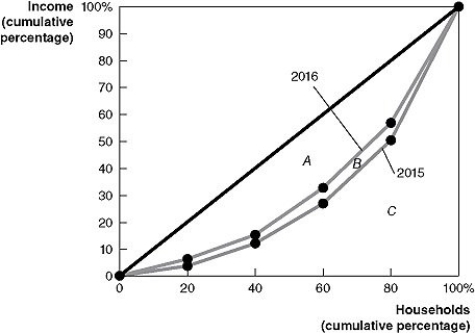 -Refer to Figure 18-9 to answer the following questions.
a. Did the distribution of income become more equal in 2016 that it was in 2015, or did it become less equal? Explain.
b. If area A = 1,600, area B = 200, and area C = 3,200, calculate the Gini coefficient for 2015 and the Gini coefficient for 2016.
-Refer to Figure 18-9 to answer the following questions.
a. Did the distribution of income become more equal in 2016 that it was in 2015, or did it become less equal? Explain.
b. If area A = 1,600, area B = 200, and area C = 3,200, calculate the Gini coefficient for 2015 and the Gini coefficient for 2016. (Essay)
5.0/5 (92)
(92) If the marginal tax rate is less than the average tax rate as taxable income increases, the tax structure is
(Multiple Choice)
4.9/5 (79)
(79) In the United States, taxpayers are allowed to exclude from taxation a certain amount of income, called
(Multiple Choice)
4.8/5 (91)
(91) Figure 18-2  Figure 18-2 shows a demand curve and two sets of supply curves, one set more elastic than the other.
-Refer to Figure 18-2. If the government imposes an excise tax of $1.00 on every unit sold, what is the size of the deadweight loss, if there is any?
Figure 18-2 shows a demand curve and two sets of supply curves, one set more elastic than the other.
-Refer to Figure 18-2. If the government imposes an excise tax of $1.00 on every unit sold, what is the size of the deadweight loss, if there is any? (Multiple Choice)
4.7/5 (78)
(78) In 2016, over 75 percent of the revenue of the U.S. federal government was raised through
(Multiple Choice)
4.8/5 (78)
(78) Economists often analyze the interaction of individuals and firms in markets. Economists also examine the actions of individuals and firms as they attempt to use government to make themselves better off at the expense of others, a process that is referred to as
(Multiple Choice)
4.9/5 (87)
(87) Most businesses in the United States are sole proprietorships. Most sole proprietors pay ________ on their profits.
(Multiple Choice)
4.9/5 (89)
(89) Table 18-4
 -Refer to Table 18-4. The table above outlines the rankings of three members of the U.S. House of Representatives on three spending alternatives. Assume that Congress can spend additional revenue on only one of the three spending alternatives and that Tom, Dick, and Harriet, all members of the House of Representatives, participate in a series of votes in which they are to determine which of the spending alternatives should receive funding. Three votes will be taken: (1) Foreign Aid and Post-Secondary Education (2) Foreign Aid and Roads and Bridges and (3) Post-Secondary Education and Roads and Bridges.
Determine whether the voting paradox will occur as a result of these votes.
-Refer to Table 18-4. The table above outlines the rankings of three members of the U.S. House of Representatives on three spending alternatives. Assume that Congress can spend additional revenue on only one of the three spending alternatives and that Tom, Dick, and Harriet, all members of the House of Representatives, participate in a series of votes in which they are to determine which of the spending alternatives should receive funding. Three votes will be taken: (1) Foreign Aid and Post-Secondary Education (2) Foreign Aid and Roads and Bridges and (3) Post-Secondary Education and Roads and Bridges.
Determine whether the voting paradox will occur as a result of these votes. (Essay)
4.8/5 (72)
(72) When the demand for a product is less elastic than the supply, consumers pay the majority of the tax on the product.
(True/False)
4.8/5 (86)
(86) In the United States, the largest source of funds for public schools is
(Multiple Choice)
4.9/5 (81)
(81) Figure 18-8 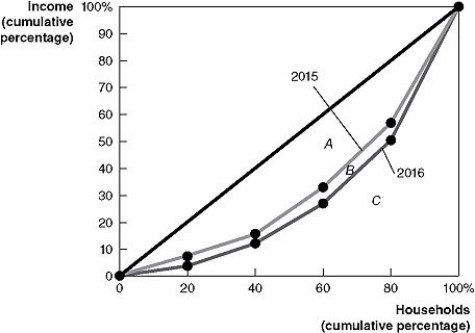 -Refer to Figure 18-8 to answer the following questions.
a. Did the distribution of income become more equal in 2016 than it was in 2015, or did it become less equal? Explain.
b. If area A = 1,900, area B = 450, and area C = 2,650, calculate the Gini coefficient for 2015 and the Gini coefficient for 2016.
-Refer to Figure 18-8 to answer the following questions.
a. Did the distribution of income become more equal in 2016 than it was in 2015, or did it become less equal? Explain.
b. If area A = 1,900, area B = 450, and area C = 2,650, calculate the Gini coefficient for 2015 and the Gini coefficient for 2016. (Essay)
4.8/5 (79)
(79) 
Filters
- Essay(0)
- Multiple Choice(0)
- Short Answer(0)
- True False(0)
- Matching(0)