



 Chat with AI
Exam 22: Long-Run Economic Growth: Sources and Policies

Exam 1: Economics: Foundations and Models459 Questions
Exam 2: Trade-Offs, Comparative Advantage, and the Market System492 Questions
Exam 3: Where Prices Come From: the Interaction of Demand and Supply476 Questions
Exam 4: Economic Efficiency, Government Price Setting, and Taxes420 Questions
Exam 5: Externalities, Environmental Policy, and Public Goods262 Questions
Exam 6: Elasticity: the Responsiveness of Demand and Supply293 Questions
Exam 7: The Economics of Health Care337 Questions
Exam 8: Firms, the Stock Market, and Corporate Governance512 Questions
Exam 9: Comparative Advantage and the Gains From International Trade377 Questions
Exam 10: Consumer Choice and Behavioral Economics304 Questions
Exam 11: Technology, Production, and Costs326 Questions
Exam 12: Firms in Perfectly Competitive Markets296 Questions
Exam 13: Monopolistic Competition: the Competitive Model in a More Realistic Setting272 Questions
Exam 14: Oligopoly: Firms in Less Competitive Markets256 Questions
Exam 15: Monopoly and Antitrust Policy279 Questions
Exam 16: Pricing Strategy258 Questions
Exam 17: The Markets for Labor and Other Factors of Production279 Questions
Exam 18: Public Choice, Taxes, and the Distribution of Income258 Questions
Exam 19: Gdp: Measuring Total Production and Income260 Questions
Exam 20: Unemployment and Inflation290 Questions
Exam 21: Economic Growth, the Financial System, and Business Cycles251 Questions
Exam 22: Long-Run Economic Growth: Sources and Policies261 Questions
Exam 23: Aggregate Expenditure and Output in the Short Run305 Questions
Exam 24: Aggregate Demand and Aggregate Supply Analysis286 Questions
Exam 25: Money, Banks, and the Federal Reserve System278 Questions
Exam 26: Monetary Policy280 Questions
Exam 27: Fiscal Policy313 Questions
Exam 28: Inflation, Unemployment, and Federal Reserve Policy257 Questions
Exam 29: Macroeconomics in an Open Economy277 Questions
Exam 30: The International Financial System258 Questions
Select questions type


The catch-up prediction of economic growth models predicts that ________ across countries will converge over time.
(Multiple Choice)
4.8/5  (75)
(75) Productivity gains in the United States since 1990 have been ________ the productivity gains in other leading industrial nations.
(Multiple Choice)
4.9/5 (77)
(77) In the United States, the number of hours worked per person has decreased since 1800. How would growth rates since 1800 be different if they were calculated for real GDP per capita instead of GDP per hour worked?
(Essay)
4.8/5 (76)
(76) Table 22-6
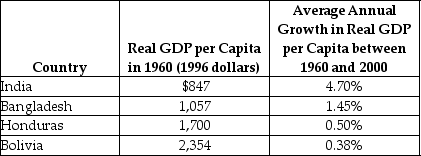 -Refer to Table 22-6. Consider the statistics in the table above in describing the developing countries. Are these consistent with the economic growth model? Briefly explain.
 (Essay)
4.7/5 (76)
(76) All of the following are reasons why China is unlikely to maintain high enough rates of productivity growth to catch-up with the standard of living in the United States except
(Multiple Choice)
5.0/5 (84)
(84) Which of the following government provisions would help increase the accumulation of knowledge capital?
(Multiple Choice)
4.9/5 (84)
(84) A copyright grants the creator of a book, film, or piece of software exclusive legal rights to use the creation for how long?
(Multiple Choice)
4.9/5 (76)
(76) According to new growth theory, firms accumulate the efficient level of both physical and knowledge capital.
(True/False)
4.9/5 (89)
(89) In the early 1900s, Henry Ford revolutionized the automotive manufacturing industry by instituting the assembly line. What impact did the assembly line method for producing automobiles have on the per-worker production function for Ford?
(Multiple Choice)
4.8/5 (81)
(81) High-income countries have ________ and ________ as compared to developing countries.
(Multiple Choice)
4.8/5 (72)
(72) According to Douglass North, the Industrial Revolution occurred in England because
(Multiple Choice)
4.7/5 (68)
(68) In a small Asian country, it is estimated that a $10,000 increase in capital per hour worked will increase real GDP per hour worked by $600. Based on this information, what is the slope of the per-worker production function in this range?
(Multiple Choice)
4.9/5 (75)
(75) In 2016, South America had a lower average GDP per capita than any other continent.
(True/False)
4.8/5 (74)
(74) The Soviet Union's economic growth rate slowed despite rapid increases in capital per hour worked.
(True/False)
4.7/5 (58)
(58) Empirical evidence from 1960 to 2014 shows that convergence in economic growth is occurring in which of the following cases?
(Multiple Choice)
4.9/5 (89)
(89) Draw a graph of "catch-up" that shows where you would expect to see a country with low saving rates and low levels of health and education. How would you expect real GDP per capita to grow in a country like this? Explain.
(Essay)
4.8/5 (80)
(80) If there is a change in the ability of a firm to produce a given level of output with a given level of inputs, we say there is
(Multiple Choice)
4.9/5 (77)
(77) 
Filters
- Essay(0)
- Multiple Choice(0)
- Short Answer(0)
- True False(0)
- Matching(0)