



 Chat with AI
Exam 22: Long-Run Economic Growth: Sources and Policies

Exam 1: Economics: Foundations and Models459 Questions
Exam 2: Trade-Offs, Comparative Advantage, and the Market System492 Questions
Exam 3: Where Prices Come From: the Interaction of Demand and Supply476 Questions
Exam 4: Economic Efficiency, Government Price Setting, and Taxes420 Questions
Exam 5: Externalities, Environmental Policy, and Public Goods262 Questions
Exam 6: Elasticity: the Responsiveness of Demand and Supply293 Questions
Exam 7: The Economics of Health Care337 Questions
Exam 8: Firms, the Stock Market, and Corporate Governance512 Questions
Exam 9: Comparative Advantage and the Gains From International Trade377 Questions
Exam 10: Consumer Choice and Behavioral Economics304 Questions
Exam 11: Technology, Production, and Costs326 Questions
Exam 12: Firms in Perfectly Competitive Markets296 Questions
Exam 13: Monopolistic Competition: the Competitive Model in a More Realistic Setting272 Questions
Exam 14: Oligopoly: Firms in Less Competitive Markets256 Questions
Exam 15: Monopoly and Antitrust Policy279 Questions
Exam 16: Pricing Strategy258 Questions
Exam 17: The Markets for Labor and Other Factors of Production279 Questions
Exam 18: Public Choice, Taxes, and the Distribution of Income258 Questions
Exam 19: Gdp: Measuring Total Production and Income260 Questions
Exam 20: Unemployment and Inflation290 Questions
Exam 21: Economic Growth, the Financial System, and Business Cycles251 Questions
Exam 22: Long-Run Economic Growth: Sources and Policies261 Questions
Exam 23: Aggregate Expenditure and Output in the Short Run305 Questions
Exam 24: Aggregate Demand and Aggregate Supply Analysis286 Questions
Exam 25: Money, Banks, and the Federal Reserve System278 Questions
Exam 26: Monetary Policy280 Questions
Exam 27: Fiscal Policy313 Questions
Exam 28: Inflation, Unemployment, and Federal Reserve Policy257 Questions
Exam 29: Macroeconomics in an Open Economy277 Questions
Exam 30: The International Financial System258 Questions
Select questions type


Robert Lucas, a Nobel laureate in economics, argues that there are ________ returns to human capital.
(Multiple Choice)
4.8/5  (77)
(77) The Soviet Union's economy grew rapidly in terms of GDP per hour worked in the 1950s, but eventually this growth slowed. Why did this occur?
(Multiple Choice)
4.8/5 (80)
(80) In a small European country, it is estimated that a $10,000 increase in capital per hour worked will increase real GDP per hour worked by $300. Based on this information, what is the slope of the per-worker production function in this range?
(Multiple Choice)
5.0/5 (71)
(71) If the Commerce Department adjusts the growth rate of GDP downward for the first quarter of 2018, and the Bureau of Labor Statistics adjusts the number of hours worked upward for the first quarter of 2018, what will the Bureau of Labor Statistics do in terms of revising the figures on the growth rate of labor productivity for the first quarter of 2018?
(Multiple Choice)
4.9/5 (84)
(84) The owner of a firm wants some advice on how to increase productivity. Suggest three ways the entrepreneur could increase labor productivity through improving technology.
(Essay)
4.8/5 (89)
(89) Table 22-2
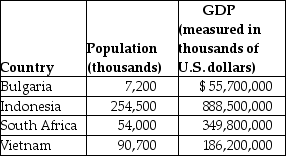 -Refer to Table 22-2. Calculate the GDP per capita for each country in the table. Which country has the highest standard of living? Why?
 (Essay)
4.8/5 (77)
(77) Suggest two policies the government could pursue to help increase the accumulation of knowledge.
(Essay)
4.9/5 (85)
(85) Which of the following reasons has been suggested for Mexico's slow economic growth?
(Multiple Choice)
4.7/5 (73)
(73) All of the following policies are ways for a country to promote long-run economic growth except
(Multiple Choice)
4.9/5 (66)
(66) In a small European country, it is estimated that changing the level of capital from $8 million to $10 million will increase real GDP from $2 million to $3 million. What level of GDP would you expect the economy to be able to reach if spending on capital continued to rise to $12 million, assuming no technological change and no change in the hours of work?
(Multiple Choice)
4.9/5 (93)
(93) Which of the following would you expect to result in faster economic growth?
(Multiple Choice)
4.8/5 (76)
(76) Increased foreign direct investment in India has contributed to its recent economic growth.
(True/False)
4.9/5 (65)
(65) By offering less generous unemployment insurance programs, the United States can expect
(Multiple Choice)
4.9/5 (85)
(85) Growth in real GDP per capita for the world economy was greatest during
(Multiple Choice)
4.8/5 (88)
(88) Which of the following is an example of foreign portfolio investment?
(Multiple Choice)
5.0/5 (91)
(91) Which of the following statements related to productivity growth in China is true?
(Multiple Choice)
4.9/5 (78)
(78) 
Filters
- Essay(0)
- Multiple Choice(0)
- Short Answer(0)
- True False(0)
- Matching(0)