



 Chat with AI
Exam 22: Long-Run Economic Growth: Sources and Policies

Exam 1: Economics: Foundations and Models459 Questions
Exam 2: Trade-Offs, Comparative Advantage, and the Market System492 Questions
Exam 3: Where Prices Come From: the Interaction of Demand and Supply476 Questions
Exam 4: Economic Efficiency, Government Price Setting, and Taxes420 Questions
Exam 5: Externalities, Environmental Policy, and Public Goods262 Questions
Exam 6: Elasticity: the Responsiveness of Demand and Supply293 Questions
Exam 7: The Economics of Health Care337 Questions
Exam 8: Firms, the Stock Market, and Corporate Governance512 Questions
Exam 9: Comparative Advantage and the Gains From International Trade377 Questions
Exam 10: Consumer Choice and Behavioral Economics304 Questions
Exam 11: Technology, Production, and Costs326 Questions
Exam 12: Firms in Perfectly Competitive Markets296 Questions
Exam 13: Monopolistic Competition: the Competitive Model in a More Realistic Setting272 Questions
Exam 14: Oligopoly: Firms in Less Competitive Markets256 Questions
Exam 15: Monopoly and Antitrust Policy279 Questions
Exam 16: Pricing Strategy258 Questions
Exam 17: The Markets for Labor and Other Factors of Production279 Questions
Exam 18: Public Choice, Taxes, and the Distribution of Income258 Questions
Exam 19: Gdp: Measuring Total Production and Income260 Questions
Exam 20: Unemployment and Inflation290 Questions
Exam 21: Economic Growth, the Financial System, and Business Cycles251 Questions
Exam 22: Long-Run Economic Growth: Sources and Policies261 Questions
Exam 23: Aggregate Expenditure and Output in the Short Run305 Questions
Exam 24: Aggregate Demand and Aggregate Supply Analysis286 Questions
Exam 25: Money, Banks, and the Federal Reserve System278 Questions
Exam 26: Monetary Policy280 Questions
Exam 27: Fiscal Policy313 Questions
Exam 28: Inflation, Unemployment, and Federal Reserve Policy257 Questions
Exam 29: Macroeconomics in an Open Economy277 Questions
Exam 30: The International Financial System258 Questions
Select questions type


Figure 22-1  -Refer to Figure 22-1. Many countries in Africa strongly discouraged and prohibited foreign direct investment in the 1950s and 1960s. By doing so, these countries were essentially preventing a moment from
 (Multiple Choice)
5.0/5  (88)
(88) Table 22-5
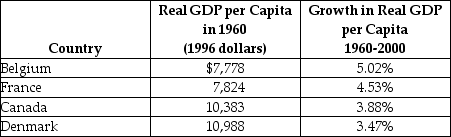 -Refer to Table 22-5. Consider the statistics in the table above in describing the industrialized countries. Are these consistent with the economic growth model? Briefly explain.
 (Essay)
4.8/5 (78)
(78) In the long run, a country will experience an increasing standard of living only if it experiences
(Multiple Choice)
4.8/5 (72)
(72) GDP in a country grew from $10 billion to $14 billion over the span of 5 years. The average annual growth rate of GDP was
(Multiple Choice)
4.8/5 (70)
(70) Of all industrialized nations, real GDP per capita was the highest in Japan in 2016.
(True/False)
4.8/5 (83)
(83) An increase in ________ shifts the production function ________, and makes it possible to produce a higher level of GDP with ________ capital per hour worked.
(Multiple Choice)
5.0/5 (81)
(81) The opportunity cost of being unemployed tends to be the highest in which of the following countries?
(Multiple Choice)
4.9/5 (76)
(76) Developing countries with low saving rates and poor levels of health and education are likely to experience
(Multiple Choice)
4.8/5 (89)
(89) During which of the following periods was growth in GDP per capita the strongest?
(Multiple Choice)
4.9/5 (80)
(80) Article Summary
Due to political, economic, demographic, and cultural reasons, North Africa is experiencing an exodus of some of its brightest students. Limited job opportunities for the young, as well as limited space and poor facilities at universities, have pushed academics abroad for a growing number of North African students. Although this brain drain is leaving the region with a shortage of young, trained professionals, some students have chosen to return home following their graduation, while others who remain abroad send money home to families. Researcher Samia Nour found that these financial remittances from abroad equal the total amount of foreign direct investment for the region. The governments of North Africa have begun to realize the unsustainability of this brain drain, and have enacted policy which requires students with scholarships to return home to work following graduation or else repay all costs of their education.
-Refer to the Article Summary. In North Africa, many students are leaving the country to study abroad, but in some countries, less-educated citizens are the primary group to leave. Should an outflow of citizens leave a country with a smaller but more productive workforce and the capital per hour worked does not change, there would be ________ the per-worker production function in that country.
(Multiple Choice)
4.8/5 (80)
(80) Which of the following accurately describes the impact of the rule of law on a country's economic growth rate?
(Multiple Choice)
4.8/5 (76)
(76) Which of the following countries had the lowest GDP per capita in 2016?
(Multiple Choice)
4.7/5 (76)
(76) Figure 22-1
-Refer to Figure 22-1. Diminishing marginal returns is illustrated in the per-worker production function in the figure above by a movement
-Refer to Figure 22-1. Diminishing marginal returns is illustrated in the per-worker production function in the figure above by a movement (Multiple Choice)
4.8/5 (71)
(71) According to Nobel laureate Douglass North, one reason why the Industrial Revolution occurred in England before many other countries was because the king in England consistently maintained control over the court system and the government.
(True/False)
4.9/5 (87)
(87) Which of the following is a normative statement about economic growth?
(Multiple Choice)
4.7/5 (66)
(66) Most economic growth in the world occurred between 1,000,000 B.C. and 1300 A.D.
(True/False)
4.9/5 (93)
(93) 
Filters
- Essay(0)
- Multiple Choice(0)
- Short Answer(0)
- True False(0)
- Matching(0)