



 Chat with AI
Exam 22: Long-Run Economic Growth: Sources and Policies

Exam 1: Economics: Foundations and Models459 Questions
Exam 2: Trade-Offs, Comparative Advantage, and the Market System492 Questions
Exam 3: Where Prices Come From: the Interaction of Demand and Supply476 Questions
Exam 4: Economic Efficiency, Government Price Setting, and Taxes420 Questions
Exam 5: Externalities, Environmental Policy, and Public Goods262 Questions
Exam 6: Elasticity: the Responsiveness of Demand and Supply293 Questions
Exam 7: The Economics of Health Care337 Questions
Exam 8: Firms, the Stock Market, and Corporate Governance512 Questions
Exam 9: Comparative Advantage and the Gains From International Trade377 Questions
Exam 10: Consumer Choice and Behavioral Economics304 Questions
Exam 11: Technology, Production, and Costs326 Questions
Exam 12: Firms in Perfectly Competitive Markets296 Questions
Exam 13: Monopolistic Competition: the Competitive Model in a More Realistic Setting272 Questions
Exam 14: Oligopoly: Firms in Less Competitive Markets256 Questions
Exam 15: Monopoly and Antitrust Policy279 Questions
Exam 16: Pricing Strategy258 Questions
Exam 17: The Markets for Labor and Other Factors of Production279 Questions
Exam 18: Public Choice, Taxes, and the Distribution of Income258 Questions
Exam 19: Gdp: Measuring Total Production and Income260 Questions
Exam 20: Unemployment and Inflation290 Questions
Exam 21: Economic Growth, the Financial System, and Business Cycles251 Questions
Exam 22: Long-Run Economic Growth: Sources and Policies261 Questions
Exam 23: Aggregate Expenditure and Output in the Short Run305 Questions
Exam 24: Aggregate Demand and Aggregate Supply Analysis286 Questions
Exam 25: Money, Banks, and the Federal Reserve System278 Questions
Exam 26: Monetary Policy280 Questions
Exam 27: Fiscal Policy313 Questions
Exam 28: Inflation, Unemployment, and Federal Reserve Policy257 Questions
Exam 29: Macroeconomics in an Open Economy277 Questions
Exam 30: The International Financial System258 Questions
Select questions type


List two ways the labor force experience is different between workers in Europe and in the United States. How do these differences influence productivity?
(Essay)
4.8/5  (73)
(73) For how long does a patent give a firm the exclusive legal right to a product?
(Multiple Choice)
4.8/5 (79)
(79) Which of the following describes the Soviet Union's economy through most of the second half of the 20th century?
(Multiple Choice)
4.9/5 (83)
(83) Which of the following policies is designed specifically to directly promote technological change in an economy?
(Multiple Choice)
4.8/5 (72)
(72) In a small Asian country, it is estimated that changing the level of capital from $8 million to $12 million will increase real GDP from $5 million to $6 million. If the number of hours worked in the labor force does not change, what does this information tell you about the slope of the per-worker production function in this range?
(Multiple Choice)
4.9/5 (74)
(74) How do government policies that enforce property rights affect economic growth?
(Essay)
4.8/5 (82)
(82) Over the last three decades in the United States, services have become a smaller fraction of GDP relative to goods.
(True/False)
4.9/5 (82)
(82) Figure 22-2  -Refer to Figure 22-2. Based on the per-worker production function above, if the economy raises capital per hour worked from $35,000 to $40,000, by how much will real GDP per hour worked increase?
 (Multiple Choice)
4.9/5 (78)
(78) If real GDP per capita in the United States is $8,000 in 2018, and if real GDP per capita is $12,000 in 2028, what is the total percent change in the growth rate of GDP per capita between 2018 and 2028?
(Multiple Choice)
4.9/5 (76)
(76) One of the primary reasons that Mexico has had trouble attracting foreign investment and has therefore experienced relatively low rates of economic growth is
(Multiple Choice)
4.7/5 (86)
(86) A policy that offers parents a tax reduction based on how much they are saving for their children's college education should ________ the equilibrium level of loanable funds and ________ the rate of long-term growth.
(Multiple Choice)
4.7/5 (79)
(79) Article Summary
Due to political, economic, demographic, and cultural reasons, North Africa is experiencing an exodus of some of its brightest students. Limited job opportunities for the young, as well as limited space and poor facilities at universities, have pushed academics abroad for a growing number of North African students. Although this brain drain is leaving the region with a shortage of young, trained professionals, some students have chosen to return home following their graduation, while others who remain abroad send money home to families. Researcher Samia Nour found that these financial remittances from abroad equal the total amount of foreign direct investment for the region. The governments of North Africa have begun to realize the unsustainability of this brain drain, and have enacted policy which requires students with scholarships to return home to work following graduation or else repay all costs of their education.
-Refer to the Article Summary. If, after the outflow of students in North Africa, it now takes more capital per hour worked to get the same amount of GDP per hour worked, this indicates ________ the per-worker production function in the North African region.
(Multiple Choice)
4.8/5 (71)
(71) Describe the pattern of growth rates in real GDP per hour worked in the United States since the early nineteenth century. Has output per hour worked consistently increased at the same rate? Explain.
(Essay)
4.8/5 (77)
(77) If real GDP per capita in Ireland is estimated to be $7,400 in 2018, what will real GDP per capita be in 2023 if real GDP per capita grows at an annual rate of 2.8%?
(Multiple Choice)
4.9/5 (87)
(87) Figure 22-5 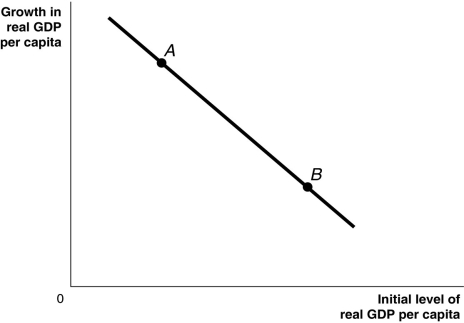 -Refer to Figure 22-5. Based on the "catch-up line" drawn above, poorer countries are more likely to be at a point like ________, where growth in GDP is relatively ________, while richer countries are more likely to be at a point like ________, where growth in GDP is relatively ________.
 (Multiple Choice)
4.9/5 (80)
(80) Figure 22-4  -Refer to Figure 22-4. The movement from E to B to D in the figure above illustrates
 (Multiple Choice)
4.8/5 (70)
(70) 
Filters
- Essay(0)
- Multiple Choice(0)
- Short Answer(0)
- True False(0)
- Matching(0)