



 Chat with AI
Exam 22: Long-Run Economic Growth: Sources and Policies

Exam 1: Economics: Foundations and Models459 Questions
Exam 2: Trade-Offs, Comparative Advantage, and the Market System492 Questions
Exam 3: Where Prices Come From: the Interaction of Demand and Supply476 Questions
Exam 4: Economic Efficiency, Government Price Setting, and Taxes420 Questions
Exam 5: Externalities, Environmental Policy, and Public Goods262 Questions
Exam 6: Elasticity: the Responsiveness of Demand and Supply293 Questions
Exam 7: The Economics of Health Care337 Questions
Exam 8: Firms, the Stock Market, and Corporate Governance512 Questions
Exam 9: Comparative Advantage and the Gains From International Trade377 Questions
Exam 10: Consumer Choice and Behavioral Economics304 Questions
Exam 11: Technology, Production, and Costs326 Questions
Exam 12: Firms in Perfectly Competitive Markets296 Questions
Exam 13: Monopolistic Competition: the Competitive Model in a More Realistic Setting272 Questions
Exam 14: Oligopoly: Firms in Less Competitive Markets256 Questions
Exam 15: Monopoly and Antitrust Policy279 Questions
Exam 16: Pricing Strategy258 Questions
Exam 17: The Markets for Labor and Other Factors of Production279 Questions
Exam 18: Public Choice, Taxes, and the Distribution of Income258 Questions
Exam 19: Gdp: Measuring Total Production and Income260 Questions
Exam 20: Unemployment and Inflation290 Questions
Exam 21: Economic Growth, the Financial System, and Business Cycles251 Questions
Exam 22: Long-Run Economic Growth: Sources and Policies261 Questions
Exam 23: Aggregate Expenditure and Output in the Short Run305 Questions
Exam 24: Aggregate Demand and Aggregate Supply Analysis286 Questions
Exam 25: Money, Banks, and the Federal Reserve System278 Questions
Exam 26: Monetary Policy280 Questions
Exam 27: Fiscal Policy313 Questions
Exam 28: Inflation, Unemployment, and Federal Reserve Policy257 Questions
Exam 29: Macroeconomics in an Open Economy277 Questions
Exam 30: The International Financial System258 Questions
Select questions type


Table 22-3
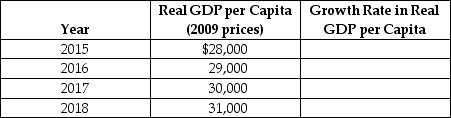 -Refer to Table 22-3. Use the table above to calculate the annual growth rate in GDP. Also calculate the total percentage change in the growth from 2015 through 2018. Explain the difference between the average annual growth rate in real per capita GDP from 2015 through 2018 and the total percentage change in growth from 2015 and 2018.
 (Essay)
4.8/5  (69)
(69) The period of time from 1,000,000 B.C. to 1300 A.D. was a period of
(Multiple Choice)
4.9/5 (90)
(90) Which of the following countries had the highest GDP per capita in 2016?
(Multiple Choice)
4.8/5 (96)
(96) According to Joseph Schumpeter, which of the factors of production is central to economic growth?
(Multiple Choice)
5.0/5 (78)
(78) Policies to promote growth by increasing saving and investment work through
(Multiple Choice)
4.9/5 (80)
(80) The purchase by an individual or firm of stock or bonds issued in another country is called
(Multiple Choice)
4.9/5 (79)
(79) One explanation for recent productivity growth rates appearing worse than they actually are is
(Multiple Choice)
4.8/5 (89)
(89) New growth theory states that increases in ________ capital will result in ________ at the ________ level.
(Multiple Choice)
4.7/5 (90)
(90) From 1990-2016, productivity growth in the United States was ________ the growth rates of other high-income countries.
(Multiple Choice)
4.8/5 (87)
(87) If real GDP per capita in the United States is $8,000 in 2018, and if real GDP per capita is $12,000 in 2028, what is the approximate average annual percent change in the growth rate of GDP per capita between 2018 and 2028?
(Multiple Choice)
4.9/5 (81)
(81) ________ is considered a high income country, ________ a developing country, and ________ a newly industrializing country.
(Multiple Choice)
4.7/5 (85)
(85) One reason why many low-income countries experience low rates of growth is because of low rates of saving and investment in those countries.
(True/False)
4.9/5 (70)
(70) If the slope of the per-worker production function is 1/4 in a given range, how will a $10,000 increase in capital per hour worked affect real GDP per hour worked in the same given range?
(Multiple Choice)
4.8/5 (79)
(79) How does government support of health and education programs foster economic growth?
(Essay)
4.9/5 (72)
(72) The purchase or building by a corporation of a facility in a foreign country is called
(Multiple Choice)
4.8/5 (83)
(83) Robert Lucas argues that there are ________ returns to human capital, and these productivity increases are not completely captured by individuals as they decide how much education to purchase. As a result, the market produces ________ education and training.
(Multiple Choice)
4.9/5 (69)
(69) The lower-income industrial countries are catching up to the higher-income industrial countries in terms of real GDP per capita.
(True/False)
4.7/5 (72)
(72) 
Filters
- Essay(0)
- Multiple Choice(0)
- Short Answer(0)
- True False(0)
- Matching(0)