



 Chat with AI
Exam 26: Monetary Policy

Exam 1: Economics: Foundations and Models459 Questions
Exam 2: Trade-Offs, Comparative Advantage, and the Market System492 Questions
Exam 3: Where Prices Come From: the Interaction of Demand and Supply476 Questions
Exam 4: Economic Efficiency, Government Price Setting, and Taxes420 Questions
Exam 5: Externalities, Environmental Policy, and Public Goods262 Questions
Exam 6: Elasticity: the Responsiveness of Demand and Supply293 Questions
Exam 7: The Economics of Health Care337 Questions
Exam 8: Firms, the Stock Market, and Corporate Governance512 Questions
Exam 9: Comparative Advantage and the Gains From International Trade377 Questions
Exam 10: Consumer Choice and Behavioral Economics304 Questions
Exam 11: Technology, Production, and Costs326 Questions
Exam 12: Firms in Perfectly Competitive Markets296 Questions
Exam 13: Monopolistic Competition: the Competitive Model in a More Realistic Setting272 Questions
Exam 14: Oligopoly: Firms in Less Competitive Markets256 Questions
Exam 15: Monopoly and Antitrust Policy279 Questions
Exam 16: Pricing Strategy258 Questions
Exam 17: The Markets for Labor and Other Factors of Production279 Questions
Exam 18: Public Choice, Taxes, and the Distribution of Income258 Questions
Exam 19: Gdp: Measuring Total Production and Income260 Questions
Exam 20: Unemployment and Inflation290 Questions
Exam 21: Economic Growth, the Financial System, and Business Cycles251 Questions
Exam 22: Long-Run Economic Growth: Sources and Policies261 Questions
Exam 23: Aggregate Expenditure and Output in the Short Run305 Questions
Exam 24: Aggregate Demand and Aggregate Supply Analysis286 Questions
Exam 25: Money, Banks, and the Federal Reserve System278 Questions
Exam 26: Monetary Policy280 Questions
Exam 27: Fiscal Policy313 Questions
Exam 28: Inflation, Unemployment, and Federal Reserve Policy257 Questions
Exam 29: Macroeconomics in an Open Economy277 Questions
Exam 30: The International Financial System258 Questions
Select questions type


When the Fed sells a security to a financial firm and the Fed agrees to buy back the security the next day, the transaction is known as
(Multiple Choice)
4.9/5  (62)
(62) Most of the pressure for a monetary growth rule has disappeared because since 1980
(Multiple Choice)
4.9/5 (90)
(90) Write out the expression for the Taylor rule. Use the Taylor rule to explain how a decline in real GDP below potential GDP will affect the Federal Reserve's target for the federal funds rate.
(Essay)
4.9/5 (79)
(79) Most economists believe that the best monetary policy target is
(Multiple Choice)
4.9/5 (86)
(86) The Taylor rule accurately predicted the changes in the federal funds target during the period
(Multiple Choice)
4.8/5 (92)
(92) The leader of the monetarist school and major proponent of a monetary growth rule was
(Multiple Choice)
4.8/5 (76)
(76) What actions should the Fed take if it believes the economy is about to fall into recession?
(Essay)
5.0/5 (90)
(90) Figure 26-7  -Refer to Figure 26-7. Suppose the economy is in a recession and no policy is pursued. Using the basic AD-AS model in the figure above, this situation would be depicted as a movement from
 (Multiple Choice)
4.8/5 (78)
(78) Figure 26-4 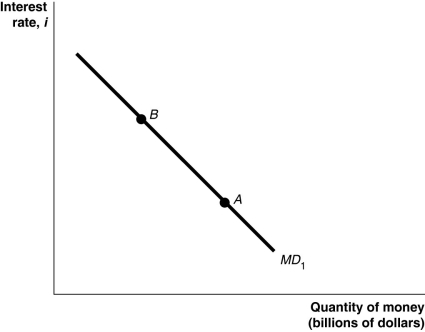 -Refer to Figure 26-4. In the figure above, a movement from point A to point B would be caused by
 (Multiple Choice)
4.8/5 (72)
(72) When the Federal Reserve increases the money supply, people spend more because they now have more money.
(True/False)
5.0/5 (77)
(77) Does the money demand curve have a positive slope or a negative slope? Why does it have this slope? Explain why an increase in the variable on the vertical axis of the money demand curve causes either an increase or a decrease in the variable on the horizontal axis of the money demand curve.
(Essay)
4.9/5 (78)
(78) With the federal funds rate near zero and the economy still struggling, in response to already low interest rates doing little to stimulate the economy, the Fed began buying 10-year Treasury notes and certain mortgage-backed securities to keep interest rates low. This policy is known as
(Multiple Choice)
4.7/5 (72)
(72) The dynamic aggregate demand and aggregate supply model accounts for the price level rising every year.
(True/False)
4.8/5 (65)
(65) To reassure investors who were unwilling to buy mortgages in the secondary market, the U.S. Congress used two government sponsored enterprises, Fannie Mae and Freddie Mac, to stand between investors and banks that grant mortgages. Fannie Mae and Freddie Mac
(Multiple Choice)
4.8/5 (78)
(78) Under the monetary growth rule proposed by the monetarists, the money supply would grow each year at a constant rate equal to the long-run rate of growth of
(Multiple Choice)
4.8/5 (94)
(94) Figure 26-5 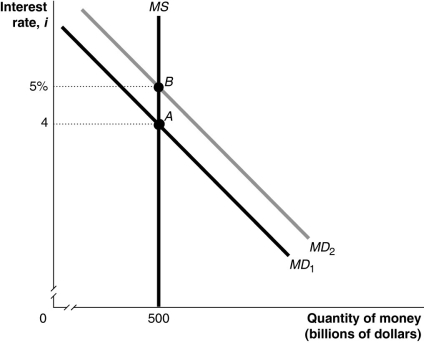 -Refer to Figure 26-5. In the figure above, the movement from point A to point B in the money market would be caused by
 (Multiple Choice)
4.8/5 (68)
(68) Figure 26-1 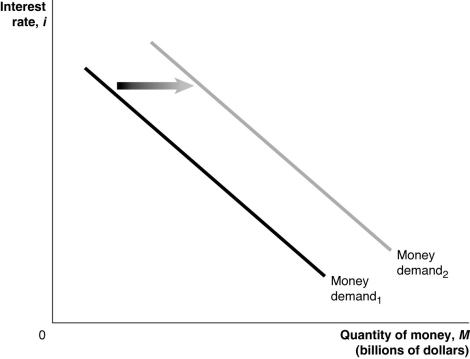 -Refer to Figure 26-1. In the figure above, the money demand curve would move from Money demand1 to Money demand2 if
 (Multiple Choice)
4.8/5 (81)
(81) Suppose the equilibrium real federal funds rate is 3 percent, the target rate of inflation is 3 percent, the current inflation rate is 1 percent, and real GDP is 8 percent below potential real GDP. If the weights for the inflation gap and the output gap are both 1/2, then according to the Taylor rule the federal funds target rate equals
(Multiple Choice)
4.9/5 (81)
(81) 
Filters
- Essay(0)
- Multiple Choice(0)
- Short Answer(0)
- True False(0)
- Matching(0)