



 Chat with AI
Exam 26: Monetary Policy

Exam 1: Economics: Foundations and Models459 Questions
Exam 2: Trade-Offs, Comparative Advantage, and the Market System492 Questions
Exam 3: Where Prices Come From: the Interaction of Demand and Supply476 Questions
Exam 4: Economic Efficiency, Government Price Setting, and Taxes420 Questions
Exam 5: Externalities, Environmental Policy, and Public Goods262 Questions
Exam 6: Elasticity: the Responsiveness of Demand and Supply293 Questions
Exam 7: The Economics of Health Care337 Questions
Exam 8: Firms, the Stock Market, and Corporate Governance512 Questions
Exam 9: Comparative Advantage and the Gains From International Trade377 Questions
Exam 10: Consumer Choice and Behavioral Economics304 Questions
Exam 11: Technology, Production, and Costs326 Questions
Exam 12: Firms in Perfectly Competitive Markets296 Questions
Exam 13: Monopolistic Competition: the Competitive Model in a More Realistic Setting272 Questions
Exam 14: Oligopoly: Firms in Less Competitive Markets256 Questions
Exam 15: Monopoly and Antitrust Policy279 Questions
Exam 16: Pricing Strategy258 Questions
Exam 17: The Markets for Labor and Other Factors of Production279 Questions
Exam 18: Public Choice, Taxes, and the Distribution of Income258 Questions
Exam 19: Gdp: Measuring Total Production and Income260 Questions
Exam 20: Unemployment and Inflation290 Questions
Exam 21: Economic Growth, the Financial System, and Business Cycles251 Questions
Exam 22: Long-Run Economic Growth: Sources and Policies261 Questions
Exam 23: Aggregate Expenditure and Output in the Short Run305 Questions
Exam 24: Aggregate Demand and Aggregate Supply Analysis286 Questions
Exam 25: Money, Banks, and the Federal Reserve System278 Questions
Exam 26: Monetary Policy280 Questions
Exam 27: Fiscal Policy313 Questions
Exam 28: Inflation, Unemployment, and Federal Reserve Policy257 Questions
Exam 29: Macroeconomics in an Open Economy277 Questions
Exam 30: The International Financial System258 Questions
Select questions type


Figure 26-7  -Refer to Figure 26-7. Suppose the Fed lowers its target for the federal funds rate. Using the basic AD-AS model in the figure above, this situation would be depicted as a movement from
 (Multiple Choice)
4.9/5  (89)
(89) When calculating GDP, the Bureau of Economic Analysis releases its "advanced estimate" of a quarter's GDP approximately
(Multiple Choice)
4.7/5 (73)
(73) Figure 26-13 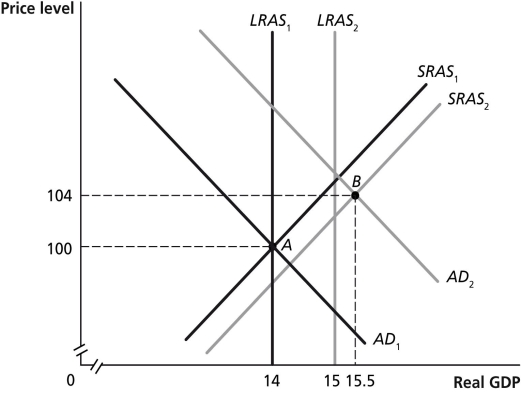 -Refer to Figure 26-13. In the figure above, if the economy in Year 1 is at point A and is expected in Year 2 to be at point B, then the appropriate monetary policy by the Federal Reserve would be to
 (Multiple Choice)
4.9/5 (70)
(70) Federal Reserve Board Chairmen Paul Volcker, as well as later Fed chairs, focused on which of the following as their main goal of monetary policy?
(Multiple Choice)
5.0/5 (76)
(76) Figure 26-12  -Refer to Figure 26-12. In the dynamic AD-AS model, if the economy is at point A in year 1 and is expected to go to point B in year 2, and the Federal Reserve pursues no policy, then at point B
 (Multiple Choice)
4.8/5 (90)
(90) Figure 26-12
-Refer to Figure 26-12. In the dynamic AD-AS model, the economy is at point A in year 1 and is expected to go to point B in year 2, and the Federal Reserve pursues policy. This will result in
-Refer to Figure 26-12. In the dynamic AD-AS model, the economy is at point A in year 1 and is expected to go to point B in year 2, and the Federal Reserve pursues policy. This will result in (Multiple Choice)
4.7/5 (81)
(81) The supporters of a monetary growth rule believe that active monetary policy
(Multiple Choice)
4.8/5 (76)
(76) The consumer price index (CPI), the personal consumption expenditures price index (PCE), and the core PCE have over the last 15 years
(Multiple Choice)
4.8/5 (95)
(95) Although the Federal Reserve had traditionally made discount loans only to commercial banks, in response to the financial crisis in 2008 the Fed made ________ eligible for discount loans as well.
(Multiple Choice)
4.9/5 (81)
(81) When the Fed buys a security from a financial firm and the financial firm agrees to buy back the security the next day, the transaction is known as
(Multiple Choice)
4.9/5 (73)
(73) Table 26-4
 -Refer to Table 26-4. Suppose the following table illustrates the values of real and potential GDP and the price level if the Fed does not vote to change their current policy to be more contractionary or expansionary. If the Fed wants to keep real GDP at its potential level in 2019, should the Fed use a contractionary or expansionary policy? How should it conduct open market operations to achieve its goal?
 (Essay)
4.9/5 (81)
(81) The main goal of monetary policy for recent Fed Chairmen has been to maintain high employment in labor markets.
(True/False)
5.0/5 (82)
(82) Why doesn't the Fed have both a money supply target and an interest rate target?
(Multiple Choice)
4.9/5 (77)
(77) Figure 26-12
-Refer to Figure 26-12. In the dynamic AD-AS model, if the economy is at point A in year 1 and is expected to go to point B in year 2, the Federal Reserve would most likely
-Refer to Figure 26-12. In the dynamic AD-AS model, if the economy is at point A in year 1 and is expected to go to point B in year 2, the Federal Reserve would most likely (Multiple Choice)
4.8/5 (81)
(81) The body that is responsible for dating the beginning and ending dates for a recession is
(Multiple Choice)
4.7/5 (75)
(75) What is a reverse repurchase agreement? How does the Fed use reverse repurchase agreements to target the federal funds rate?
(Essay)
4.9/5 (68)
(68) Using the money demand and money supply model, an increase in money demand would cause the equilibrium interest rate to
(Multiple Choice)
4.8/5 (77)
(77) In 2008, the Fed began paying banks interest on their reserve holdings.
(True/False)
4.9/5 (75)
(75) 
Filters
- Essay(0)
- Multiple Choice(0)
- Short Answer(0)
- True False(0)
- Matching(0)