



 Chat with AI
Exam 26: Monetary Policy

Exam 1: Economics: Foundations and Models459 Questions
Exam 2: Trade-Offs, Comparative Advantage, and the Market System492 Questions
Exam 3: Where Prices Come From: the Interaction of Demand and Supply476 Questions
Exam 4: Economic Efficiency, Government Price Setting, and Taxes420 Questions
Exam 5: Externalities, Environmental Policy, and Public Goods262 Questions
Exam 6: Elasticity: the Responsiveness of Demand and Supply293 Questions
Exam 7: The Economics of Health Care337 Questions
Exam 8: Firms, the Stock Market, and Corporate Governance512 Questions
Exam 9: Comparative Advantage and the Gains From International Trade377 Questions
Exam 10: Consumer Choice and Behavioral Economics304 Questions
Exam 11: Technology, Production, and Costs326 Questions
Exam 12: Firms in Perfectly Competitive Markets296 Questions
Exam 13: Monopolistic Competition: the Competitive Model in a More Realistic Setting272 Questions
Exam 14: Oligopoly: Firms in Less Competitive Markets256 Questions
Exam 15: Monopoly and Antitrust Policy279 Questions
Exam 16: Pricing Strategy258 Questions
Exam 17: The Markets for Labor and Other Factors of Production279 Questions
Exam 18: Public Choice, Taxes, and the Distribution of Income258 Questions
Exam 19: Gdp: Measuring Total Production and Income260 Questions
Exam 20: Unemployment and Inflation290 Questions
Exam 21: Economic Growth, the Financial System, and Business Cycles251 Questions
Exam 22: Long-Run Economic Growth: Sources and Policies261 Questions
Exam 23: Aggregate Expenditure and Output in the Short Run305 Questions
Exam 24: Aggregate Demand and Aggregate Supply Analysis286 Questions
Exam 25: Money, Banks, and the Federal Reserve System278 Questions
Exam 26: Monetary Policy280 Questions
Exam 27: Fiscal Policy313 Questions
Exam 28: Inflation, Unemployment, and Federal Reserve Policy257 Questions
Exam 29: Macroeconomics in an Open Economy277 Questions
Exam 30: The International Financial System258 Questions
Select questions type


In the following table, fill in the columns for your return on investment if the price of your house increased or decreased by 40 percent, based on the down payments specified in the first column.
Return on Your Investment From
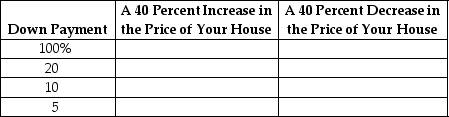
(Essay)
4.8/5  (74)
(74) The Federal Reserve does not target both the money supply and an interest rate because
(Multiple Choice)
4.9/5 (80)
(80) Using the Taylor rule, if the current inflation rate equals the target inflation rate and real GDP equals potential GDP, then the federal funds target rate equals the
(Multiple Choice)
4.8/5 (74)
(74) Suppose that the Federal Reserve Open Market Committee adheres to the ideas expressed by ________. If the economy moves into a recession, the Fed would recommend that the federal funds target rate decrease as long as the inflation rate did not rise above the publicly announced goal for inflation.
(Multiple Choice)
4.9/5 (69)
(69) Figure 26-2  -Refer to Figure 26-2. In the figure above, the movement from point A to point B in the money market would be caused by
 (Multiple Choice)
4.9/5 (82)
(82) Suppose that households became mistrustful of the banking system and decide to decrease their checking account balances and increase their holdings of currency. Using the money demand and money supply model and assuming everything else is held constant, the equilibrium interest rate should
(Multiple Choice)
4.8/5 (77)
(77) If the probability of losing your job remains ________, a recession would be a good time to purchase a home because the Fed usually ________ interest rates during this time.
(Multiple Choice)
4.8/5 (81)
(81) Inflation targeting allows monetary policy to focus on inflation and inflation forecasts except during times of severe recession.
(True/False)
4.9/5 (70)
(70) In 2017, some banks in Europe had to make interest payments to borrowers rather than receive interest payments from borrowers. Which of the following statements describes this situation?
(Multiple Choice)
5.0/5 (87)
(87) Figure 26-10 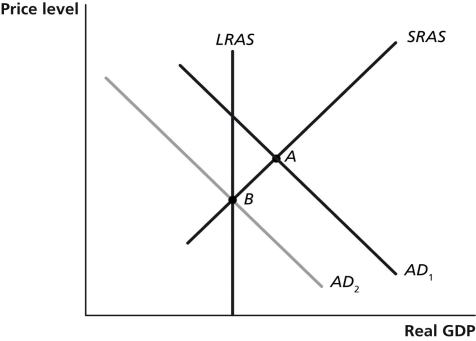 -Refer to Figure 26-10. In the figure above, suppose the economy is initially at point A. The movement of the economy to point B as shown in the graph illustrates the effect of which of the following policy actions by the Federal Reserve?
 (Multiple Choice)
4.9/5 (84)
(84) Figure 26-7  -Refer to Figure 26-7. Suppose the economy is in short-run equilibrium above potential GDP, the unemployment rate is very low, and wages and prices are rising. Using the basic AD-AS model in the figure above, the correct Fed policy for this situation would be depicted as a movement from
 (Multiple Choice)
4.9/5 (69)
(69) Figure 26-11  -Refer to Figure 26-11. In the dynamic model of AD-AS in the figure above, if the economy is at point A in year 1 and is expected to go to point B in year 2, and the Federal Reserve pursues no policy, then at point B
 (Multiple Choice)
4.9/5 (72)
(72) By the 2000s, an important market change occurred when investment banks became significant participants in the secondary market for
(Multiple Choice)
5.0/5 (83)
(83) Your income will increase if the Federal Reserve buys a Treasury bill from you and pays you with a check from the Fed.
(True/False)
4.7/5 (85)
(85) Which of the following would cause the money demand curve to shift to the left?
(Multiple Choice)
4.9/5 (82)
(82) Figure 26-9 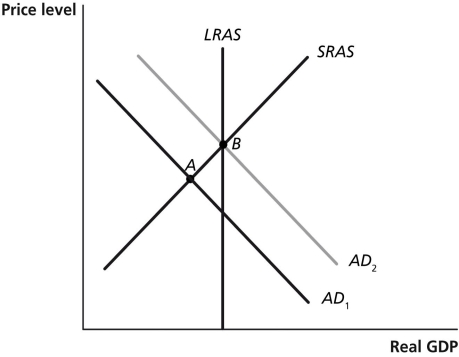 -Refer to Figure 26-9. In the figure above suppose the economy is initially at point A. The movement of the economy to point B as shown in the graph illustrates the effect of which of the following policy actions by the Federal Reserve?
 (Multiple Choice)
4.9/5 (77)
(77) What is a mortgage? What were the important developments in the mortgage market during the years after 1970?
(Essay)
4.9/5 (80)
(80) Give an example of a monetary policy target. Explain why the Fed uses policy targets.
(Essay)
4.9/5 (82)
(82) 
Filters
- Essay(0)
- Multiple Choice(0)
- Short Answer(0)
- True False(0)
- Matching(0)