



 Chat with AI
Exam 26: Monetary Policy

Exam 1: Economics: Foundations and Models459 Questions
Exam 2: Trade-Offs, Comparative Advantage, and the Market System492 Questions
Exam 3: Where Prices Come From: the Interaction of Demand and Supply476 Questions
Exam 4: Economic Efficiency, Government Price Setting, and Taxes420 Questions
Exam 5: Externalities, Environmental Policy, and Public Goods262 Questions
Exam 6: Elasticity: the Responsiveness of Demand and Supply293 Questions
Exam 7: The Economics of Health Care337 Questions
Exam 8: Firms, the Stock Market, and Corporate Governance512 Questions
Exam 9: Comparative Advantage and the Gains From International Trade377 Questions
Exam 10: Consumer Choice and Behavioral Economics304 Questions
Exam 11: Technology, Production, and Costs326 Questions
Exam 12: Firms in Perfectly Competitive Markets296 Questions
Exam 13: Monopolistic Competition: the Competitive Model in a More Realistic Setting272 Questions
Exam 14: Oligopoly: Firms in Less Competitive Markets256 Questions
Exam 15: Monopoly and Antitrust Policy279 Questions
Exam 16: Pricing Strategy258 Questions
Exam 17: The Markets for Labor and Other Factors of Production279 Questions
Exam 18: Public Choice, Taxes, and the Distribution of Income258 Questions
Exam 19: Gdp: Measuring Total Production and Income260 Questions
Exam 20: Unemployment and Inflation290 Questions
Exam 21: Economic Growth, the Financial System, and Business Cycles251 Questions
Exam 22: Long-Run Economic Growth: Sources and Policies261 Questions
Exam 23: Aggregate Expenditure and Output in the Short Run305 Questions
Exam 24: Aggregate Demand and Aggregate Supply Analysis286 Questions
Exam 25: Money, Banks, and the Federal Reserve System278 Questions
Exam 26: Monetary Policy280 Questions
Exam 27: Fiscal Policy313 Questions
Exam 28: Inflation, Unemployment, and Federal Reserve Policy257 Questions
Exam 29: Macroeconomics in an Open Economy277 Questions
Exam 30: The International Financial System258 Questions
Select questions type


Which of the following correctly describes what the Fed used as monetary targets in the past?
(Multiple Choice)
5.0/5  (70)
(70) If the Fed orders an expansionary monetary policy, describe what will happen to the following variables relative to what would have happened without the policy:
a. The money supply
b. Interest rates
c. Investment
d. Consumption
e. Net Exports
f. The aggregate demand curve
g. Real GDP
h. The price level
(Essay)
4.9/5 (83)
(83) Consider the Taylor rule for the target of the federal funds rate. Suppose the equilibrium real federal funds rate is 2 percent, the target rate of inflation is 3 percent, the current inflation rate is 3 percent, real GDP equals potential real GDP, and the weights are 1/2 for the inflation gap and the output gap. Using the Taylor rule, what does the target for the federal funds rate equal? Next, if the Federal Reserve lowered the target for the inflation rate to 1 percent, how much would the target for the federal funds rate change?
(Essay)
4.8/5 (74)
(74) Which of the following situations is one in which the Fed will potentially pursue expansionary monetary policy?
(Multiple Choice)
4.9/5 (72)
(72) Suppose the equilibrium real federal funds rate is 2 percent, the target rate of inflation is 2 percent, the current inflation rate is 4 percent, and real GDP is 2 percent above potential real GDP. If the weights for the inflation gap and the output gap are both 1/2, then according to the Taylor rule the federal funds target rate equals
(Multiple Choice)
4.7/5 (64)
(64) Expansionary monetary policy to prevent real GDP from falling below potential real GDP would cause the inflation rate to be relatively ________ and real GDP to be relatively ________.
(Multiple Choice)
4.8/5 (68)
(68) Monetarists think that the Fed should use ________ as a target when conducting monetary policy.
(Multiple Choice)
5.0/5 (83)
(83) Use a graph to show the effects of a contractionary monetary policy to reduce inflation and move an economy back to potential real GDP. Explain what happens to aggregate demand, real GDP, and the price level.
(Essay)
4.8/5 (73)
(73) Which of the following characterizes the Fed's ability to prevent recessions?
(Multiple Choice)
5.0/5 (80)
(80) Mortgage lenders often resell mortgages in secondary markets. How might this make lenders act differently than if they intended to hold the mortgages themselves?
(Essay)
4.9/5 (96)
(96) The Federal Reserve responded to the 2008 financial crisis in several ways. Which of the following is not one of the ways the Fed responded?
(Multiple Choice)
4.9/5 (70)
(70) Figure 26-14 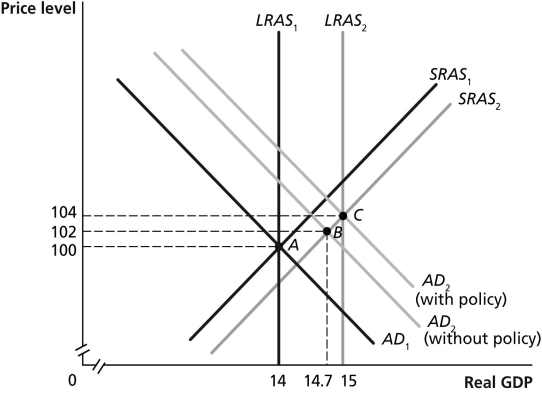 -Refer to Figure 26-14. In the figure above, suppose the economy in Year 1 is at point A and is expected in Year 2 to be at point B. Which of the following policies could the Federal Reserve use to move the economy to point C?
 (Multiple Choice)
4.9/5 (76)
(76) Figure 26-1  -Refer to Figure 26-1. In the figure, the money demand curve would move from Money demand1 to Money demand2 if
 (Multiple Choice)
4.7/5 (79)
(79) In June 2017, the Federal Open Market Committee raised the target for the federal funds rate to a range of 1.00 to 1.25 percent. To keep the federal funds rate in this target band, the Fed set the interest rate it pays on bank reserves to
(Multiple Choice)
4.8/5 (92)
(92) Article Summary
With global borrowing costs so low, economic analysts are warning that central banks need to be prepared to set negative interest rates during the next economic downturn. Several central banks in Europe set negative interest rates in 2014, as did the Japanese central bank in 2016, in an attempt to spur lending. The global market value of negative-yielding bonds rose to $8.6 trillion in mid-2017 due to low inflation and increased perceptions of geopolitical risk. The current U.S. economic expansion is the third longest since the 19th century, and credit markets are showing signs of reaching a cyclical peak. According to Harvard professor Kenneth Rogoff, low interest rates this late in an economic cycle are unprecedented, noting that the Fed cut interest rates by an average of 5.5 percentage points in the nine recessions since the 1950s, and this would be impossible today without negative interest rates.
-Refer to the Article Summary. Implementing a negative interest rate policy, as is discussed in the article summary, would be designed to ________ the price level and ________ real GDP.
(Multiple Choice)
4.9/5 (76)
(76) Figure 26-7  -Refer to Figure 26-7. Suppose the Fed sells Treasury Bills in pursuit of contractionary monetary policy. Using the basic AD-AS model in the figure above, this situation would be depicted as a movement from
 (Multiple Choice)
4.9/5 (73)
(73) Which of the following statements about inflation targeting is true?
(Multiple Choice)
4.9/5 (90)
(90) To reassure investors who were unwilling to buy mortgages in the secondary market, the U.S. Congress used two government sponsored enterprises, ________, to sell bonds to investors and use the funds to purchase mortgages from banks.
(Multiple Choice)
4.7/5 (88)
(88) By the 2000s, investment banks had become significant participants in the secondary market for mortgages.
(True/False)
4.8/5 (79)
(79) Maintaining a strong dollar in international currency markets is not one of the four monetary policy goals of the Fed listed in the textbook.
(True/False)
4.9/5 (74)
(74) 
Filters
- Essay(0)
- Multiple Choice(0)
- Short Answer(0)
- True False(0)
- Matching(0)