



 Chat with AI
Exam 26: Monetary Policy

Exam 1: Economics: Foundations and Models459 Questions
Exam 2: Trade-Offs, Comparative Advantage, and the Market System492 Questions
Exam 3: Where Prices Come From: the Interaction of Demand and Supply476 Questions
Exam 4: Economic Efficiency, Government Price Setting, and Taxes420 Questions
Exam 5: Externalities, Environmental Policy, and Public Goods262 Questions
Exam 6: Elasticity: the Responsiveness of Demand and Supply293 Questions
Exam 7: The Economics of Health Care337 Questions
Exam 8: Firms, the Stock Market, and Corporate Governance512 Questions
Exam 9: Comparative Advantage and the Gains From International Trade377 Questions
Exam 10: Consumer Choice and Behavioral Economics304 Questions
Exam 11: Technology, Production, and Costs326 Questions
Exam 12: Firms in Perfectly Competitive Markets296 Questions
Exam 13: Monopolistic Competition: the Competitive Model in a More Realistic Setting272 Questions
Exam 14: Oligopoly: Firms in Less Competitive Markets256 Questions
Exam 15: Monopoly and Antitrust Policy279 Questions
Exam 16: Pricing Strategy258 Questions
Exam 17: The Markets for Labor and Other Factors of Production279 Questions
Exam 18: Public Choice, Taxes, and the Distribution of Income258 Questions
Exam 19: Gdp: Measuring Total Production and Income260 Questions
Exam 20: Unemployment and Inflation290 Questions
Exam 21: Economic Growth, the Financial System, and Business Cycles251 Questions
Exam 22: Long-Run Economic Growth: Sources and Policies261 Questions
Exam 23: Aggregate Expenditure and Output in the Short Run305 Questions
Exam 24: Aggregate Demand and Aggregate Supply Analysis286 Questions
Exam 25: Money, Banks, and the Federal Reserve System278 Questions
Exam 26: Monetary Policy280 Questions
Exam 27: Fiscal Policy313 Questions
Exam 28: Inflation, Unemployment, and Federal Reserve Policy257 Questions
Exam 29: Macroeconomics in an Open Economy277 Questions
Exam 30: The International Financial System258 Questions
Select questions type


Table 26-3
 -Refer to Table 26-3. Consider the hypothetical information in the table above for potential real GDP, real GDP, and the price level in 2018 and in 2019 if the Federal Reserve does not use monetary policy. If the Fed uses monetary policy successfully to keep real GDP at its potential level in 2019, which of the following will be lower than if the Fed had taken no action?
 (Multiple Choice)
4.8/5  (88)
(88) Table 26-6
 -Refer to Table 26-6. Suppose the table above illustrates the values of real and potential GDP and the price level if the Fed does not vote to change their current policy to be more contractionary or expansionary. If the Fed wants to keep real GDP at its potential level in 2019, should the Fed use a contractionary or expansionary policy? Should it raise or lower its interest rate target? How should it conduct open market operations to achieve its goal?
 (Essay)
4.9/5 (87)
(87) Expansionary monetary policy to prevent real GDP from falling below potential real GDP would cause the inflation rate to be ________ and real GDP to be ________.
(Multiple Choice)
4.9/5 (91)
(91) A monetary policy target is a variable that the Fed can affect directly, which then affects one or more of the Fed's policy goals.
(True/False)
5.0/5 (80)
(80) A financial asset is considered ________ if it can be sold in a secondary market.
(Multiple Choice)
4.7/5 (77)
(77) If the Fed raises its target for the federal fund rate, this indicates that
(Multiple Choice)
4.8/5 (70)
(70) Inflation targeting is a framework for carrying out monetary policy whereby
(Multiple Choice)
4.9/5 (81)
(81) In the following table, fill in the columns for your return on investment if the price of your house increased or decreased by 20 percent, based on the down payments specified in the first column.
Return on Your Investment From
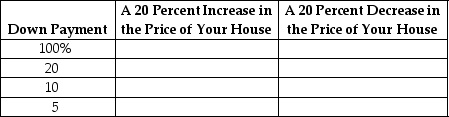
(Essay)
4.9/5 (80)
(80) The Fed has adopted an interest rate target for most of the time since World War II.
(True/False)
4.8/5 (80)
(80) In June 2017, the Federal Open Market Committee raised the target for the federal funds rate to a range of 1.00 to 1.25 percent. To keep the federal funds rate in this target band, the Fed set the interest rate it pays on reverse repurchase agreements to
(Multiple Choice)
4.8/5 (91)
(91) Table 26-2
 -Refer to Table 26-2. Consider the hypothetical information in the table above for potential real GDP, real GDP, and the price level in 2018 and in 2019 if the Federal Reserve does not use monetary policy. If the Fed uses monetary policy successfully to keep real GDP at its potential level in 2019, which of the following will be higher than if the Fed had taken no action?
 (Multiple Choice)
4.9/5 (85)
(85) The economy suffered a mild recession in 2001. Despite the recession, home sales and durable goods sales remained high. Which of the following is a plausible explanation?
(Multiple Choice)
4.9/5 (82)
(82) Using the Taylor rule, if the current inflation rate equals the target inflation rate and real GDP is less than potential GDP, then the federal funds target rate ________ the sum of the current inflation rate plus the real equilibrium federal funds rate.
(Multiple Choice)
4.7/5 (67)
(67) What actions should the Fed take if it believes the economy is about to experience a high rate of inflation?
(Essay)
4.9/5 (72)
(72) When the Federal Reserve System was established in 1913, its main policy goal was
(Multiple Choice)
4.9/5 (84)
(84) 
Filters
- Essay(0)
- Multiple Choice(0)
- Short Answer(0)
- True False(0)
- Matching(0)