



 Chat with AI
Exam 11: The Income-Expenditure Model

Exam 1: Introduction: What Is Economics144 Questions
Exam 2: The Key Principles of Economics195 Questions
Exam 3: Exchange and Markets135 Questions
Exam 4: Demand, Supply, and Market Equilibrium279 Questions
Exam 5: Measuring a Nations Production and Income161 Questions
Exam 6: Unemployment and Inflation206 Questions
Exam 7: The Economy at Full Employment165 Questions
Exam 8: Why Do Economies Grow203 Questions
Exam 9: Aggregate Demand and Aggregate Supply189 Questions
Exam 10: Fiscal Policy166 Questions
Exam 11: The Income-Expenditure Model265 Questions
Exam 12: Investment and Financial Markets179 Questions
Exam 13: Money and the Banking System184 Questions
Exam 14: The Federal Reserve and Monetary Policy203 Questions
Exam 15: Modern Macroeconomics: From the Short Run to the Long Run176 Questions
Exam 16: The Dynamics of Inflation and Unemployment186 Questions
Exam 17: Macroeconomic Policy Debates143 Questions
Exam 18: International Trade and Public Policy226 Questions
Exam 19: The World of International Finance189 Questions
Select questions type


If the marginal propensity to import is 0.2, then a $1,000 increase in income will:
(Multiple Choice)
4.8/5  (83)
(83) 
 -Refer to Table 11.5. If G increases to 400 (all other components constant), then the equilibrium income in this economy increases by:
 (Multiple Choice)
4.8/5 (85)
(85) 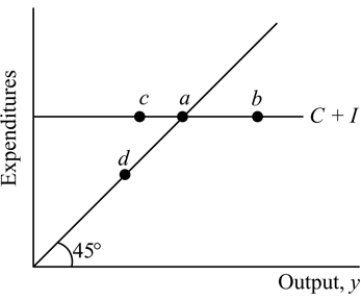 Figure 11.1
-Refer to Figure 11.1. If the expenditures in the economy correspond to C + I, what should businesses do to get back to equilibrium if the economy is at point b?
Figure 11.1
-Refer to Figure 11.1. If the expenditures in the economy correspond to C + I, what should businesses do to get back to equilibrium if the economy is at point b? (Multiple Choice)
4.9/5 (76)
(76) When the consumption function is expressed as C = Ca + b (y- T), taxes are collected by the government as:
(Multiple Choice)
4.8/5 (85)
(85) Recall Application 4, "The Locomotive Effect: Why Do Foreign Demand Affects a Country's Output," to answer the following questions:
-According to the Application, a US recession could cause a recession abroad.
(True/False)
4.7/5 (78)
(78) 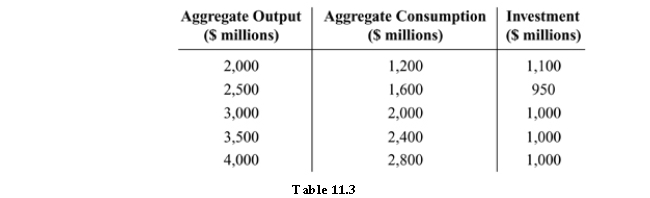 -Refer to Table 11.3. At an aggregate output level of $3,000 million, the unplanned inventory change is:
 (Multiple Choice)
5.0/5 (87)
(87) If imports are expressed as M = my where M is the level of imports and y is the level of GDP, then the government spending multiplier equals:
(Multiple Choice)
4.8/5 (81)
(81) 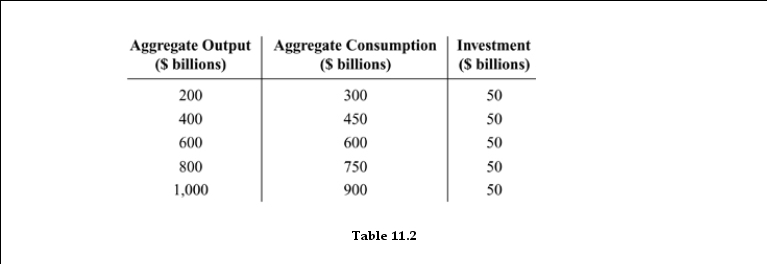 -Refer to Table 11.2. At an aggregate output level of $200, the unplanned inventory change is:
 (Multiple Choice)
4.8/5 (79)
(79) The multiplier for government spending can be calculated using which formula?
(Multiple Choice)
4.8/5 (75)
(75) If the consumption function is C = 100 + 0.6Y, then the multiplier is:
(Multiple Choice)
4.8/5 (79)
(79) The marginal propensity to consume is the increase in consumption brought about by an increase in wealth.
(True/False)
4.7/5 (80)
(80) Define the multiplier and identify the variable(s) determines its size.
(Essay)
4.8/5 (94)
(94) The consumption function describes the relationship between consumption expenditures and:
(Multiple Choice)
4.9/5 (88)
(88) Assume that C = 150 + 0.9Y and I = 50. The balanced budget multiplier is:
(Multiple Choice)
4.8/5 (90)
(90) An unexpected increase in inventories is usually observed before a recession.
(True/False)
4.9/5 (71)
(71) Recall Application 4, "The Locomotive Effect: Why Do Foreign Demand Affects a Country's Output," to answer the following questions:
-According to the application, the US growth acts as a "locomotive" for the growth rates of other countries because:
(Multiple Choice)
4.8/5 (68)
(68) If the economy finds itself at a point where planned spending is greater than output, then we will expect to see:
(Multiple Choice)
4.9/5 (85)
(85) If output is less than aggregate planned expenditures, there will be an unplanned decrease in inventories.
(True/False)
4.9/5 (78)
(78) 
Filters
- Essay(0)
- Multiple Choice(0)
- Short Answer(0)
- True False(0)
- Matching(0)