



 Chat with AI
Exam 11: The Income-Expenditure Model

Exam 1: Introduction: What Is Economics144 Questions
Exam 2: The Key Principles of Economics195 Questions
Exam 3: Exchange and Markets135 Questions
Exam 4: Demand, Supply, and Market Equilibrium279 Questions
Exam 5: Measuring a Nations Production and Income161 Questions
Exam 6: Unemployment and Inflation206 Questions
Exam 7: The Economy at Full Employment165 Questions
Exam 8: Why Do Economies Grow203 Questions
Exam 9: Aggregate Demand and Aggregate Supply189 Questions
Exam 10: Fiscal Policy166 Questions
Exam 11: The Income-Expenditure Model265 Questions
Exam 12: Investment and Financial Markets179 Questions
Exam 13: Money and the Banking System184 Questions
Exam 14: The Federal Reserve and Monetary Policy203 Questions
Exam 15: Modern Macroeconomics: From the Short Run to the Long Run176 Questions
Exam 16: The Dynamics of Inflation and Unemployment186 Questions
Exam 17: Macroeconomic Policy Debates143 Questions
Exam 18: International Trade and Public Policy226 Questions
Exam 19: The World of International Finance189 Questions
Select questions type


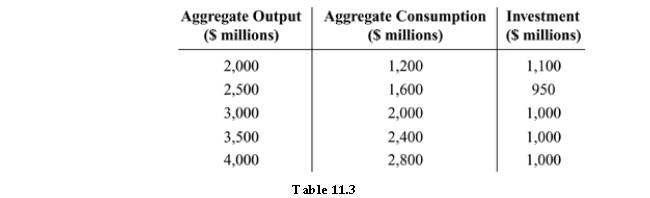 -Refer to Table 11.3 At an aggregate output level of $4,000 million, what will change in order to bring the economy to equilibrium?
 (Multiple Choice)
4.9/5  (91)
(91)  -Refer to Table 11.3. If aggregate output equals _______, there will be a $50 million unplanned decrease in inventories.
 (Multiple Choice)
4.9/5 (92)
(92) An increase in the income tax rate will cause the C + I + G line to become:
(Multiple Choice)
4.9/5 (75)
(75) 
Filters
- Essay(0)
- Multiple Choice(0)
- Short Answer(0)
- True False(0)
- Matching(0)