



 Chat with AI
Exam 11: The Income-Expenditure Model

Exam 1: Introduction: What Is Economics144 Questions
Exam 2: The Key Principles of Economics195 Questions
Exam 3: Exchange and Markets135 Questions
Exam 4: Demand, Supply, and Market Equilibrium279 Questions
Exam 5: Measuring a Nations Production and Income161 Questions
Exam 6: Unemployment and Inflation206 Questions
Exam 7: The Economy at Full Employment165 Questions
Exam 8: Why Do Economies Grow203 Questions
Exam 9: Aggregate Demand and Aggregate Supply189 Questions
Exam 10: Fiscal Policy166 Questions
Exam 11: The Income-Expenditure Model265 Questions
Exam 12: Investment and Financial Markets179 Questions
Exam 13: Money and the Banking System184 Questions
Exam 14: The Federal Reserve and Monetary Policy203 Questions
Exam 15: Modern Macroeconomics: From the Short Run to the Long Run176 Questions
Exam 16: The Dynamics of Inflation and Unemployment186 Questions
Exam 17: Macroeconomic Policy Debates143 Questions
Exam 18: International Trade and Public Policy226 Questions
Exam 19: The World of International Finance189 Questions
Select questions type


Recall Application 2, "Using Long-Term Macro Data to Measure Multipliers," to answer the following questions:
-According to the application, the reason why other studies found a strong correlation between government spending and GDP was:
(Multiple Choice)
4.8/5  (85)
(85) 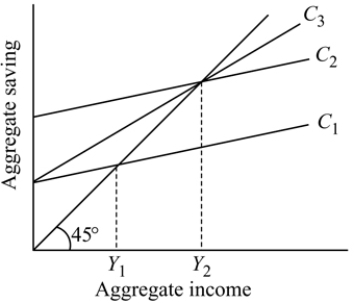 Figure 11.2
-Refer to Figure 11.2. The consumption functions C1 and C2:
Figure 11.2
-Refer to Figure 11.2. The consumption functions C1 and C2: (Multiple Choice)
4.8/5 (63)
(63) If C = 100 + 0.6Y and I = 50, then the equilibrium level of income is:
(Multiple Choice)
4.9/5 (87)
(87) Assume that the consumption function is C = 200 + 0.8Y. The marginal propensity to save is:
(Multiple Choice)
4.9/5 (74)
(74) If the marginal propensity to consume is 0.55, the tax multiplier is:
(Multiple Choice)
4.8/5 (78)
(78)  -Refer to Table 11.3. At an aggregate output level of $4,000 million, the unplanned inventory change is:
 (Multiple Choice)
4.8/5 (76)
(76) Recall Application 3, "John Maynard Keynes: A World Intellectual," to answer the following questions:
-According to the application, Keynes book The General Theory of Employment, Interest and Money was his last major written work.
(True/False)
4.8/5 (69)
(69) 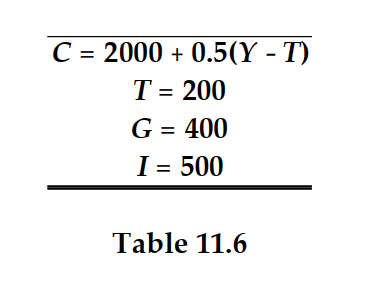 -Refer to Table 11.6. In this example, the tax multiplier is:
 (Multiple Choice)
4.9/5 (67)
(67) Recall Application 1, "Falling Home Prices, the Wealth Effect, and Decreased Consumer Spending," to answer the
following questions:
-According to the application, from 1997- 2006, the nationwide increase in home values averaged:
(Multiple Choice)
4.9/5 (86)
(86) A tax cut of $10 billion will have less effect on the economy than an increase in government spending of $10 billion.
(True/False)
4.8/5 (80)
(80) If both government spending and taxes increase by an equal amount at the same time, GDP will:
(Multiple Choice)
4.9/5 (83)
(83) If an economy's marginal propensity to consume is 0.6 and the marginal propensity to import is 0.1, then the multiplier in an open economy is
(Multiple Choice)
4.8/5 (88)
(88) Taxes are reduced by $50 billion and income increases by $1,000 billion. The value of the tax multiplier is:
(Multiple Choice)
4.9/5 (75)
(75) Give an example of an automatic stabilizer. Explain how automatic stabilizers operate within the economy during a recession and during an expansion.
(Essay)
4.9/5 (77)
(77) 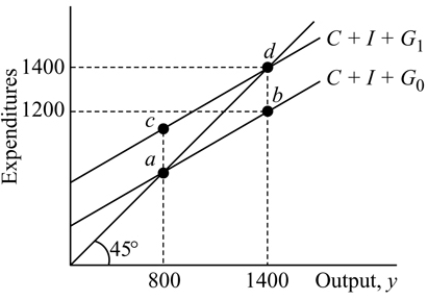 Figure 11.4
-Refer to Figure 11.4. Between expenditure lines C+I+G0 and C+I+G1, the multiplier for government spending is:
Figure 11.4
-Refer to Figure 11.4. Between expenditure lines C+I+G0 and C+I+G1, the multiplier for government spending is: (Multiple Choice)
4.9/5 (66)
(66) The government spending multiplier in a closed economy is the same as the government spending multiplier in an open economy.
(True/False)
4.9/5 (77)
(77) 
Filters
- Essay(0)
- Multiple Choice(0)
- Short Answer(0)
- True False(0)
- Matching(0)