



 Chat with AI
Exam 11: The Income-Expenditure Model

Exam 1: Introduction: What Is Economics144 Questions
Exam 2: The Key Principles of Economics195 Questions
Exam 3: Exchange and Markets135 Questions
Exam 4: Demand, Supply, and Market Equilibrium279 Questions
Exam 5: Measuring a Nations Production and Income161 Questions
Exam 6: Unemployment and Inflation206 Questions
Exam 7: The Economy at Full Employment165 Questions
Exam 8: Why Do Economies Grow203 Questions
Exam 9: Aggregate Demand and Aggregate Supply189 Questions
Exam 10: Fiscal Policy166 Questions
Exam 11: The Income-Expenditure Model265 Questions
Exam 12: Investment and Financial Markets179 Questions
Exam 13: Money and the Banking System184 Questions
Exam 14: The Federal Reserve and Monetary Policy203 Questions
Exam 15: Modern Macroeconomics: From the Short Run to the Long Run176 Questions
Exam 16: The Dynamics of Inflation and Unemployment186 Questions
Exam 17: Macroeconomic Policy Debates143 Questions
Exam 18: International Trade and Public Policy226 Questions
Exam 19: The World of International Finance189 Questions
Select questions type


 -Refer to Table 11.5. If both G and T decrease by 100, equilibrium output will:
 (Multiple Choice)
4.8/5  (69)
(69) Suppose that the marginal propensity to consume in Montavada is 0.75.
(a) If taxes were reduced by $1,000 in Montavada, by how much would equilibrium output change?
(b) If government spending were increased by $1,000 in Montavada, by how much would equilibrium output change?
(c) Explain why a tax cut of $1,000 would have less effect on the economy of Montavada than an increase in government spending of $1,000.
(Essay)
4.8/5 (83)
(83) Suppose the consumption function is represented as follows: C = 200 + 0.75Y. If Y increases by $100, then consumption would increase by:
(Multiple Choice)
4.7/5 (79)
(79) If you save $20 when you experience a $200 rise in your income:
(Multiple Choice)
4.9/5 (79)
(79) Assuming there is no government or foreign sector, if the multiplier is 2.5, the marginal propensity to consume must be:
(Multiple Choice)
4.8/5 (74)
(74) 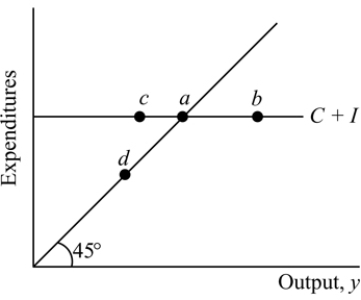 Figure 11.1
-Refer to Figure 11.1. If the expenditures in the economy correspond to C + I, what should businesses do to get back to equilibrium if the economy is at point c?
Figure 11.1
-Refer to Figure 11.1. If the expenditures in the economy correspond to C + I, what should businesses do to get back to equilibrium if the economy is at point c? (Multiple Choice)
5.0/5 (74)
(74) Recall Application 1, "Falling Home Prices, the Wealth Effect, and Decreased Consumer Spending," to answer the following questions:
-According to the application, from 1997- 2006, the largest increase in net wealth for most families in the US came from:
(Multiple Choice)
4.9/5 (85)
(85) Discuss an important difference between the government spending multiplier and the tax multiplier.
(Essay)
4.9/5 (81)
(81) If Jack received a $1,000 bonus and his marginal propensity to save is 0.15, his consumption rises by _______ and his saving rises by _______ .
(Multiple Choice)
4.8/5 (77)
(77) When the consumption function is expressed as C = 200 + .75(1- t)y where t =0.2, then an increase in income y by 100 will result in an increase in consumption by:
(Multiple Choice)
4.8/5 (87)
(87) Assume there is no government or foreign sector. If the multiplier is 5, a $10 billion increase in investment will cause equilibrium output to increase by:
(Multiple Choice)
4.7/5 (77)
(77) Recall Application 2, "Using Long-Term Macro Data to Measure Multipliers," to answer the following questions:
-According to the application, the multiplier for government spending _______ during periods of high unemployment.
(Multiple Choice)
4.8/5 (78)
(78) Recall Application 1, "Falling Home Prices, the Wealth Effect, and Decreased Consumer Spending," to answer the
following questions:
-According to the application, since 2006, the nationwide decrease in home values averaged _______ from their peaks.
(Multiple Choice)
4.9/5 (79)
(79) Suppose that planned expenditure is less than aggregate output. Explain the process by which the economy moves toward equilibrium.
(Essay)
4.7/5 (81)
(81)  -Refer to Table 11.6. In this example, the government spending multiplier is:
 (Multiple Choice)
5.0/5 (70)
(70) 
Filters
- Essay(0)
- Multiple Choice(0)
- Short Answer(0)
- True False(0)
- Matching(0)