



 Chat with AI
Exam 11: The Income-Expenditure Model

Exam 1: Introduction: What Is Economics144 Questions
Exam 2: The Key Principles of Economics195 Questions
Exam 3: Exchange and Markets135 Questions
Exam 4: Demand, Supply, and Market Equilibrium279 Questions
Exam 5: Measuring a Nations Production and Income161 Questions
Exam 6: Unemployment and Inflation206 Questions
Exam 7: The Economy at Full Employment165 Questions
Exam 8: Why Do Economies Grow203 Questions
Exam 9: Aggregate Demand and Aggregate Supply189 Questions
Exam 10: Fiscal Policy166 Questions
Exam 11: The Income-Expenditure Model265 Questions
Exam 12: Investment and Financial Markets179 Questions
Exam 13: Money and the Banking System184 Questions
Exam 14: The Federal Reserve and Monetary Policy203 Questions
Exam 15: Modern Macroeconomics: From the Short Run to the Long Run176 Questions
Exam 16: The Dynamics of Inflation and Unemployment186 Questions
Exam 17: Macroeconomic Policy Debates143 Questions
Exam 18: International Trade and Public Policy226 Questions
Exam 19: The World of International Finance189 Questions
Select questions type


Recall Application 2, "Using Long-Term Macro Data to Measure Multipliers," to answer the following questions:
-According to the application, the multiplier for defense spending during wars was:
(Multiple Choice)
4.8/5  (79)
(79) For each of the following, indicate if the change would lead to an increase or decrease in the equilibrium level of output. Explain each of your answers.
(a) planned investment increases
(b) consumers become pessimistic about the future of the economy
(c) households begin to save a larger fraction of their income
(Essay)
4.8/5 (80)
(80) If a economy's planned expenditures turn out to be greater than production, then inventories will be:
(Multiple Choice)
4.8/5 (94)
(94) 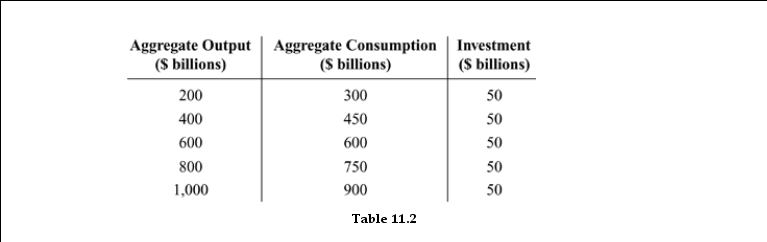 -Refer to Table 11.2. At an aggregate output level of $1000, what will change in order to bring the economy to equilibrium?
 (Multiple Choice)
4.8/5 (74)
(74) The multiplier in an open economy _______ the multiplier in a closed economy.
(Multiple Choice)
4.7/5 (82)
(82) If the marginal propensity to save is 0.3, the tax multiplier is:
(Multiple Choice)
4.9/5 (76)
(76) As the marginal propensity to consume decreases, the government spending multiplier increases.
(True/False)
4.8/5 (102)
(102) Recall Application 2, "Using Long-Term Macro Data to Measure Multipliers," to answer the following questions:
-According to the application, the best time to measure the country's spending multipliers is:
(Multiple Choice)
4.8/5 (78)
(78) The larger the marginal propensity to save, the smaller the multiplier.
(True/False)
4.9/5 (93)
(93) Suppose that in the United States people begin to spend a smaller fraction of their income on imports. This would cause the multiplier to:
(Multiple Choice)
4.9/5 (78)
(78) Recall Application 1, "Falling Home Prices, the Wealth Effect, and Decreased Consumer Spending," to answer the
following questions:
-According to the application, one reason why the economy experienced a reduced rate of growth in 2007 was:
(Multiple Choice)
4.9/5 (83)
(83) An increase in the marginal propensity to import will cause the aggregate expenditure line to:
(Multiple Choice)
4.9/5 (80)
(80) The level of consumption in the economy when the level of income is zero is called:
(Multiple Choice)
4.9/5 (84)
(84) An unexpected increase in inventories has a positive effect on future production.
(True/False)
4.7/5 (75)
(75) Firms react to a unplanned positive inventory investment by increasing output.
(True/False)
4.8/5 (77)
(77) If the marginal propensity to consume is 0.9, the tax multiplier is:
(Multiple Choice)
4.8/5 (76)
(76) The multiplier for a change in taxes is not the same as the multiplier for a change in government spending.
(True/False)
4.9/5 (58)
(58) Assume that the consumption function is C = 200 + 0.8Y. The value of the point at which the consumption function intersects the C axis is:
(Multiple Choice)
4.8/5 (78)
(78) 
Filters
- Essay(0)
- Multiple Choice(0)
- Short Answer(0)
- True False(0)
- Matching(0)