



 Chat with AI
Exam 6: Protein Function

Exam 1: Principles of Biochemistry100 Questions
Exam 2: Physical Biochemistry: Energy Conversion, Water, and Membranes100 Questions
Exam 3: Nucleic Acid Structure and Function100 Questions
Exam 4: Protein Structure100 Questions
Exam 5: Methods in Protein Biochemistry100 Questions
Exam 6: Protein Function114 Questions
Exam 7: Enzyme Mechanisms106 Questions
Exam 8: Cell Signaling Systems102 Questions
Exam 9: Glycolysis: a Paradigm of Metabolic Regulation100 Questions
Exam 10: The Citrate Cycle100 Questions
Exam 11: Oxidative Phosphorylation99 Questions
Exam 12: Photosynthesis100 Questions
Exam 13: Carbohydrate Structure and Function100 Questions
Exam 14: Carbohydrate Metabolism100 Questions
Exam 15: Lipid Structure and Function100 Questions
Exam 16: Lipid Metabolism100 Questions
Exam 17: Amino Acid Metabolism100 Questions
Exam 18: Nucleotide Metabolism99 Questions
Exam 19: Metabolic Integration101 Questions
Exam 20: DNA Replication, Repair, and Recombination99 Questions
Exam 21: RNA Synthesis, Processing, and Gene Silencing100 Questions
Exam 22: Protein Synthesis, Posttranslational Modification, and Transport100 Questions
Exam 23: Gene Regulation100 Questions
Select questions type


As 18 Na+ ions are exported out of the cell by the Na+-K+ ATPase membrane transport protein, K+ ions are imported into the cell.
(Multiple Choice)
4.8/5  (73)
(73) The mutation that would lead to the most dramatic effect on Ca2+ transport is a mutation of
(Multiple Choice)
4.9/5 (70)
(70) Given the following data for myoglobin and O2 concentrations, what is ?
[Mb] = 0.07 mM, [MbO2] = 0.69 mM, [O2] = 3.5 kPa.
(Essay)
4.8/5 (80)
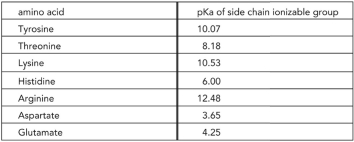
(80) Decide if the rate of malate transport by the Omp32 protein of Delftia acidovorans will be affected if the pH of the system is changed from 6.8 to 8.2. Explain your reasoning.
The pKa of amino acids with ionizable side chains are provided in the table below. Note that malic acid contains two ionizable groups with pKa of 3.40 and 5.20. Assume in this scenario that the pH change does not alter the overall conformation of the protein.
(Essay)
4.8/5 (78)
(78) Below is a figure of adult hemoglobin. The arrow points to where binds. 
(Multiple Choice)
4.8/5 (70)
(70) As K+ passes through the selectivity filter of the K+ channel of Streptomyces lividans it interacts with
(Multiple Choice)
4.8/5 (74)
(74) Approximately how many amino acids are identical in both myoglobin and the adult -subunit of hemoglobin?
(Multiple Choice)
4.8/5 (74)
(74) Which of the following would shift the oxygen binding curve for hemoglobin to the left?
(Multiple Choice)
4.9/5 (89)
(89) Consider the movement of fructose into a cell by passive transport. If the extracellular concentration of fructose is 0.35 mM and the intracellular concentration of fructose is
0.42 mM, what is the free energy of transport in kJ/mol?
(Essay)
4.8/5 (88)
(88) What is the clinical term for reduced O2 transport efficiency from the lungs to the tissues, arising from altered hemoglobin function or reduced numbers of red blood cells per unit of blood? Provide an example of a specific type of anemia that is caused by a single point
mutation.
(Short Answer)
4.7/5 (84)
(84) You design an experiment in which you can monitor the step-by-step movement of H+ and Ca2+ through the SERCA protein, starting with the protein in the E2-ATP state and moving through the transport cycle, ultimately returning to the E2-ATP state. Your control experiment includes everything required for the system to function normally, and you easily detect four distinct conformations of the protein. You then replace the ATP in the system with ATP S, a nonhydrolyzable form of ATP, and begin the experiment again with the
protein in the E2-ATP state. Predict which conformations of SERCA you will detect.
(Essay)
5.0/5 (92)
(92) Which of the following is a pharmaceutical drug that targets an active transporter?
(Multiple Choice)
4.8/5 (88)
(88) Consider the following interaction between a protein and its ligand: [P] + [L] [PL]. If [L] = 5 mM, [P] = 3 mM, and [PL] = 2 mM, what is the Ka for the interaction?
(Multiple Choice)
4.8/5 (83)
(83) A cell with a membrane potential of -70 mV that contains functioning Na+-K+ ATPase membrane transport proteins will maintain an extracellular __________ concentration that is __________ than the intracellular concentration.
(Multiple Choice)
4.9/5 (87)
(87) When oxygen binds to hemoglobin, which of the following occurs?
(Multiple Choice)
4.8/5 (74)
(74) 
Consider the movement of glucose into a cell by passive transport. If the extracellular concentration of glucose is 4 mM and the intracellular concentration of glucose is 2 mM, what is the free energy of transport in kJ/mol?
(Essay)
4.8/5 (80)
(80) Which of the following statements is true for hemoglobin but NOT myoglobin?
(Multiple Choice)
4.8/5 (83)
(83) Consider the transport scenario shown. Which curve represents the overall movement of the small molecule from the extracellular environment to the cytosol? 
(Multiple Choice)
4.8/5 (80)
(80) In the shift from the T to the R state in adult hemoglobin, a shift between the subunits occurs. Explain how this shift leads to the variation of binding affinity for 2,3-BPG in the two states.
(Essay)
4.8/5 (67)
(67) 
Filters
- Essay(0)
- Multiple Choice(0)
- Short Answer(0)
- True False(0)
- Matching(0)