



 Chat with AI
Exam 6: Protein Function

Exam 1: Principles of Biochemistry100 Questions
Exam 2: Physical Biochemistry: Energy Conversion, Water, and Membranes100 Questions
Exam 3: Nucleic Acid Structure and Function100 Questions
Exam 4: Protein Structure100 Questions
Exam 5: Methods in Protein Biochemistry100 Questions
Exam 6: Protein Function114 Questions
Exam 7: Enzyme Mechanisms106 Questions
Exam 8: Cell Signaling Systems102 Questions
Exam 9: Glycolysis: a Paradigm of Metabolic Regulation100 Questions
Exam 10: The Citrate Cycle100 Questions
Exam 11: Oxidative Phosphorylation99 Questions
Exam 12: Photosynthesis100 Questions
Exam 13: Carbohydrate Structure and Function100 Questions
Exam 14: Carbohydrate Metabolism100 Questions
Exam 15: Lipid Structure and Function100 Questions
Exam 16: Lipid Metabolism100 Questions
Exam 17: Amino Acid Metabolism100 Questions
Exam 18: Nucleotide Metabolism99 Questions
Exam 19: Metabolic Integration101 Questions
Exam 20: DNA Replication, Repair, and Recombination99 Questions
Exam 21: RNA Synthesis, Processing, and Gene Silencing100 Questions
Exam 22: Protein Synthesis, Posttranslational Modification, and Transport100 Questions
Exam 23: Gene Regulation100 Questions
Select questions type


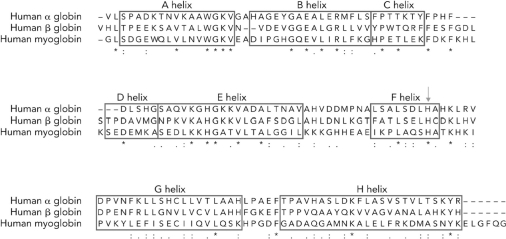
Look at the data in the figure below. One amino acid location is indicated by an arrow. Why is the amino acid at that location invariant among the three sequences?
(Essay)
4.8/5  (83)
(83) Which of the following accounts for some of the specificity of the K+ channel?
(Multiple Choice)
4.8/5 (93)
(93) The E. coli maltoporin protein is a homotrimeric porin complex. A related protein is found in another bacterial species that does not form trimers but rather functions as a monomer. A comparison of the amino acid composition of a maltoporin subunit and the new porin showed similar ratios of hydrophobic/hydrophilic amino acids for the two proteins. Explain how this can be the case.
(Essay)
4.8/5 (79)
(79) A passive transporter is discovered that can transport both galactose and glucose. The pore of the transporter can accommodate a single sugar at a time. If the extracellular concentrations of galactose and glucose are 0.2 and 3.6 mM, respectively, and the intracellular concentrations are 0.39 and 2.6 mM, respectively, which sugar is most likely to enter the cell through the transporter? Provide two reasons for your answer.
(Essay)
4.9/5 (82)
(82) There are two main structural differences between a typical -helix and the helix formed by gramicidin A. Describe the two structural differences and choose which structural characteristic is more important in the function of gramicidin A. Explain your choice.
(Essay)
4.8/5 (69)
(69) Explain the relationship between P50 of oxygen binding and Kd for oxygen binding to myoglobin.
(Essay)
4.8/5 (87)
(87) Which of the following is NOT a characteristic of an enzyme active site?
(Multiple Choice)
4.7/5 (80)
(80) 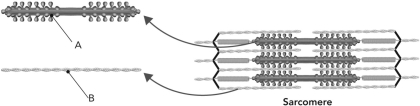
If SERCA is not functioning in a myoblast, which of the following may occur?
(Multiple Choice)
4.8/5 (75)
(75) In studying a transporter, it is found that no external energy input is needed to facilitate the movement of a neutral compound through the transporter. The translocation rate of the compound reaches a plateau at high levels of compound. It is a(n)
(Multiple Choice)
4.8/5 (71)
(71) The subunit of adult hemoglobin has higher sequence similarity to than to __________.
(Multiple Choice)
4.9/5 (88)
(88) In both myoglobin and hemoglobin, O2 reversibly binds to a(n) atom contained in a porphyrin ring that is tightly bound to the protein.
(Multiple Choice)
4.8/5 (85)
(85) The selectivity of aquaporin for H2O relies on all EXCEPT which of the following?
(Multiple Choice)
4.8/5 (80)
(80) A newly discovered transporter protein is being investigated using an assay to determine whether transport has occurred in the cells. A nonhydrolyzable form of ATP is added to the cells, and it is found that transport is reduced. Explain these results.
(Essay)
4.7/5 (72)
(72) 
Filters
- Essay(0)
- Multiple Choice(0)
- Short Answer(0)
- True False(0)
- Matching(0)