



 Chat with AI
Exam 22: Protein Synthesis, Posttranslational Modification, and Transport

Exam 1: Principles of Biochemistry100 Questions
Exam 2: Physical Biochemistry: Energy Conversion, Water, and Membranes100 Questions
Exam 3: Nucleic Acid Structure and Function100 Questions
Exam 4: Protein Structure100 Questions
Exam 5: Methods in Protein Biochemistry100 Questions
Exam 6: Protein Function114 Questions
Exam 7: Enzyme Mechanisms106 Questions
Exam 8: Cell Signaling Systems102 Questions
Exam 9: Glycolysis: a Paradigm of Metabolic Regulation100 Questions
Exam 10: The Citrate Cycle100 Questions
Exam 11: Oxidative Phosphorylation99 Questions
Exam 12: Photosynthesis100 Questions
Exam 13: Carbohydrate Structure and Function100 Questions
Exam 14: Carbohydrate Metabolism100 Questions
Exam 15: Lipid Structure and Function100 Questions
Exam 16: Lipid Metabolism100 Questions
Exam 17: Amino Acid Metabolism100 Questions
Exam 18: Nucleotide Metabolism99 Questions
Exam 19: Metabolic Integration101 Questions
Exam 20: DNA Replication, Repair, and Recombination99 Questions
Exam 21: RNA Synthesis, Processing, and Gene Silencing100 Questions
Exam 22: Protein Synthesis, Posttranslational Modification, and Transport100 Questions
Exam 23: Gene Regulation100 Questions
Select questions type


An experimental prep is able to separate the following membrane fractions: nuclear membrane, Golgi apparatus membrane, transport vesicle membrane, and mitochondrial membrane. The membrane fractions can then be analyzed via Western blotting for the presence of specific proteins. Which fraction would indicate the presence of t-SNAREs?
(Multiple Choice)
4.8/5  (86)
(86) Compare the chemical structures of puromycin with an aminoacylated tRNA. How do their similarities allow puromycin to function as an antibiotic?
(Essay)
4.8/5 (84)
(84) Which antibiotic functions by inhibiting cell wall synthesis?
(Multiple Choice)
4.8/5 (82)
(82) Below are examples of sequences from seven different E. coli genes. The underlined sequences are known as sequences and the bolded AUG sequences are known as the codon.

(Multiple Choice)
4.9/5 (75)
(75) How many GTP are hydrolyzed during a single round of translation elongation in a eukaryote?
(Multiple Choice)
4.9/5 (66)
(66) Noncanonical base pairings of A and I would contain hydrogen bonds. The base pairing of C and I would contain hydrogen bonds.
(Multiple Choice)
4.8/5 (71)
(71) How many potential codons does the following mRNA sequence contain? 
(Multiple Choice)
4.9/5 (83)
(83) Contrast the discrimination at the active site and at the editing site of aminoacyl-tRNA synthetases, so that combined they ensure that tRNAs are charged with the correct amino acid.
(Essay)
4.8/5 (86)
(86) Which sequence is MOST likely to contain an O-linked oligosaccharide in the ER? (The … represents additional amino acids N-terminal or C-terminal to those shown.)
(Multiple Choice)
4.8/5 (78)
(78) Choose the sequence that is MOST likely to be modified with the fatty acid palmitoylate in the ER. (The … represents additional amino acids N-terminal or C-terminal to those shown.)
(Multiple Choice)
4.9/5 (83)
(83) A common feature of translation in both eukaryotes and prokaryotes is
(Multiple Choice)
5.0/5 (78)
(78) Although the genetic code is considered universal, this may not be fully true when comparing the human nuclear code with the human mitochondrial code. Describe how and provide a specific example.
(Essay)
4.8/5 (79)
(79) Ribosomal rRNA interacts with all EXCEPT during the process of translation.
(Multiple Choice)
4.7/5 (81)
(81) Release factor hydrolyzes GTP during the __________ step of translation.
(Multiple Choice)
4.8/5 (72)
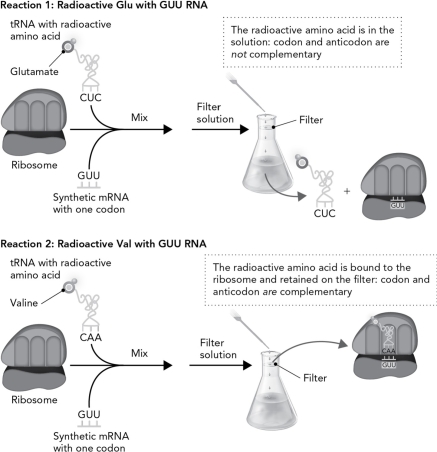
(72) Nirenberg and Leder completed the experiment illustrated below. If the tRNA used had an anticodon that recognizes UAA and the mRNA added contained repeats of UAA, what would be the expected result? Would the membrane contain any radioactivity, and if so, which amino acid would be retained on the membrane?
(Essay)
4.8/5 (73)
(73) How was the selectivity of the nitrocellulose filter essential in the Nirenberg-Leder experiment, which was able to assign triplet codons to specific amino acids?
(Essay)
4.9/5 (67)
(67) How does the wobble hypothesis allow for fewer than 63 tRNAs to effectively recognize 63 codons?
(Essay)
4.8/5 (86)
(86) Which sequence is MOST likely to be modified with the fatty acid myristoylate in the ER? (The … represents additional amino acids N-terminal to those shown.)
(Multiple Choice)
4.8/5 (73)
(73) 
Filters
- Essay(0)
- Multiple Choice(0)
- Short Answer(0)
- True False(0)
- Matching(0)