



 Chat with AI
Exam 22: Protein Synthesis, Posttranslational Modification, and Transport

Exam 1: Principles of Biochemistry100 Questions
Exam 2: Physical Biochemistry: Energy Conversion, Water, and Membranes100 Questions
Exam 3: Nucleic Acid Structure and Function100 Questions
Exam 4: Protein Structure100 Questions
Exam 5: Methods in Protein Biochemistry100 Questions
Exam 6: Protein Function114 Questions
Exam 7: Enzyme Mechanisms106 Questions
Exam 8: Cell Signaling Systems102 Questions
Exam 9: Glycolysis: a Paradigm of Metabolic Regulation100 Questions
Exam 10: The Citrate Cycle100 Questions
Exam 11: Oxidative Phosphorylation99 Questions
Exam 12: Photosynthesis100 Questions
Exam 13: Carbohydrate Structure and Function100 Questions
Exam 14: Carbohydrate Metabolism100 Questions
Exam 15: Lipid Structure and Function100 Questions
Exam 16: Lipid Metabolism100 Questions
Exam 17: Amino Acid Metabolism100 Questions
Exam 18: Nucleotide Metabolism99 Questions
Exam 19: Metabolic Integration101 Questions
Exam 20: DNA Replication, Repair, and Recombination99 Questions
Exam 21: RNA Synthesis, Processing, and Gene Silencing100 Questions
Exam 22: Protein Synthesis, Posttranslational Modification, and Transport100 Questions
Exam 23: Gene Regulation100 Questions
Select questions type


In an iteration of the Nirenberg-Leder experiment to assign triplet codons to specific amino acids, radioactively labeled aminoacyl-tRNA with the anticodon of CUG was used. The radioactivity was retained on the filter at the end of the experiment. Which mRNA was used in this iteration of the experiment?
(Multiple Choice)
5.0/5  (76)
(76) What characteristics of eukaryotic mRNA are recognized through specific interactions during the formation of the translation initiation complex?
(Multiple Choice)
4.9/5 (76)
(76) Where might the molecule shown below be located in both the prokaryotic and eukaryotic ribosome? 
(Multiple Choice)
4.9/5 (79)
(79) Nirenberg and Matthaei determined the genetic code experimentally by using a cell-free translation system. Two components, however, were restricted in their system. One was the use of a single type of mRNA. What was the other component that was restricted? How did this restriction allow them to determine the genetic code?
(Essay)
4.7/5 (70)
(70) Which of the following catalyzes the formation of a bond between an amino acid and a tRNA?
(Multiple Choice)
4.8/5 (81)
(81) Which protein would initially have been translated on free ribosomes?
(Multiple Choice)
4.8/5 (75)
(75) The prokaryotic ribosome contains __________ subunits. The eukaryotic ribosome contains __________ subunits.
(Multiple Choice)
4.9/5 (77)
(77) Place the following steps in the initiation phase in a prokaryote in their proper order.
A. mRNA binds to the complex.
B. GTP is hydrolyzed.
C. IF1, IF2, and IF3 bind the 30S subunit.
(Multiple Choice)
4.9/5 (86)
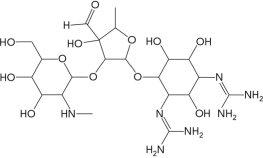
(86) Identify the antibiotic shown below and illustrate how it functions to inhibit bacterial cell growth.
(Essay)
4.8/5 (76)
(76) Place the following steps in the elongation phase of translation in their proper order.
A. Peptide bond formation occurs.
B. GTP is hydrolyzed, and the ribosome moves one codon in the 3 ' direction.
C. GTP is hydrolyzed, and EF-Tu•GDP is released.
D. tRNA is released from the E site.
(Multiple Choice)
4.9/5 (93)
(93) Which of the following is NOT a component that is released from the ribosome on translation termination?
(Multiple Choice)
5.0/5 (73)
(73) tRNA must be before binding to the ribosome to allow for translation to occur.
(Multiple Choice)
4.8/5 (50)
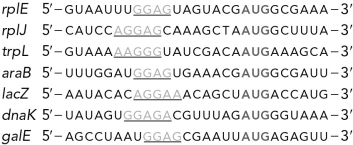
(50) Below are seven examples of sequences found in E. coli. Differentiate between the underlined and bolded sequences. Explain where each would ultimately be located in the 70S initiation complex and what types of interactions are required to achieve these locations.
(Essay)
4.8/5 (77)
(77) Place the following steps in proper order for the translation of a membrane-bound protein.
A. GTP binds to SRP.
B. Protein synthesis occurs on free ribosome.
C. Protein synthesis halts.
D. SRP binds to the signal peptide sequence.
(Multiple Choice)
4.8/5 (65)
(65) Consider an in vitro experiment in which all components needed for protein synthesis are present. If tRNAs charged with radioactively labeled amino acids are added, over time the radioactivity would be located in which of the following components?
(Multiple Choice)
4.9/5 (85)
(85) If the following mRNA was added to a cell-free translation system, how many unique protein sequences would be generated? 
(Multiple Choice)
4.9/5 (92)
(92) Eukaryotes are directed to begin scanning the mRNA for the start codon based on binding of the
(Multiple Choice)
4.7/5 (88)
(88) Radioactively labeled aminoacyl-tRNAs were used in the Nirenberg-Leder experiment to assign triplet codons to specific amino acids. Why was this important in the experimental design?
(Essay)
4.7/5 (78)
(78) Differentiate between the mechanisms of type I and type II aminoacyl-tRNA synthetases.
(Essay)
4.9/5 (90)
(90) 
Filters
- Essay(0)
- Multiple Choice(0)
- Short Answer(0)
- True False(0)
- Matching(0)